Monday, July 8, 2013

X-MEN Episode Twenty-Six - February 19, 1994


Reunion - Part Two  
Written by Michael Edens


Summary:  The X-Men arrive in the Savage Land and immediately realize their powers have been neutralized.  The Nasty Boys and Savage Land Mutates kidnap the team, but Wolverine manages to escape.  He meets Ka-Zar, and after an initial misunderstanding, teams up with him to stop Sinister.  They reach Sinister’s citadel and distract him long enough for the X-Men to break free and destroy his machines.  Sinister is blasted into pieces after Morph fights against his brainwashing and aids the X-Men.  Magneto departs peacefully, while Sauron secretly plots his own plans for the Savage Land.


Continuity Notes:  
  • Gambit tells Rogue that he loves her while they’re being held captive.  He also kisses her without consequence when their powers are neutralized.
  • Sinister’s motivation is to “take mutantkind to the ultimate expression of their power.”  His dialogue implies that he himself is a mutant, although Marvel instead makes him a human mad scientist when his origin is later revealed.  He of course isn’t dead at the episode’s end; somehow, particles making the shape of his face wash up on the shore.
  • Sinister’s master plan is to use his technology to power up one mutant with another’s powers.  He absorbs Magneto’s powers and uses them to supercharge Vertigo.
  • More vague talk from Sinister:  He tells Cyclops that he “can’t, won’t” leave him and Jean alone.  He claims, “The world needs…” before he’s silenced by Cyclops’ blasts.


Review:  The second season draws to an end, after hitting on as many ‘90s continuity points as possible in a thirteen-episode span.  This season touched on everything from Graydon Creed to Omega Red to the Thieves Guild to Cable to the X-Ternals to the Russian guys in gold armor that killed Colossus’ parents.  So, arguably, it could be viewed as something of a mess.  I still think it holds together rather well, though, even if some of the areas explored never should’ve left the comics (or been introduced in the comics in the first place.)  

The basic structure of the season is a strong one, as the opening two-parter introduces a subplot that carries throughout all of the episodes, while the main stories are free to do character-driven plots for most of the X-Men until it’s time for the season finale.  Jubilee’s episode gets absorbed by a Colossus story for some reason, and Cyclops and Jean aren’t given time alone outside of their interactions with Sinister, but the rest of the cast is fleshed out and given something to do outside of the team.  I’m sure every kid had his or her own favorite X-Man, so doing spotlight stories was a great way to keep them involved in the show, while routinely cutting away to the Savage Land kept some momentum going.  

This episode draws the Sinister/Savage Land story to a close, hitting on most of the things you might expect to find in a Savage Land story.  Wolverine fights dinosaurs.  Wolverine fights Ka-Zar.  Ka-Zar rallies the Fall People to help the X-Men.  And the united Nasty Boys/Savage Land Mutate pairing actually provides one of the strongest challenges the team has faced so far.  Add in a happy ending for Morph and a classy departure for Magneto and it’s a solid episode.  Not as memorable as the first season’s finale, but still one of the better episodes of the series’ run.  


Credit to http://marvel.toonzone.net/xmen/ for the screencaps.

Friday, July 5, 2013

X-MEN Episode Twenty-Five - February 12, 1994


Reunion - Part 1
Written by Len Wein

Summary:  The X-Men respond to a message left by Morph, who’s terrified of Mr. Sinister.  When they arrive, the Nasty Boys ambush the team and kidnap Jean Grey.  In the Savage Land, Xavier and Magneto are abducted by the Savage Land Mutates.  Sinister uses Sauron’s hypnotism to force Xavier into calling the X-Men to his citadel.  The X-Men willfully enter the trap in order to rescue Jean and Xavier.

Continuity Notes:  

  • Sinister explains that Xavier’s ability to walk was an unintended side effect of the field he uses to dampen mutant powers.
  • Morph is living as an actor, starring in the role of Dr. Jekyll and Mr. Hyde.  The version of Mr. Hyde he transforms into strongly resembles the Marvel supervillain.

Review:  I don’t think it’s a big secret that many of the early episodes of this series were directly inspired by the Claremont/Lee issues of Uncanny X-Men, which would explain the version of the Savage Land Mutates used here.  With the exception of miniskirt Vertigo, this cast of Mutates is identical to the one used circa Uncanny X-Men #275, a collection of villains I have a lot of nostalgia for (although it would’ve been nice to see Whiteout and Worm, as well).  After weeks of teasing, we finally see the Mutates actually accomplish something and bring in Xavier and Magneto, just in time for the big season finale.  Wein’s able to pull together the three Sinister-related threads that have run throughout the season (Morph’s resurrection, Xavier and Magneto’s Savage Land adventure, and Sinister’s obsession with Scott and Jean) organically, making this feel like a legitimate payoff after months of waiting.  The only real cheat is the explanation for Xavier’s sudden ability to walk; as if having a damaged spinal cord is in some way connected with telepathic powers.  As absurd as this is, it does introduce a question the show never asked -- would Xavier give up his mutant powers if it meant walking again?

Credit to http://marvel.toonzone.net/xmen/ for the screencaps.

Wednesday, July 3, 2013

X-MEN Episode Twenty-Four - February 5, 1994


Mojovision
Written by Brooks Wachtel

Summary:  Looking for new television stars, Mojo sets his sights on the X-Men.  He teleports the team to his dimension and forces them to compete in his hi-tech gladiator games.  Mojo’s former star, Longshot, turns against Mojo and frees the X-Men.  The X-Men destroy Mojo's studio and return to Earth.  Mojo changes his focus and spies on a jungle setting, the Savage Land.  There, Xavier and Magneto witness Sauron kidnapping Shanna the She-Devil.

Continuity Notes:  

  • This episode marks the animated debuts of Mojo, Spiral, Major Domo, Longshot, Sauron, and Shanna the She-Devil.  One of Longshot’s make-up artists also resembles Dazzler, although she is later introduced as a separate character with no connection to Mojo, and a different hair color.
  • Cameos that appear during the Mojoworld scenes include aliens that somewhat resemble the Brood, the Punisher, Psylocke, and the Super-Adaptoid.

Saban Quality:  Rogue is not with the X-Men when they’re kidnapped by Spiral in the episode’s opening, yet she suddenly appears when they arrive in Mojoworld.

Review:  Mojo stories have spotty track record in the comics, and it’s arguable that they only truly work when they’re used to parody the comic book industry.  Introducing Mojo into the cartoon removes virtually any chance that the character is going to be used to mock Marvel’s relentless commercialization of the X-Men franchise; in fact, the only parody here is a tame knock off of Miami Vice, years after the show had been cancelled anyway.  If Mojo isn’t going to be used for satire, his only real purpose is to set up various fight scenes.  And fight scenes are not this show’s forte.  If you’re a fan of the comics, spotting the various Easter Eggs can be fun, but those dull, clunky action sequences just drag on and on.  And it’s one thing to simply read Mojo’s dialogue in the comics; having to hear an actor actually give voice to this intentionally annoying character just grates.  I don’t know how exactly Mojo should sound in a cartoon, but I would rather he not sound like a weak Gilbert Gottfried impression.


Credit to http://marvel.toonzone.net/xmen/ for the screencaps.

Monday, July 1, 2013

X-MEN Episode Twenty-Three - January 15, 1994


Beauty and the Beast
Written by Stephanie Mathison

Summary:  Beast works to cure a blind patient named Carly, but is targeted by the Friends of Humanity.  Following Jean’s advice, Wolverine uses stealth to infiltrate the FoH’s headquarters and learns more about its founder, Graydon Creed.  When the FoH again attacks the hospital and kidnaps a recently cured Carly, Wolverine contacts the X-Men and asks them to bring a hologram projector.  With the hologram, Wolverine proves to the FoH that their leader is the son of a mutant, Sabretooth.  Carly is rescued, but Beast refuses to pursue their relationship if it means endangering her.  Meanwhile, Xavier and Magneto narrowly escape the Savage Land Mutates.

Continuity Notes:  
  • For perhaps the first time in the show’s continuity, Wolverine’s bare hands are drawn properly without the circular metal housings.
  • The doctor working with Beast is named Donald Olson.  I wonder if he was originally intended to be Thor’s alter ego, Donald Blake, because there is a resemblance.
  • Wolverine gives his name to Graydon Creed as “John Logan.”

“Um, Actually…”:  

  • Pictures in Beast’s photo album imply that he slowly grew into his blue, furry state, contradicting the comic book’s continuity that Beast’s blue fur is a result of a serum he ingested.  
  • Sabretooth’s real name is given as “Graydon Creed, Sr.” as opposed to Victor Creed.
  • “Beauty and the Beast” is also the name of a comic miniseries featuring a totally unrelated story, starring Beast and Dazzler.

Saban Quality:  The Friends of Humanity members have jackets that read “HoH” in one scene.

"Actiiing!":  Graydon Creed’s breakdown after he sees the Sabretooth hologram is unbelievable.  “I’M NOT LIKE HIM!  I’M NOT LIKE HIM!  YOU’RE NOT MY FATHER!!!”

I Love the '90s:  Wolverine sarcastically suggests a “kinder, gentler way” to stop the FoH, which is a reference to a famous speech given by George H. W. Bush.

Review:  Just to be clear, this episode establishes that Beast can cure blindness.  Oddly enough, this is never mentioned again, even though it would probably be the greatest publicity battle that mutants could win.  Who could hate mutants after one of them literally worked a miracle and cured the blind?  Speaking of publicity, what are the Friends of Humanity thinking, attacking a hospital for the blind?  This is outrageously stupid, even by the low standards set by Graydon Creed in the comics.  So, the premise is a little strained, although the episode does a nice job of just allowing the Beast to be the likeable Beast, which makes the story more palatable.  I suspect the entire episode was merely an excuse to have Wolverine use his mind against an enemy while Beast goes berserk, an irony Jubilee helpfully spells out to the audience.  Not a bad starting point for a story, although surely there was a more plausible way to get to this point.

Credit to http://marvel.toonzone.net/xmen/ for the screencaps.

Friday, June 28, 2013

PETER PARKER, SPIDER-MAN #76 - January 1997


SHOC
Credits:  Howard Mackie (writer), John Romita, Jr. (penciler), Scott Hanna (inks), Comicraft (letters)

The Plot:  Seven years ago, ESU professor Dr. Fields is murdered and his scientific notes go missing.  Today, Peter Parker and underclassman Neil Aiken hope to work on a research project based on Dr. Fields’ work.  The project is soon attacked by the mysterious Crown, who wants Dr. Fields’ research.  As Spider-Man, Peter tries to protect the students from Crown.  He’s joined by a new hero, SHOC, who has a past with Crown.  With SHOC’s help, Crown and his henchmen are sent to another dimension.

The Subplots:  Betty Brant is angry with Flash Thompson for an unrevealed reason.  While registering for classes at ESU, Mary Jane meets Jill Stacy, the cousin of Gwen.

Web of Continuity:  Howard Mackie goes out of his way to hint at numerous continuity points regarding Dr. Fields, SHOC, and Crown.  Here goes…

  • The implication is that Crown killed Dr. Fields (and possibly his wife) in the story’s opening flashback.  They leave behind a young child, who would now be in his late teens.  
  • This boy is given the responsibility of safeguarding Dr. Fields’ notes.  The notes being used for today’s experiment are “incomplete.”
  • The SHOC who fights Crown is apparently the second SHOC, a departure from the grim, taciturn SHOC that Crown remembers.
  • SHOC refuses to give Spider-Man any details on his identity or Crown’s plot, but points him in the direction of Hydra.
  • Crown claims that absorbing energy generated by the experiment will make him a god.  SHOC is somehow able to use the energy to send Crown and his henchmen to (presumably) another dimension.

I Love the ‘90s:  Spider-Man references both Sally Jesse Raphael and Rosie O’Donnell’s talk shows in his course of terrible joke making.

“Huh?” Moment:  Spider-Man is miraculously able to discern that “SHOC” is an acronym just by hearing people say his name.  He also knows the specific spelling of “SHOC.”  The only way this could possibly work is if these characters are actually spelling out the letters S.H.O.C. when saying the character’s name.

Creative Differences:  Jill Stacy was originally supposed to make her official debut a few issues earlier, according to “Life of Reilly.”  She was intended to be a police officer, of all things, and there even exists some penciled pages of her in uniform that were never used.

Review:  I don’t want anyone to think that I’m just picking on the same creators over and over again, but...I guess Howard Mackie keeps coming up, huh?   After writing something as unreadable as X-Factor for so long, I couldn’t justify ever buying anything written by Mackie again, so I avoided these issues for years.  The fact that Marvel not only kept him around the X-Office, but the Spider-Titles as well, just astonished me.  Moreover, they paired him with John Romita, Jr.!  Why put one of your worst writers and one of your best artists on the same book?  It made no sense to me.

Now, having read the majority of this run, I can take some comfort knowing that it isn’t as bad as X-Factor.  It’s still not any good, and a waste of John Romita, Jr., but it isn’t relentlessly, insultingly bad every issue.  This issue seems to be standard for the run.  Many ideas are vaguely hinted at, no resolution is given, Romita draws a few double-page spreads, and personal subplots languish in the background.  Years after his run on Web of Spider-Man, Mackie seems to be getting even worse at story construction, character development, and above all, dialogue.  (The words Mackie has characters say in this issue are often unbelievable.  Read pages twelve through seventeen and count the number of horribly awkward sentences.)  

Overlooking the bad jokes and poor syntax, this could charitably be viewed as a decent start for a new storyline.  The details are so vague you can’t say that SHOC’s story is horrible just yet, so there's still potential for this to go somewhere.  SHOC’s design, which isn’t too far away from ROM’s look, isn’t a homerun, but it isn’t hideous.  And if Mackie is setting up the idea that new student Neil Aiken is SHOC’s secret identity, he’s seeded some clues that aren’t painfully obvious…just regular obvious.

You might even be fooled into believing that this Jill Stacy subplot has potential.  Under most writers, it probably would, but for some reason the Stacys are adopted by this book and usually left as bit players in the other Spider-Man titles.  Why Howard Mackie took on the Stacy family when he’s A) by far the worst when it comes to constructing personalities and writing natural dialogue, and B) not noticeably interested in any aspect of these characters, is a mystery.  The Stacys languish around the books for over a year, apparently deemed “interesting” by Marvel simply due to their last name, and accomplish absolutely nothing.  And even when dwindling sales force the titles into a relaunch, Jill and her dad get dragged along into more hopeless storylines.  Jill even becomes (ugh) a romantic rival for MJ after Marvel decides to reintroduce “girl troubles” into the books.  Unfortunately, the seeds for some truly awful comics are in this issue.  That's the future, though.  Right now, this is at least readable, even if the dialogue is occasionally painful.

Thursday, June 27, 2013

SENSATIONAL SPIDER-MAN #15 - April 1997


Deluge Part Three - Inundated!
Credits:  Todd Dezago (writer), Mike Wieringo (penciler), Richard Case (inks), Gregory Wright w/GCW (colors), Comicraft (letters)

The Plot:  Spider-Man convinces Stegron that Ka-Zar is fighting to protect the Savage Land, leading him to command his dinosaurs to help.  The Hulk and Chtylok suddenly enter, engaged in their days-old battle.  Stegron sends his dinosaurs to incapacitate Chtylok, while Ka-Zar rushes off to confront Dr. Roth.  He reveals to SHIELD Roth’s plan to flood the Savage Land, which would make the area legally available for oil drilling.  Later, after Roxxon disavows Dr. Roth, he detonates charges on the dams and floods the area.  Luckily, the water disappears in the crater created by Hulk and Chtylok’s fight.  Ka-Zar allows Dr. Roth to escape, knowing that Chtylok will kill him in the wild.

The Subplots:  None.

Web of Continuity:  It’s possible this issue was meant to justify why the Hulk is in the Savage Land at the beginning of Incredible Hulk #454.

I Love the ‘90s:  The opening narrative captions still describe dinosaurs as reptiles, which is a theory that I believe has been replaced with the belief that dinosaurs were closer to birds than lizards.

Review:  The pieces fall into place for the final chapter, with the previous issue’s prophesy that Chtylok would one day save the Savage Land actually coming true in a cute way.  One plot element that doesn’t work, however, is the “plan” that Spider-Man spontaneously develops and conveniently explains off-panel (the comic book equivalent of the old Hanna-Barbara “whisper whisper whisper” into someone’s ear).  Apparently his plan is to ask Hulk and Stegron to help him destroy all of the heating units Roxxon’s placed all along the Savage Land, but…what kind of a plan is that?  Of course that’s what they’re going to do next.  And their actions are pointless anyway, since Dr. Roth detonates the dams out of spite and floods the area they were trying to save.  Ka-Zar intimates that this all a part of Spider-Man’s plan (even though Spider-Man is shocked when the dams blow), but how is it a “plan” that a giant crater would collect rushing water?  What did Spider-Man have to do with any of this?  The screw-up isn’t too obvious until you stop and think about it, but it is annoying.  The light-hearted ending, involving the death of the villain, also feels at odds with the tone of the rest of the arc.  Would Dezago treat, say, the Shocker’s death as a joke?  

Regardless, the majority of this arc has been fun, and it’s obvious Dezago and Wieringo work really well together.  Even if the stories aren’t airtight, they’re pretty entertaining and always suitable for Wieringo’s art style.  I don’t know if Marvel would ever release a hardcover collection of this run, but any fan of this style of superhero cartooning should at least search out the back issues.

Wednesday, June 26, 2013

SENSATIONAL SPIDER-MAN #14 - March 1997


Deluge Part Two - Higher Ground
Credits:  Todd Dezago (writer), Mike Wieringo (penciler), Richard Case (inks), Gregory Wright w/GCW (colors), Comicraft (letters)

The Plot:  A Fall People elder explains the legend of Chtylok to Ka-Zar and Spider-Man.  After the tribe is again moved out of harm’s way, Ka-Zar shows Spider-Man one of Roxxon’s relay units.  Spider-Man realizes that the unit is actually increasing the temperature, and acting as an oil rig.  Ka-Zar races off to confront the Roxxon employees, but is ambushed by Roxxon guards in armored suits.  Spider-Man tries to help, but their fight is interrupted by Stegron, who emerges with an army of dinosaurs under his command.

The Subplot:  The Hulk investigates the exodus of beasts from Monster Island and discovers Chtylok.  Their fight takes them to the tunnels underneath Monster Island.

*See _________ For Details:  Stegron was frozen outside of the Savage Land in Thunderstrike #20.  

Review:  Unlike the rest of the internet, I don’t have an ironic appreciation of Stegron.  I’ve never cared for the design, and can’t think of any stories featuring Stegron as the main villain that were particularly good.  Stegron in small doses is fine, though, and luckily this story treats him as just another one of the crazy menaces you might run into in the Savage Land.  And while this issue covers much of the same ground as the previous issue, there is a genuinely touching moment during the Fall People evacuation scene.  It’s easy to dismiss the characters as generic native warrior clichés and to play the older members of the tribe as a joke, but Dezago does a great job in merely one page detailing just how hard it can be for anyone to leave their home behind.  As for the art, it’s another issue of Wieringo drawing dinosaurs and giant Marvel monsters, so it’s great.  I will point out, however, that this issue is one of the more egregious examples of Wieringo drawing Spider-Man’s eyes and head inconsistently.  It probably shouldn't bother me as much as it does, but I think it's a major reason why it took me a while to appreciate Wieringo's Spider-Man.

Tuesday, June 25, 2013

SENSATIONAL SPIDER-MAN #13 - February 1997


Deluge Part One - A Savage Land
Credits:  Todd Dezago (writer), Mike Wieringo (penciler), Richard Case (inks), Gregory Wright w/GCW (colors), Richard Starkings and Comicraft (letters)

The Plot:  Peter Parker arrives in the Savage Land.  His escort, Agent Chris Townsend, shows him to the location where SHIELD, the UN, and the Roxxon Corporation are studying ways to protect the Savage Land from flooding.  As Spider-Man, Peter goes off on his own to find Ka-Zar.  He discovers the Savage Land is heating up faster than anticipated and helps Ka-Zar and the Fall People escape from a burst dam.  Meanwhile, Roxxon’s Dr. Gerald Roth secretly continues to flood the area with Roxxon’s “refrigeration units.”

The Subplots:  Stegron and the Chtylok are both released from captivity by the melting ice surrounding the Savage Land.  Chtylok goes on to terrorize Monster Island.  Meanwhile, Spider-Man helps Ka-Zar and Shanna rescue a girl with malaria.  Shanna complains that a tribal shaman has ostracized the girl and turned the Fall People against Shanna’s medical training.

Web of Continuity:  Jonah Jameson’s rationale for sending Peter to the Savage Land is that he’s one of the few members of the media that has been there before.  Spider-Man’s first trip to the Savage Land began in Amazing Spider-Man #101.

“Huh?” Moment:  The implication in this story is that Chtylok is awakened by water created by the melting ice caps near the Savage Land.  He then somehow emerges on Monster Island, in the Bermuda Triangle.  I vaguely recall stories about tunnels beneath the Earth that allow people to travel great distances in the Marvel Universe.  I assume Chtylok used one of them?

Commercial Break:  An insert for Radio Shack’s new line of remote controlled cars appears in the middle of the comic, interrupting a double-page spread.

Review:  According to Todd Dezago, Stan Lee told the assembled group of Spider-Man writers that he really liked this storyline during one of his tours of Marvel’s offices in the late ‘90s.  And it’s not hard to see the appeal -- Mike Wieringo.  Dinosaurs.  Chtylok.  It’s bright, fun, unpretentious superhero comics.  I would say that making Roxxon the evil corporate villains yet again is a boring cliché, but this arc is all about traditional Marvel fun, and “traditional Marvel” states that Roxxon must always be the baddies.  (You would think Tony Stark would’ve simply bought them out and brought in new management by now, though.)  I doubt Stan Lee had any sway over this decision, but this story arc must’ve been fairly popular within Marvel’s offices, since it became one of the few Marvel trade paperbacks to be released during this era.

Aside from giving Spider-Man a break from his traditional setting, and giving Mike Wieringo cool things to draw, the story also serves as one of Marvel’s attempts to set up Ka-Zar’s new on-going series.  Ka-Zar went from occasionally appearing once every three years in books like X-Men Unlimited to showing up all over Marvel’s line in late 1996.  And his new book, by Mark Waid and Andy Kubert, was legitimately good.  It’s the type of slightly sophisticated and slightly retro superhero comic that Marvel doesn’t get enough credit for publishing during these days.  And, because the internet loved it, it was fated to die a quick death.  In fact, I think it died out just as the Dezago/Wieringo days of Sensational drew to an end, reminding me that “fun” usually doesn’t last long in modern comics.

Monday, June 24, 2013

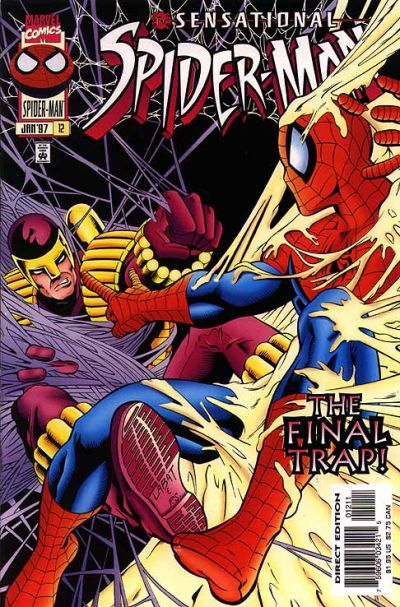
SENSATIONAL SPIDER-MAN #12 - January 1997


A Matter of Respect
Credits:  Todd Dezago (writer), Josh Hood (penciler), John Lowe (inks), Gregory Wright w/GCW (colors), Richard Starkings and Comicraft (letters)

The Plot:  The Trapster brutalizes two mob strongmen who harassed him in the past.  The next day, the Daily Bugle reports that Spider-Man was responsible.  Incensed that Spider-Man received the credit, Trapster decides to bolster his reputation by killing Spider-Man.  After leaving a trail through the city, Trapster eventually catches Spider-Man in a trap.  When he finally escapes, Trapster is gone.

The Subplots:  J. Jonah Jameson tells Peter Parker he should focus on more serious stories, such as global warming.  He announces that he’s sending Peter to the Savage Land to photograph the impact of melting glaciers on its environment.

*See _________ For Details:  Trapster apparently had an encounter with the same two hoods in Silver Sable #26.  He claims he had to feign weakness in front of Sandman, which I’m assuming ties in somehow with their past together in the Frightful Four.

I Love the ‘90s:  Trapster declares he’s going to have the biggest comeback since John Travolta.  Later, Jonah Jameson blames ozone depletion above the South Pole for global warming in the Savage Land.  I haven't heard anyone blame the hole in the ozone layer on anything in years.

“Huh?” Moment:  Peter Parker is bizarrely given orange colored hair throughout the issue.

Review:  This reads as a typical inventory story, except that 1) the final page leads directly into the next issue, and 2) the idea of the Trapster’s glue being mistaken for Spider-Man’s webbing will turn up again months later in the “Spider-Hunt” and “Identity Crisis” crossovers.  As Sensational’s first issue in the post-clone, please-stop-hating-us, Wizard era of Spider-Man, it’s a bomb.  There’s no strong gimmick, none of the jokes are that great, and Peter Parker is given nothing to do except get yelled at by Jonah Jameson.  But the most egregious offender is the art.  This is wretched stuff; an unsightly mix of bad manga clones and bad Jim Lee clones.  Josh Hood’s Spider-Man occasionally looks okay (even if the eyes are always excessively big), but his human figures are just awful caricatures that are painfully distracting.  One of the worst aspects of the post-clone era is the multitude of subpar fill-in artists.  There is some legitimately ugly stuff being published between 1996 and 1998, and that seems inexcusable when you consider that everyone from Ron Frenz to ChrisCross was probably available to do a fill-in.

Friday, June 21, 2013

AMAZING SPIDER-MAN #420 - February 1997


‘Twas the Night Before Christmas…
Credits:  Tom DeFalco (writer), Steve Skroce (penciler), Bud LaRosa (inks), Bob Sharen and GCW (colors), Richard Starkings and Comicraft (letters)

The Plot:  Peter arrives in Central Park to photograph a street prophet, not realizing he’s the mutant X-Man.  X-Man recognizes Peter’s secret identity and asks to speak to Peter privately.  The two bond over stories about their past.  Meanwhile, El Uno escapes from the hospital.  He’s stalked by Delilah, who eventually kills him by slamming his body into a gasoline tanker.  Later, El Uno’s head is mailed to the Black Tarantula.

The Subplots:  Peter wants to buy an expensive pair of boots for MJ’s Christmas present, but can’t afford them.  Luckily, he makes enough money photographing the hole El Uno left in the hospital to buy the boots.  Later, after X-Man joins Peter for the Parkers’ Christmas dinner, he gives Peter a psychic conversation with Aunt May in his dreams.  She absolves him for any guilt he feels over losing the baby.

I Love the ‘90s:  The Daily Bugle contacts Peter through a beeper.

Review:  Ah, yes.  Peter Parker and X-Man were supposed to be great friends in the late ‘90s.  I have absolutely no idea what the thinking behind this move was.  Okay, I understand that Bob Harras wanted to make the Marvel Universe more cohesive and have the various corners of the MU interact more often, and it’s possible that someone felt the need to have Steve Skroce draw X-Man again.  But, seriously, who would want to be friends with an infamous snot like X-Man?  The only way DeFalco can make it work is by virtually ignoring all of Nate Grey’s established characterization (X-Man is the one who actually suggests skipping the gratuitous fight!) and just presenting him as a slightly naive teenager who doesn’t know how to responsibly use his power.  I wonder if Spider-Man has any words than can help him out?

DeFalco’s making the best of what he’s been given, and the result works out okay.  Ignoring Peter’s odd decision to cover a psychic in the first place (even if he were skeptical, I imagine Peter’s protective enough of his secret identity to just avoid telepaths), the Spider-Man/X-Man scenes are decent enough.  Since this is a Christmas story, DeFalco’s stuck in the odd position of writing the Parkers’ first Christmas since the miscarriage, and presumably losing Aunt May, yet adhering to Marvel’s decision not to dwell on the events of the past few years of continuity.  The story doesn’t get into any serious exploration of what Peter must be feeling, but instead works in a few references to him seeing a therapist and still feeling guilty.  Guilt that’s apparently magically relieved by this issue’s guest star.  I can see why many readers would view this as a cheat, but I think DeFalco narrowly walks the line.  We’re not getting the pages of psychological torment that J. M. DeMatteis might’ve provided during his first Spectacular Spider-Man stint, but DeFalco is working in hints of what Peter’s experiencing along the edges of the very mainstream superhero story he’s telling.  

Speaking of which, there isn’t much to say about the Black Tarantula storyline.  Two underworld characters we barely know anything about try to kill each other.  One succeeds.  Steve Skroce gets to draw another giant explosion.  It’s not great, but it’s obviously there to just nudge that plot forward and give the main story something to cut away to.

Wednesday, June 19, 2013

AMAZING SPIDER-MAN #419 - January 1997


Beware the Black Tarantula!
Credits:  Tom DeFalco (writer), Steve Skroce (penciler), Bud LaRosa (inks), Bob Sharen (colors), Richard Starkings and Comicraft (letters)

The Plot:  Ben Urich learns of an emerald deal between the Rose and an unknown crimelord known as the Black Tarantula.  During the meeting, Black Tarantula’s emissary ambushes Rose’s representative, Delilah.  The bomb Delilah brought for protection goes off, forcing Spider-Man to flee with Ben Urich, and leave his camera behind.  

The Subplots:  MJ paints over baby May’s room.  Aunt Anna tells MJ that she’s taking college night courses, which inspires her to consider college.  Peter also mentions his desire to finish his Master’s Degree.  

Web of Continuity:  

  • According to the Chronology Project, this issue (and around a dozen other comics featuring Spider-Man) takes place in-between the pages of Sensational Spider-Man #13.  Presumably, they’re saying Spider-Man had numerous adventures right before he left on his flight to the Savage Land.  Since Sensational Spider-Man #12 ends with Peter getting his assignment to go to the Savage Land, I consider SSM #12-14 to be one complete arc, so I’m not going to be inserting other issues in-between this storyline when writing the reviews.
  • Black Tarantula appears in shadow at the issue’s opening, speaking to his diminutive assistant Chesbro.
  • The large man representing Black Tarantula, who Spider-Man initially assumes is Black Tarantula, is El Uno.
  • Rose's top assassin, Delilah, is given unusually flamboyant fonts by Comicraft on seemingly arbitrary words.
  • One of Ben Urich’s informants tells him that Black Tarantula is a cold-blooded killer, and that he’s recently come out of hiding after something happened to his wife and children.
  • Peter complains that Aunt May’s old home only has one bathroom.  That seems highly unlikely given that it’s a two-story house.  And how did all of May’s boarders share one bathroom?

*See _________ For Details:  Fortunato consolidated much of the New York underworld in Spider-Man #74.  Robbie Robertson mentions Graydon Creed’s assassination, which occurred in the truly classic X-Factor #130.  Spectacular Spider-Man #241 (not Sensational, as the footnote reads) featured MJ’s return to baby May’s room.

I Love the ‘90s:  Spider-Man lets out a “Happy!  Happy!  Joy!  Joy!” while web-slinging.  He also mentions coming home in time to watch ER, but says MJ’s lost her crush on George Clooney since he signed on to play a “big bat in his next movie.”

Review:  Tom DeFalco has stated that he isn’t too thrilled with his late ‘90s return to Amazing Spider-Man.  I read this run once after the 40th anniversary Amazing Spider-Man CD-ROM collection was released, and have to admit that the bulk of the issues are underwhelming.  The quality probably would’ve been helped if Steve Skroce had remained as artist, but he’s fated to become the least “regular” artist in the history of this book.

This specific issue, however, doesn’t foreshadow the mediocrity to come.  It’s actually a nice little setup story that efficiently puts the pieces in place for DeFalco’s new direction.  I’m not sure if all of these hints are paid off (like the unusual amount of emphasis placed on a photo of MJ’s maternity doctor when Peter walks through the Daily Bugle), but it reads as a promising start.  And for fans of this era of Spider-Man, who had to suffer through one ridiculous plot twist and strained status quo after another for over two years, it was probably comforting to read a simple story about Peter and MJ dealing with real life issues, Spider-Man taking photos for the Daily Bugle, and new mob bosses invading New York.  

It’s also a decent looking comic, although I recognize that some fans have issues with Steve Skroce’s faces.  For some reason he can’t seem to give MJ a facial expression outside of “annoyed cheerleader,” which doesn’t match DeFalco’s dialogue at all, but I have no problem with the rest of the civilian cast.  And his Spider-Man is very good.  I think Mike Wieringo will go on to develop the best Spider-Man from this era, but Skroce’s is already very consistent and appropriately Ditko and McFarlane influenced.  The very dark shade of red Bob Sharen is using on the costume also works well; I think we’re only now getting to the point where colorists are free to do more than just basic colors on the costume.  Skroce and LaRosa are emphasizing the dark areas of Spider-Man’s costume, so going for a darker red works perfectly.  Honestly, in retrospect, this reads as if it should’ve been the start of a solid run.
Related Posts Plugin for WordPress, Blogger...