Showing posts with label DVDs. Show all posts

Friday, April 12, 2013

MARVEL KNIGHTS: INHUMANS on DVD


Review copy provided by the studio.

The latest motion comic from Marvel, surprisingly enough, goes back to the initial launch of Marvel Knights back in 1998.  Paul Jenkins and Jae Lee's Inhumans debuted to great reviews, helping to cement the new line's reputation for resurrecting moribund properties and selling them to an audience that would ordinarily never give them a shot.  (Even if people did rightly complain months into the series that the story was moving too slowly, I do think the last two chapters do a lot to make up for the idle middle segment.)  Vertigo writer Paul  Jenkins and Image star Jae Lee didn't seem like an obvious fit, especially on an old Lee/Kirby property, but the final result was pretty undeniable.  Jenkins breathes a lot of life into the concept by taking what's already there and using it as a venue to explore everything from puberty to slavery to classism, while also fleshing out the main Inhumans and exploring their relationship as a family.  And Lee's art fits the mood perfectly, maintaining most of the style that made him popular in the '90s without getting in the way of the story.

If you ever want to see Lee's art animated, probably the only chance you'll have is in the motion comics format.  If you're annoyed by the simple motions and odd lip synch, I doubt this one would change your mind, but I think the performances and music help to compensate for the limited animation.  The narrator in particular is very good, with a style that sounds like it could just as easily be on PBS, but fits Jenkins' dry narration perfectly.  The trade is apparently long out of print, and going for outrageous prices on Amazon, so this could be your only opportunity to get the story at a reasonable price.  I have to point out, however, that this is the second Marvel Motion Comic DVD that has major audio issues in my Panasonic DVD player.  It's not that much of an inconvenience, since like most people I have more than once device that can play DVDs, but it is an odd problem to occur more than once.

Saturday, August 11, 2012

ASTONISHING X-MEN: TORN on DVD

I'm not sure what the thinking is behind the recent series of limited animation adaptations of Marvel storylines, but I guess there's a precedent for such a thing. Torn is the third adaptation of Joss Whedon/John Cassaday's Astonishing X-Men run; the arc you might remember as "Emma betrays the team, things get weird, things get normal again." Torn is reminiscent of Mark Millar's more "outrageous" work, with a shocking cliffhanger or ridiculous stunt occurring every few minutes, yet Whedon has enough sense to set things right with a plausible hand-wave at the end. It's certainly a much more enjoyable work than the previous installment, Dangerous, which I consider the nadir of modern X-storytelling.

I've never watched any of the Marvel motion comics before, but Astonishing seems like a natural fit for the line. Whedon's stories read like plays, with action only rarely interrupting the conversations, which means the limited animation is mainly concentrated on moving lips instead of trying to sell a convincing fight scene. And John Cassaday's art, with Laura Martin's coloring, looks amazing when digitally reproduced on television. The voice acting, and music, also help to sell the material, occasionally reminding me of my favorite comics-to-TV adaptation, The Maxx. If you've already read the comic, there might not be enough here to draw your attention, but it could serve as a nice introduction to Whedon's comics work for any of his fans who only know the TV or movie projects. Also, checking Amazon, I see that this new DVD is selling for less than the Torn trade paperback, which is several years old. Reading, clearly, is for suckers.

Sunday, July 29, 2012

WOLVERINE ANIME and BLADE ANIME on DVD


Review copies provided by the studio.

When the Marvel/Madhouse anime projects were announced a few years ago, I thought Wolverine was going to be a one-off movie, starring an extremely off-model Wolverine, and I had no idea Blade was even under consideration. As it turns out, Wolverine and Blade were both ongoing series, and they’ve already aired in America on G4. I only know this now because the series are being released on DVD, which the 99% of the nation that can’t watch G4 anymore might appreciate.

Following that original teaser, most of the responses I heard regarding Wolverine were complaints about the design of the character. And, while Madhouse abandoned the Wolverine-in-name-only look from the original teaser, the design for the regular series is still likely to annoy purists. Wolverine should not be tall, thin, and fifteen. He probably shouldn’t be voiced by a young, handsome actor trying to sound gritty, either. The justification for the redesign is that Madhouse has externalized Wolverine’s inner “James Dean” persona, which is certainly an odd rationalization. Isn’t Wolverine supposed to be Dirty Harry?

The story (written by Warren Ellis), however, does bring the character closer to familiar territory. The series is essentially an adaptation of the original Claremont/Miller Wolverine miniseries, stretched out over twelve episodes. Ellis uses the extra space to touch on various other elements we’ve seen in the comics. Flashbacks to his secret agent days, a Weapon X callback or two, a new female sidekick, Madripoor, and…Omega Red? Yes, there now exists in the world a big-budget anime project that prominently features Omega Red. And Madhouse does an incredible job bringing the Jim Lee design to life. I wish the rest of the designs were as loyal to the original comics, but I guess that’s my western bias showing through.

If you want uncensored Wolverine claw action, this is for you. However, the action often comes at the expense of story. The plots of several episodes are amazingly thin, testing the patience of anyone who doesn’t want to see twenty straight minutes of Wolverine cutting up Madripoor pirates. Obviously, adapting four comic issues into 250 minutes of television is going to require some filler, but the pacing of the show is absolutely glacial at times.


Blade isn’t a specific adaptation, which leaves Ellis free to do a “wandering warrior” take on the character. According to the DVD extras, the vampires in the story are taken from various vampire myths found in Asia, which is a welcome break from the standard Victorian interpretation. These vampires are absolutely freaky, and perfectly suited for Madhouse’s animation style. Blade’s been redesigned with head and face tattoos, along with earrings, making me wonder if this came from the Japanese producers or Marvel employees who wanted to add “edge” to the project. He doesn’t look totally ridiculous, thankfully. His redesign is easier to accept than Wolverine’s, at least.

Ellis doesn’t seem to have a novel take on the character, he’s essentially a brooding, silent hunter throughout the entire series, but the flashbacks in the earlier episodes help to flesh him out. I don’t know if this was ever established in the comics, but in the series, Blade’s partial motivation for hunting vampires is to make amends to the people he killed before he was able to control his own urges. Young Blade is an interesting, sympathetic figure…who’s barely in the show. Adult Blade mutely kills vampires, travels to another Asian location, then kills more vampires. The action’s great, the animation is beautiful, but like Wolverine, the focus is rarely on plot or character. As pure popcorn entertainment, they’re enjoyable, though. I’d again like to repeat my request for a Spider-Man anime, or maybe even Daredevil. If we can get an anime Omega Red, why not an anime Bushwacker?

Tuesday, April 24, 2012

X-MEN ANIME and IRON MAN ANIME on DVD


Review copies provided by the studio.

My satellite provider dropped G4 over a year ago, so I haven’t been able to watch the Marvel/Madhouse anime collaborations. (I’ve barely seen a reference to them online since the project was announced, making me wonder if G4 is somehow blocked in every comic fan’s home.) Thankfully, the X-Men and Iron Man series have been released on DVD, without any of the annoying clutter that G4 no doubt pastes all over the screen during pivotal moments of the episodes.

Both series are written by Warren Ellis, and apparently translated into Japanese by the Madhouse production staff, then translated back into English for the American airings. I initially thought these guys were very serious about making this authentic anime, since my DVDs were already set for Japanese language with English subtitles when I hit play. Only after watching the first X-Men episode did I realize that you can turn off the subtitles and listen to an English translation. And, surprisingly, the English dubs are very enjoyable. The X-Men receive some of their best voice acting ever, and the dubbed Iron Man is mercifully not the annoying voice chosen for the recent Avengers Disney XD cartoon. By the way, I wouldn’t be so quick to turn off the subtitles. The translated text often doesn’t match the spoken English dialogue, and some of the incongruities are interesting.

Much of the look of the X-Men series comes from the movies, while New X-Men and Astonishing X-Men serve as the main inspirations from the comics. Speaking as someone who doesn’t particularly like much of this new-fangled continuity, I’ll give Warren Ellis some credit for providing more reasonable rationalizations for many of the events he’s adapting (Emma Frost’s secondary mutation, for instance). His use of Armor as the latest replacement for Kitty Pryde also makes sense, giving the series an organic connection to Japan. One of the DVD extras features an interview with Madhouse’s producers, which reveals that they found Ellis’ original ending far too depressing (Warren Ellis, you say?) so they changed it to better reflect Japanese sensibilities. The story is still clearly Ellis, though, for better and for worse. The pacing of the series is leisurely to say the least, and the show never quite creates a balance between extremely long conversation scenes and extremely long fight scenes. Conversely, the character interactions work pretty well, the dialogue is often sharp, and the “horrors of science” villains blend perfectly with Madhouse’s art.

Iron Man might as well be named Iron Man: The Movie: The Anime. This is flagrantly the movie interpretation of the Iron Man mythos, minus Pepper Potts, whose role is downplayed in favor of two potential Japanese love interests. Visually, the series is amazing (with one glaring exception I’ll get to later), while the stories are mostly done-in-one action pieces that pit Iron Man against mech-influenced interpretations of the old Avengers villains, the Zodiac. It doesn’t pretend to be as deep as the X-Men series, but it’s very entertaining and I think most Iron Man fans will really enjoy it, although the return of one major character from Tony Stark’s past might infuriate them.

Now, these are absolutely beautiful cartoons. I would have to be a spoiled, obnoxious fanboy to complain about the visuals in these shows, but I will. Assuming that the X-Men movies have done well in Japan, I can understand going for an amalgam of the movie and Frank Quietly comics when designing the costumes. And, Cyclops’ ridiculous shoulder pads aside, these costumes look fine. And yet…the first episode opens with a flashback to the previous year, featuring the X-Men in their retro-style costumes from the early issues of Astonishing X-Men. Not only are these superior designs, but they finally bring us an anime interpretation of Wolverine in his cowl. I’ve wanted to see the “real” Wolverine animated anime-style since I was twelve…and I get it for about five seconds in this series.

The Iron Man series also has a design element that perplexes me. The producers have decided to do Iron Man’s armor as a CGI model, along with most of the mech villains he fights. These aren’t bad CGI models, of course, but I have no idea what they’re doing here. When the Iron Man anime series was announced, I think most of us had a very specific style in mind for the armor, and it wasn’t CG. When I think of anime, I think of the classic armor and robot designs from Robotech, Gundam, and Transformers: The Movie. There is a specific anime look for this material, and it’s not reflected by computer-generated models. Any animation studio could create a CG Iron Man -- the movies are filled with CG Iron Man models, so it’s not like we haven’t seen one -- I wanted to see a genuine anime Iron Man armor.

Those are all very fannish complaints, I understand. These shows are pure eye candy, and the stories are solid enough to attract fans of the comics and the movies. Hopefully, the DVDs are going to perform well, because I’d like to see a second season for each show. And maybe someday, we’ll be lucky enough to get a Madhouse interpretation of Spider-Man. This horrible Ultimate Spider-Man thing wouldn’t prevent a simultaneous Spider-Man cartoon, would it?

Friday, November 11, 2011

THE AVENGERS: EARTH’S MIGHTIEST HEROES Volumes 3 & 4


Review copies provided by the studio.
Collecting the second half of the first season, The Avengers: Earth's Mightiest Heroes volumes 3 and 4 are now available on DVD. The first batch of Avengers episodes was a pleasant surprise, with solid designs by the late Boyd Kirkland, smooth animation by Film Roman, and stories that modernized classic Avengers battles with only a small amount of annoying Ultimization. The series clearly improves as the episodes continue, as the character designs tighten up, the digital color palate grows more complex, and the stories develop into multi-part, Avengers-worthy epics. Plus, that irritating mall punk theme song has been chopped in half in the later episodes.

It’s hard to imagine an Avengers fan not getting a kick out of most of these episodes. The storylines draw inspiration from everything from Walt Simonson’s “Casket of Ancient Winters” Thor arc, to Kurt Busiek’s global Kang vs. the World storyline from his final Avengers days. Characters you never really expected to see, such as Mockingbird and Ms. Marvel, even make appearances. Actually, Mockingbird does more than make an appearance; she’s a lead character for a few episodes. This must be what DC fans felt like when characters like Vixen and Captain Atom showed up on Justice League Unlimited. Not that Avengers: Earth's Mightiest Heroes is quite on Justice League Unlimited’s level, but it’s the closest any Marvel series has come so far.

Whether or not you wish to own these episodes on DVD likely depends on your level of fandom, but the sets are absolutely worth a rental. The entire first season has also been available via Netflix’s instant streaming service for a while now. I’m not sure when season two is set to begin, but hopefully the wait won’t be too long. This is a show that could easily match the episode runs of the ‘90s Spider-Man and X-Men series, assuming Marvel plays its cards right.

Friday, April 22, 2011

AVENGERS: EARTH’S MIGHTIEST HEROES Volumes 1 & 2


Review copies provided by the studio.

Yes, a mere seven months after its debut, Avengers: Earth's Mightiest Heroes is coming to DVD on April 26th. These kids today don’t know how lucky they are. It took twelve years for Batman: The Animated Series to be released on season sets. Sixteen years for X-Men! Avengers: Earth's Mightiest Heroes Volume One collects the original seven episodes (with the “micro-episode” compilations counting as five episodes), while Volume Two has six more episodes, ending with the “Gamma World” two-parter. For the first time, Disney has included special features in a Marvel animated series season set. Both volumes have interviews with Joshua Fine and Christopher Yost, teasing future events for the upcoming season. We learn that Vision is coming soon (yay), while Captain America is getting an Ultimate redesign (boo).

As an entitled fanboy, I proudly reject virtually all post-2000 Marvel continuity, along with the Ultimate Universe. As such, I have numerous nitpicky complaints whenever a “contribution” by Brian Michael Bendis or Mark Millar makes its way into the series. Luckily, the show borrows from almost every corner of Avengers continuity, so the use of an “Ultimate” version of a character is usually balanced out by a classic Hawkeye, or an appearance of an obscure villain or B-lister. One thing I can’t get past is Iron Man’s horrific voice acting, which is the worst Robert Downey, Jr. impression I could imagine a professional actor getting paid to do. I like the Iron Man movies, but I’m afraid they’ve cursed future generations with an endless steam of “witty” quips and smirky performances. On the other hand, Jeffery Combs is playing the Leader, so the casting department has at least one major score going for it. Actually, most of the voice acting is at the very least competent, which makes the casting of the subpar RDJ clone even more confusing.

The animation is provided by Film Roman, generally regarded as the best studio currently doing American television animation. The early episodes look a bit rough, the character designs are all over the place and the colors are just too bright, but the quality improves as the season continues. By “Gamma World” you can see a marked improvement, putting the show on the same level as Film Roman’s other Marvel cartoons, X-Men Evolution and The Superhero Squad Show. (Although, for some reason, Superhero Squad’s digital coloring still surpasses almost every Avengers episode.)

The stories on these episodes broadly follow the original Stan Lee issues, right down to the original Avengers line-up. They don’t even cheat and let Captain America in as a founder. He’s got to wait until the team forms, moves into the mansion, and fights Hulk a few times before his body is unfrozen. Surely, this is the way The Man intended. The villains range from Klaw to Baron Zemo to Man-Ape. It’s hard to think of a villain who doesn’t show up (King Cobra, Purple Man, and Wendigo are in the same episode!), and most of them have solid designs. I don’t know which animator designed Abomination, but I would say his look rivals any design from the comics. I’m not sure when the next DVD set is due, but future episodes continue to borrow heavily from classic Avengers storylines, so Kang and the Masters of Evil make appearances, as the show drops some hints regarding a war between two certain alien races. Allegedly, the plan is for the series to run 52 episodes; hopefully they’ll continue to lean towards the classic Avengers and stay away from “New” or “Ultimate” anything (although Cap’s redesign doesn’t give me a lot of hope). Even if I personally dislike some of the material chosen to be adapted, it’s still fun to see an Avengers cartoon that gets so much right. And, none of the characters are stuck wearing animal-themed cybernetic armor, which is always a plus.

Sunday, May 2, 2010

X-MEN Vol. 5 & IRON MAN - The Complete Series

Review copies provided by the studio.

The final episodes of the original X-Men animated series are strange to watch in retrospect. Actually, they were kind of odd when they first aired, too. After the producers finished what was supposed to be the big series finale, FOX kept ordering new episodes. The final season began with a two-part adaptation of the “Phalanx Covenant” crossover, followed by another Longshot episode, another solo Cyclops episode, an episode about Omega Red and a submarine, a two-part adaptation of the Chris Claremont/George Perez Arkon story, and a loose adaptation of the infamous Nightcrawler origin story from X-Men Unlimited #4. Some of these episodes were supposed to air months, or even years, earlier but were delayed due to animation errors. “No Mutant is an Island” has Cyclops reacting to Phoenix’s death, even though her resurrection episodes had already aired. The scripts tend to be on par with most of the previous episodes, and some of the adaptations even exceed the original comics. “Phalanx Covenant” takes the basic idea behind the crossover but also incorporates the early Warlock appearances from New Mutants, and brings in Magneto and Mr. Sinister as unlikely allies against the Phalanx. “Bloodlines” is a vast improvement over X-Men Unlimited #4 because it uses Nightcrawler more effectively and actually makes a modicum of sense.

Some reports say that “Bloodlines” was supposed to be the last episode, others say it was the final chapter of “Beyond Good & Evil” (included in the last DVD set), and others claim the second part of “Storm Front” was the last produced. Regardless, even more episodes were ordered. For the final batch, the producers decided to redesign the show. Joe Madureira’s manga style had revamped the look of the comics, and interviews with the producers claimed it inspired the show’s new look. You would think Joe Mad’s style would translate to animation rather easily. The actual cel-to-cel animation might not work on a TV budget, but the designs should’ve been easy to emulate and it’s not as if the overly rendered Jim Lee style worked for animation either. If the animators were going for Joe Mad, I’m not sure how they ended up with the final designs. They are cartoonier, but I don’t see the Japanese influence that made Madureira’s art so popular. The highlight of the final episodes is “Old Soldiers,” a WWII Captain America/Wolverine team-up that’s written by Len Wein.

Now that all of these episodes are paired together on DVD, the dramatic style change is even more jarring. The “new look” episodes aren’t even separated on a different disc. I could mention the lack of extras again, but by the fifth volume, I don’t think anyone was expecting any by this point. At least the show is finally on DVD, and the entire seventy-six episode run has been released within a year’s time.

Just in time for, well, the second Iron Man movie comes the release of the ‘90s Iron Man cartoon. Packaged with Fantastic Four as the Marvel Action Hour, the show is probably best known by fans for the dramatic revamp it received during the second season. Although many of the voices remained the same, both Iron Man and Fantastic Four received new designs, higher-quality animation, and vastly improved scripts. The first season of Iron Man actually looks much better than Fantastic Four’s first season, but it still desperately needed a revamp. Even though it aired in syndication, the second season of Iron Man often looks better than the network X-Men series, and it certainly exceeds the vast majority of Spider-Man episodes. I wish the original character design of Tony Stark had survived, since it was apparently based on Paul Ryan’s artwork and allowed the character to maintain his short, black hair. The revamped Tony Stark has a blue mullet, which I guess is a small price to pay for an overall better show, but wow is that an ugly haircut.

The first season of the show is best forgotten. The stories are extremely simplistic, the scripts are filled with bad puns, the designs of Iron Man and War Machine look awful (which is odd, since the rest of the designs are mostly fine), and there’s an atrocious CGI “transformation” sequence that’s repeated in every episode. The show picks up on the early ‘90s Force Works comic (a.k.a. West Coast Avengers…Extreme!), giving Iron Man a supporting cast that consists of Hawkeye, Scarlet Witch, Spider-Woman, and (remember him?) Century. Aside from MODOK’s brief cameo in a baby carriage, there’s nothing memorable here. The second season offers more complex stories and characterizations, taking its inspiration from the Layton/Michelinie run, with a little bit of Len Kaminiski's stint as well. This is what an Iron Man cartoon should feel like, and it’s too bad the show couldn’t continue in this style. The ‘90s Fantastic Four series was released on DVD years ago, and is apparently out-of-print, so I’m glad Iron Man fans now have a chance to own the companion series. I’m even glad that first season is included for posterity’s sake, but I wouldn’t dwell on it for too long.

Tuesday, October 13, 2009

SNOW WHITE AND THE SEVEN DWARFS


Note – a review copy was provided by the studio.

Anyone with an interest in comics and animation needs to see Snow White at least once. Released in 1937, Snow White was the first full-length animated movie ever produced. The field of animation was still new, and still dominated by funny animal shorts at the time. Releasing a full-length animated movie was outrageous enough, but having it star a realistic human character, a subject the artists had absolutely no experience animating, was simply unthinkable. Animating the movie took around four years, and the budget went well over three times the amount Walt Disney predicted. If the movie had failed, it’s hard to imagine what exactly would’ve happened to the fledgling animation industry. Luckily, it went on to become one of the highest-grossing films of all time. Aside from being the first animated movie, Snow White was also the first film to have its soundtrack released as an album, the first movie to be rereleased on a regular schedule (a practice Disney started a few years later when WWII severely cut into the company's cashflow), and the first film to be scanned digitally and returned to film in the early ‘90s. The success of the movie also gave MGM the confidence to produce the Wizard of Oz, and the innovative cinematography directly influenced Citizen Kane a few years later.

Disney, for obvious reasons, wants you to know that this movie is historic, which is why the new “Diamond Edition” DVD/Blu-ray is filled with documentaries and featurettes on the production. The audio commentary comes from the 2001 DVD release, which features annotations from animation historian John Canemaker, and clips from various Walt Disney interviews conducted over the course of thirty years. Disney’s comments are surprisingly candid, even though he maintains a cheerful demeanor regardless of the subject (he blithely claims that he only has $3,000 in his bank account during one recording, because he’s put so much of his money into the Disney empire). Aside from revealing little tidbits, such as the fact that Snow White’s makeup is real rouge that was actually painted on to the cells, Disney divulges that he grew to hate (and he uses that word more than once) Snow White, because critics set it up as an impossible standard for his other films to meet.

Watching the movie, it’s hard to believe that something made during the Great Depression could look so vivid and spotless. The restored colors are fairly bright, which is ironic considering that Disney wanted the movie to have a muted color palate because he didn’t know if the audience would accept over an hour of bright colors. The story moves along extremely fast, and rarely tries to oversell a joke or visual gimmick. The character of the Prince is barely even in the film, because Disney and the animators realized early on the guy was basically deadweight. You might not find the story of an exiled princess befriending seven wacky dwarfs particularly inspired, but the striking visuals and overall sincerity of the production are engaging. Aside from its historic significance, the movie’s strong enough to compare to any modern animation project, which is remarkable. One hundred years after its release, people will still be watching this movie.

Thursday, September 24, 2009

X-MEN - The Animated Series, Volumes Three & Four


I’ve written about the ‘90s X-Men cartoon before, so I won’t spend too much time repeating myself. Basically, the designs are from a different era, the animation is often stiff, and the voice acting is hit or miss. It’s also one of the most loyal comic to cartoon adaptations ever, and most of the episodes do manage to maintain the themes and characterizations that made the series so popular in the first place. The DVD releases continue, collecting most of the episodes through the fourth season. For unknown reasons, the DVDs are collecting the episodes in the order they originally aired, which is going to create some continuity issues later on. (“No Mutant Is an Island” ends with the X-Men learning that Jean Grey didn’t die at the end of “The Phoenix Saga,” which means it has to happen before “The Dark Phoenix Saga.” It aired two years late due to a series of animation errors, apparently.)

The episodes in Volume Three include the cartoon’s adaptation of “The Dark Phoenix Saga,” which has removed anything unsuitable for Saturday morning, but remains a remarkably faithful retelling of the comic’s story. Anyone who’s read the story will notice a dozen or so scenes directly taken from the comics. If the producers of the third X-Men movie had shown this much respect for the source material, maybe that franchise wouldn’t be so far off the rails at this point. “Cold Comfort” features the return of the same studio that animated the lively “Out of the Past.” There’s no shortage of animation errors here, but the movement is very fluid, and fans are treated to an appearance by the Peter David-era X-Factor. The animators have even picked up on a Steve Lightle drawing of Polaris and attempted to recreate his distinctive rendition of her neon green, straggly hair in every cel. “Nightcrawler” is an episode that FOX originally didn’t want to air, due to its forthright depiction of the character’s Christian faith. It ends with Wolverine reading out of the Bible, which probably increases its camp appeal, but the episode does give him some decent character work. It’s interesting that Gambit is portrayed as an atheist, considering that Fabian Nicieza would go on to establish him as a believer in his solo series. “Weapon X, Lies, and Videotape” adapts large sections of Larry Hama’s Wolverine run, and features a strong performance by Cal Dodd as the tormented Wolverine. The low-point of the set, and the show in general, has to be “The Juggernaut Returns,” which is a regrettable comedy episode about a feeble nerd gaining the Juggernaut’s powers. The new Juggernaut accidentally smashes some things, buys a white leisure suit, and tries to pick up women at a nightclub. After you hear Norm Spencer’s painful reading of “Women like guys to be themselves” as Cyclops, you can never un-hear it. The episode does get points for faithfully recounting the Juggernaut’s origin from the comics, though.

Volume Four opens with “Proteus,” a heavily sanitized version of the classic Claremont/Byrne storyline. The dark themes of the original story don’t lend themselves to this type of an adaptation, so it doesn’t really work. Proteus’ various zombie forms are even replaced with a non-threatening energy being that looks like something that should’ve been chasing the Amazing Chan Clan. “Sanctuary” is largely inspired by the final story of Chris Claremont’s original run, and its portrayal of Magneto is preferable to anything done to the character in the comics since Claremont’s departure. “Beyond Good and Evil” tosses in virtually every X-related character who hasn’t appeared yet, reminding me of the five-part season openers of G. I. Joe and Transformers that used to introduce the latest wave of action figures. Since this was apparently going to be the series finale, most of the major characters from the previous episodes also appear. Rather than feeling like a mess, it’s actually fun to see the various characters brought together in one large story. Unfortunately, the rest of the set features some forgettable episodes. Everyone from the High Evolutionary to the Brood to the Silver Samurai appears, but none of the episodes really click.

Once again, the sets have no special features. It shouldn’t be too hard to toss in things like the Chris Claremont interview that was already used in a previous release of Wolverine-centric episodes, or the Japanese openings for the show. A gallery of the covers of the VHS releases, which has some memorable work by Ty Templeton, would also be nice. If the rights are available for the ‘80s pilot “Pryde of the X-Men,” that definitely needs to be included before the series is finished. That complaint aside, it’s great to see the series finally on DVD, with over sixty episodes released in less than six months. If you’re willing to forgive some of the flaws, I think both sets are worth checking out.

Monday, April 20, 2009

X-MEN – The Animated Series on DVD


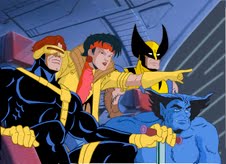
The folks at Disney were kind enough to send me review copies of the first two volumes of the ‘90s X-MEN cartoon, which is finally out on DVD April 28th. Since the series debuted a few weeks after the widely canonized Batman: TAS cartoon, it’s often viewed dismissively amongst comics fans, which isn’t entirely fair. Bruce Timm’s stripped down, expressionistic designs bore little resemblance to the accepted look of action cartoons at the time, and while they might’ve been hard to swallow at first, it’s clear that he created a look that’s influenced animation for over ten years now. X-MEN, however, didn’t look much different than G. I. Joe, which was already getting close to ten years old when the show debuted (and X-MEN unfortunately didn’t have access to some of the higher quality Japanese animation studios Joe used in the ‘80s).

Everything about the look of the show goes against accepted animation design theories today, but in Fall 1992 this really didn’t seem that strange (if anything, Batman: TAS looked like the odd man out). The animators looked at the X-comics of the early ‘90s and faithfully recreated every detailed muscle line, strand of hair (and, boy, do Storm and Rogue have a lot of it), cheek bone, belt buckle, and fold of clothes imaginable. It really is a Marvel comic brought to life. It’s unfortunately too faithful to work with the abilities of overseas animation studios, though. The animation in the early episodes is often stiff and clumsy, and it’s not hard to spot the recurring continuity errors. However, things do improve as the first season progresses. By “Days of Future Past”, the characters have lost a bit of their stiffness, and the overall animation is much more consistent. It’s still not up to the standards of what Warner Brothers was doing with television animation at the time, but the show’s visuals are no longer a distraction and actually help to sell the stories by the end of the first season. (The two-part Season Three opener “Out of the Past” actually has remarkably fluid animation, which makes me wonder why this specific studio only worked on a handful of episodes).

The stories themselves are often faithful adaptations of the original source material, so it’s hard to fault the creators for giving Marvel what they obviously wanted. Some of the dialogue is a little clunky, but most of the X-Men’s personalities are effectively conveyed, making the show an easy introduction to the characters and concepts of the original comics. Each episode leads directly into the next (even if it’s just a last-minute cliffhanger that’s tagged on at the end of a complete story), mirroring the ongoing soap opera that brought so many fans into the comics during the ‘80s and ‘90s. The stories try to find a balance between entertaining kids and adults, and while the show obviously errs on the side of the kiddies, the material itself is rarely dumbed down. The show doesn’t shy away from death, as Sabretooth is rather unambiguously labeled a murderer, Magneto describes watching innocent women and children die as a child, and Morph bites the dust in the opening two-parter (he of course comes back, but that’s due to a fidelity to comic book style storytelling and not a squeamishness over death). Some of the episodes seem to drag on for too long, some are just silly (the less said about the Juggernaut/Colossus episode the better), but the majority of them are pretty entertaining. I always thought the final three episodes of the first season were particularly good, and was pleased to see that they hold up very well. The vocal performances are all over the place, which can occasionally distract from the storytelling. Some voices, such as Cal Dodd as Wolverine, are almost perfect, while other major characters rarely seem able to deliver a credible line of dialogue (the show could never get Cyclops or Storm to sound right).

The DVD sets contain sixteen episodes each, which means you get the first season plus the first three episodes of season two with Volume One, and the second season plus the first seven episodes of season three on Volume Two. (Despite the appearance of Dark Phoenix on the Volume Two cover, those episodes aren’t covered. It actually finishes with the original storyline that transforms Jean Grey into Phoenix, so she’s not “dark” yet.) I imagine the episode count was done solely for accounting reasons (probably to give the buyer a decent amount of episodes for around $20-$25 a set), because there’s no real reason for the first volume to end three episodes into an extended storyline with no resolution. Make no mistake that these are barebones releases, as there are no special features that I can find. You’re getting the shows as they originally aired and nothing else. It would’ve been nice to have a few interviews or audio commentaries, or perhaps even the “rough” preview version of the first two episodes that aired with numerous animation blunders, but the sets don’t seem to be aimed at the more hardcore audience that pays attention to those things. Since numerous fans were brought into comics through this series, I imagine just the nostalgic appeal of seeing the episodes again is enough to warrant a purchase for many. I was already a fan before the series aired, but I can’t deny that seeing my favorite comic so faithfully translated into an animated series was a thrill. Looking back on the cartoons of your youth is always dangerous (Thundercats didn’t seem to induce narcolepsy as a child, oddly enough), but X-MEN has its moments, even if the styles have moved on.

Related Posts Plugin for WordPress, Blogger...