Showing posts with label joe casey. Show all posts

Friday, September 6, 2013

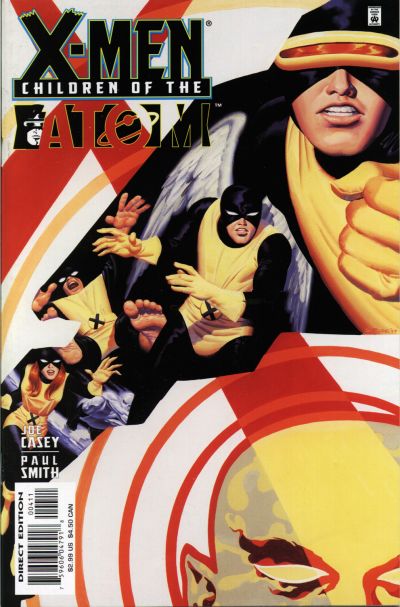
X-MEN: CHILDREN OF THE ATOM #6 - September 2000


The Great Cathedral Space 
Credits: Joe Casey (writer), Essad Ribic (penciler), Andrew Pepoy (inker), Paul Mounts (colors), Richard Starkings (letters)

Summary:  The newly formed X-Men use Cerebro to track Professor Xavier to Metzger’s hideout.  Meanwhile, Magneto attacks a gathering of Metzger’s followers.  Holding Jean and Starkey (a.k.a. Scab) captive, Metzger sends his genetically-enhanced disciple Arthur to torment them.  Starkey uses his empathetic powers to absorb Jean’s wounds and saves her life.  He dies in the cold, shortly after the X-Men, Xavier, and Fred Duncan arrive to rescue Jean.  As Metzger tries to escape, he’s apprehended by Magneto and left to die in Earth’s atmosphere.  Later, Jean arrives at Xavier’s school for her first day.

Continuity Notes:  A news report following Magneto’s attack on Metzger’s followers says that Democratic candidate Robert Kelly is now running on a platform of identifying and registering mutants.  I believe that Kelly actually didn’t show an interest in the mutant issue until he witnessed the X-Men attack the Hellfire Club at the end of the “Dark Phoenix Saga.”  (Coincidentally, his first appearance.)  It’s also interesting to see Kelly identified as a Democrat, as he’s a Republican in the movie continuity, and was later described as an Independent during Chris Claremont’s 2000 run.

Review:  I initially dismissed this miniseries as pointless, and six issues later, I can’t say my opinion has changed much.  The art has been fantastic throughout, and Casey could occasionally find a few decent character moments, but most of this series has consisted of boring recruitment scenes and dull villains plotting vague schemes in shadowy rooms.  The initial hook of this series seemed to be Fred Duncan’s initial impression of Charles Xavier after he’s forced to face the mutant issue, but Casey apparently lost interest in Fred early on.  We never even discover who his imaginary friend was supposed to be during the early issues of the mini.  (And it’s just egregious for a miniseries to have dangling plot points.)  

The basic idea of a prequel miniseries focusing on Fred Duncan and Xavier is perfectly fine; it’s actually one I would rather read than a continuity reboot of the original X-Men’s origin stories.  I don’t see what’s been added by turning Cyclops, Beast, and Iceman into high school classmates, and making Beast responsible for an anti-mutant bigot’s death just seems unnecessary (and it’s another story point that’s simply forgotten by the final issue.)  Casey seems to think he’s making a grand statement on adolescence, but his characterizations of the X-Men just feel shallow for most of the series.  The story’s more engaging when Xavier, Magneto, and Fred Duncan get the spotlight, actually.  

As for this mini’s status as a continuity reboot, the best scenes are usually the ones that play on established continuity, making me wish Casey could’ve focused more on Angel’s career as a local crimefighter or the status of Xavier and Magneto’s relationship shortly before the X-Men’s formation.  The retconned material, such as the revamped Jack O’Diamonds, just reads like a pitch for a low-budget X-Men origin movie.  

Friday, May 31, 2013

X-MEN: CHILDREN OF THE ATOM #5 - August 2000


Where Your Children Are
Credits:  Joe Casey (writer), Essad Ribic (penciler), Andrew Pepoy (inker), Paul Mounts (colors), Comicraft (letters)

Summary:  Hank finally accepts Xavier’s offer to attend his school, joining Scott, Warren, and Bobby.  Later, Magneto meets Xavier in a bar, warning him of the upcoming war.  As the newly formed X-Men train in the Danger Room, Jean Grey is abducted from her home by Metzger’s agents.  Fred Duncan informs Xavier, who insists on rescuing her without the neophyte X-Men.  After he leaves, the team decides to go on their own rescue mission.

Continuity Notes:  Xavier’s conversation with Beast establishes that he grew up on a farm in Illinois, but doesn’t explain how he ended up in a New York high school.

I Love the '90s:  Who Wants To Be A Millionaire? is parodied by a game show that focuses on the mutant issue.  (“Your next door neighbor is a mutant.  According to William Metzger, you should…A) Report him to the police…B) Move away…C) Exterminate him…D) Build a fence…”)

Review:  Five issues into the series and the X-Men have finally managed to put on a pair of black and gold tights.  Actually, I wasn’t expecting this to happen until issue six, so that’s a nice surprise.  Even if Steve Rude and Paul Smith are gone, I would probably have to label this issue the strongest so far.  Essad Ribic isn’t a bad replacement artist at all; in fact, his style is so compatible with Paul Smith’s, I wonder why he isn’t asked to fill in for him more often.  And in defiance of the previous issues, things are actually starting to happen now.  The villain is making his move, 4/5th of the X-Men have formed, and there’s a cliffhanger that might lead to more than just a conversation scene.  Plus, there are a few of the moments you probably want to see in an X-Men prequel series, such as Xavier and Magneto having a passive-aggressive chat, and the X-Men getting beaten up by the Danger Room for the first time.  Jean Grey also gets a nice scene with Metzger’s former follower that’s been cast out after his mutantcy emerged.  None of this is enough to change my overall opinion of the series, this is a book that had Beast kill someone as a part of his origin story in issue #2 and forgot about it until now, but at least it’s coming together as a more cohesive story.

Friday, March 8, 2013

X-MEN: CHILDREN OF THE ATOM #4 - July 2000


Child’s Play
Credits:  Joe Casey (writer), Paul Smith and Michael Ryan (pencilers), Paul Smith and Andrew Pepoy (inkers), Paul Mounts (colors), Jim Novak (letters)

Summary:  Scott Summers awakens inside Xavier’s mansion, still reluctant to join his side.  Meanwhile, Fred Duncan discovers William Metzger is working with his superiors.  Using technology taken from the Sentinel prototype, Metzger plans on helping the government locate mutants.  Later, Xavier invites Bobby Drake and Jean Grey to join his new school, while Magneto is rejected by a neophyte mutant.  Finally, masked men attack Warren Worthington’s home.  They’re stopped by Xavier, who asks Warren to join him.

I Love the '90s:  William Metzger appears on “Politically Inept with Bill Czar” to discuss the mutant issue.  This is a reference to Bill Maher's previous talk show, "Politically Incorrect." 

Review:  So, someone thought it would be a good idea to help the book’s deadline problems by replacing Steve Rude with Paul Smith.  That’s…c’mon…was Adam Hughes not available?  Smith doesn’t even last a full issue without needing a fill-in, although Michael Ryan’s pages thankfully aren’t a jarring transition.  This is possibly the finest looking issue of the series so far; Smith’s interpretation of the gawky teenage X-Men is fantastic, and Paul Mounts’ colors are competitive with any of the Photoshop coloring going on today.  

The story still suffers from far too much setup, however.  There are four different scenes in this issue of either Xavier or Magneto approaching a young mutant and asking him or her to join his side, along with more pages spent hinting that William Metzger is up to something nasty.  It’s been four issues now; the guy should’ve done something at this point to appear even somewhat menacing, but instead we’re stuck with more closed-door meetings and talk show appearances.  There is some action in the issue, though, as Angel is attacked in his home by a Marvelized version of the Klan.  This hate group wears black hoods and burns Xs on lawns instead of crosses, though, so you’ve got to be a sharp reader to pick up on the connection.  (They’re such a prosaic, and easily filmable, villain for the X-Men to face, I’m surprised they haven’t made it into any of the X-Men movies yet.)  Michael Ryan handles the action well, and the colors used on the flame effect as the house burns look great, but this is still a meager amount of action in a comic filled with monotonous conversation scenes.

Friday, December 21, 2012

X-MEN: CHILDREN OF THE ATOM #3 - June 2000


Children of a Lesser God

Credits:
Joe Casey (writer), Steve Rude (penciler), Andrew Pepoy (inker), Paul Mounts (colors), Jim Novak (letters)

Summary: William Metzger appears on television, waving a copy of a celebrity magazine, asking which stars could be mutants. Warren Worthington, who’s still acting as a vigilante, is shocked to see his face on the cover. Later, Magneto attempts to recruit him, but Warren refuses. Meanwhile, Fred Duncan informs Professor Xavier that Jack Winters is a known felon. Xavier follows Winters and Scott Summers to the nuclear plant Winters is robbing. When Scott refuses to use his powers on a guard, Winters violently beats him. Scott finally strikes back, but spares Winters’ life. Xavier offers Scott a new home.

I Love the '90s: A news report details a charge by the White House that a certain intern had “alluring” mutant powers. A silhouette of Monica Lewinksy is superimposed over the White House.

Review: Yes, this looks pretty. And as a modern reimagining of some old back-up stories, it’s decent enough, but the series still feels largely pointless, and it’s reached the halfway point by now. The issue opens with even more scenes of young Iceman being really cold, the generically evil William Metzger is still recruiting teenagers, a scene reminds us that Fred Duncan is talking to an invisible “Bill,” Angel is still a local vigilante, and numerous TV news montages remind us yet again that people are really afraid of mutants. If Casey were desperate to fill pages, you’d think he would at least find a way to check in on Hank and Jean. I do honestly like the idea of young Bobby Drake practically freezing to death, and Angel’s vigilante scene in this issue is great, but I feel as if we’re covering the same ground repeatedly, all for a story with a predestined ending. The numerous shipping delays during the book’s original run surely didn’t help the series’ pacing, either.

Friday, October 19, 2012

X-MEN: CHILDREN OF THE ATOM #2 - December 1999


All Children Wear the Sign
Credits
: Joe Casey (writer), Steve Rude (pencils), Andrew Pepoy (inks), Paul Mounts (colors), Jim Novak (letters)


Summary: Professor X futilely reaches out to Cyclops, who’s secretly living with criminal Jack Winters. Meanwhile, a group of anti-mutant teens is armed by a militia leader. After Beast stops them from harming Iceman at school, he’s targeted by the bullies with a sniper rifle. When Beast knocks one of them off the top of the stadium’s bleachers, the teen dies. Beast becomes an outcast, but still resists Professor X's help. Later, one of the bullies, Starkey, develops mutant powers. Elsewhere, Jack Winters plans the robbery of a nuclear plant.

Continuity Notes:
· The Sentinel from the previous issue is dismissed as a prototype. Fred Duncan tells Xavier that Trask denies the robot was his creation, but he knows Trask is lying. This might be an attempt to ease the series more closely into continuity, but I don’t know why the creators would’ve bothered.
· Jack Winters is the Silver Age villain Jack O’Diamonds. Jack O’Diamonds was a diamond-themed supervillain who played a role in Cyclops’ original origin story; he’s been recast as an average thief for this miniseries.

Review: Joe Casey has said before that Bill Jemas would’ve released Children of the Atom as Ultimate X-Men if the line had existed in 1999. It’s easy to see how this miniseries influenced the line; the slow-motion formation of the team, the constant attempts to show realistic reactions to mutants, and the “grounding” of some of the more fantastic and/or ridiculous characters, such as Jack O’Diamonds. At best, this is a modern reinterpretation that makes decades-old stories more palatable to a modern audience. At worst, it’s a needless apology made by creators embarrassed to be working on this material in the first place. I wouldn’t throw Joe Casey into that crowd, but many of the people brought into Marvel in the subsequent years clearly couldn’t hide their contempt.

I wasn’t as adamantly opposed to the Ultimate line as some fans were, but I quickly realized it served no real purpose, and I think it was obvious within a few years to everyone that Marvel had no idea where to go with it. It’s easy to start over. It’s even easier to “ground” all of the superhero elements, as if you were on a cable TV budget. It’s hard to keep the audience’s attention for more than a few months with this approach, though. I think time has shown the faux-Bryan Singer approach to superhero comics is just another gimmick that should be used sparingly.

And even though I cite Bryan Singer, I have to acknowledge that Casey wrote this at least a year before the first X-Men movie was released. He was clearly on to something; a segment of the audience wanted to see “fresh starts” for the books, and was more than happy to dismiss anything from the past that could be viewed as silly. The success of the first X-Men movie in 2000 unfortunately gave Marvel license to “ground” everything (overlooking one of the major reasons why Singer downplayed many of the fantastic elements of the X-Men was due to budget concerns), and since continuity was something too dorky to be concerned with, it seemed like almost everything Marvel published was a retelling or reimaging of an already published story with some absurd “relevance” tacked on to it. None of those comics had Steve Rude art, though.

Have I gone on a prolonged tangent that has little to do with Children of the Atom? Probably. But there isn’t a lot to say about this issue. The X-Men are moody teens who are too dumb to accept help when they clearly need it, Fred Duncan grows more sympathetic towards mutants, and some bigots do bigoted things. The pace is excessively slow, especially when you consider that everyone knows how the story is going to ultimately end. But, again, Steve Rude’s art makes even the most mundane scenes more tolerable.

Friday, August 17, 2012

X-MEN -CHILDREN OF THE ATOM #1 - December 1999


Childhood's End

Credits: Joe Casey (writer), Steve Rude (penciler), Andrew Pepoy (inker), Paul Mounts (colors), Jim Novak (letters)

Summary: As the public learns of mutants, activist William Metzger recruits young people into an anti-mutant militia. FBI agent Fred Duncan is assigned to investigate mutants, which brings him to the attention of Professor Xavier. With Duncan’s help, Xavier works undercover at a school with a suspected mutant population. At the school, new student Scott Summers is ostracized, Hank McCoy is a football hero, and Bobby Drake is overcome with mysterious chills. Meanwhile, Warren Worthington has begun his career as the vigilante Angel. When he’s attacked by a Sentinel, Magneto saves his life from the shadows.

Continuity Notes:
· This series was intended as a prequel to 1963’s X-Men #1, with Joe Casey picking and choosing which retcons he would acknowledge. The idea that Cyclops, Beast, and Iceman all went to the same high school is new to this series, and contradicts numerous stories.
· The timeline of Angel’s vigilante career is also a continuity problem. He’s inspired by newspaper reports of other heroes like Spider-Man and the Fantastic Four, yet the newspaper with Captain America on the cover doesn’t fit, since Cap wasn’t revived until a few months after the X-Men were formed. Also, the Sentinels weren’t created until several months after Xavier recruited the X-Men.
· Chris Claremont’s retcon that Xavier mentored Jean Grey before forming the X-Men is left intact. Xavier visits her parents this issue, asking their permission to send Jean away to his new school.

I Love the '90s: A Marilyn Manson analogue named “Charlie Monroe” appears on a MTV parody station during one of the media montage sequences.

Review: Marvel’s obsession with revamping origins and altering the past predates the days of Joe Quesada and Bill Jemas; one of Bob Harras’ most infamous misfires was Spider-Man: Chapter One, a year-long retelling of the early Stan Lee/Steve Ditko Amazing Spider-Man issues by John Byrne. Previously, Marvel’s strict rules on continuity prevented such projects. As Mark Gruenwald used to say, Marvel didn’t need to reboot their characters because they got them right the first time (Frank Miller and John Romita, Jr.’s Daredevil: Man without Fear was apparently never supposed to be canon, according to people who worked for Marvel at the time). Chapter One was vilified by the fan press and online fandom, not simply because it was a bad comic, but because it was utterly pointless and clearly a violation of the old Marvel spirit preached by people like Gruenwald. So, why on earth was Marvel doing the same thing to the X-Men?

Joe Casey used to promote Children of the Atom by swearing that it was not a Chapter One project; he didn’t even want to hear those words. He seemed cagey over whether or not Children of the Atom would openly contradict any previous comics at first, but eventually had to admit that the old X-Men backup strips that told the origins of the original cast were out-of-continuity (except for Angel’s, which he apparently liked). Casey defended the decision by citing the lack of times those backups have ever been reprinted or even referenced in other comics. I understand his point, and I’m not going to defend those goofy comics, but this set a dangerous precedent. A story can’t count if it hasn’t been reprinted? Any story can be erased if enough people don’t know about it? If you’ve reached that point, you should just abandon the idea of “continuity” altogether.

Judging the book on its own merits, this is an acceptable opening issue. Steve Rude’s doing a lot to support a rather thin story, but Casey also adds enough personality to the plot to keep it from becoming a bland origin retelling. FBI agent Fred Duncan, a forgotten character from the past, mostly serves as the reader’s point-of-view character, and he’s thankfully given an opportunity to live up to some of his squandered potential. Duncan doesn’t seem to have strong views either way on the mutant issue, which is one reason why Xavier finds it necessary to form a partnership with him before it’s too late. Casey portrays Duncan as a cynic, but not a bigot, using him as a plausible spokesman for the average citizen who’s just discovered that seemingly normal teenagers might have horrific powers. Hardcore fans know that Duncan serves as the X-Men’s government contact in the early issues, but Casey adds one mystery that existing X-trivia won’t be able to solve -- why is Duncan constantly talking to an imaginary friend named “Bill”?

Unfortunately, the story isn’t immune to some of the common mistakes found in these origin retellings. Those original backup strips might seem silly by today's standards, but they don’t expect the audience to believe anything as implausible as three mutants attending the same high school. Even in the days of new mutants popping up everywhere, I don’t think anyone tried to stretch credibility this far. The early issues of X-Men established only a few dozen mutants across the entire globe -- placing three in the same high school during this era is an insane choice. It’s the kind of plot convenience you see in the lesser movie adaptations of comic book properties; doing it in an actual comic comes across as especially lazy. Casey could’ve used any number of contrivances to get Beast, Cyclops, and Iceman into the same high school (especially when you consider that the man recruiting the team is a telepath) without resorting to a massive coincidence. And, honestly, I wonder how much is to be gained by making three of the original X-Men classmates. More John Hughes jocks vs. geeks, rebels vs. preps material?

Overlooking this mistake, and my general distaste for prequels and origin updates, I am interested enough to see what happens next. At this point, Casey and Rude are smart enough to keep the momentum going, and to throw in some action scenes. The closing Angel/Sentinel battle, which has an incredible sequence with a Sentinel plowing its way through a row of parked semi-trucks, is more than enough to warrant a second issue.

Friday, June 29, 2012

WOLVERINE & CABLE: GUTS AND GLORY - October 1999


Credits
: Joe Casey (writer), Stephen Platt (penciler), Batt, Lary Stucker, Bob Wiacek, Mark Pennington, Johnny Greene, Scott Koblish, & Rod Ramos (inks), Colorgraphix (colors), Mike Heisler (letters)

Summary: In the past, Cable arrives in New York for the first time. He disrupts the Vulture’s first robbery attempt and is injured by a bomb the villain set to cover his escape. A former SHIELD agent named Franklin Rhodes takes Cable in and offers him guidance. Meanwhile, a New Canaanite soldier named D’von Kray materializes in Canada. After Wolverine subdues him for Department H, the agency’s scientists accidentally revive D’von’s memory during their attempt to reprogram him. D’von realizes he’s from the future and that his mission is to kill Cable. He tracks Cable to New York, and during his ambush, kills Franklin Rhodes. Wolverine arrives and helps Cable kill D’von. As Wolverine leaves, he warns Cable about his attitude.

Continuity Notes:
· Cable’s wife, Aliya, is already dead at this point, according to his flashback.
· The Vulture tells Cable that this is his “first endeavor as a master thief.” The implication is that the Vulture had at least some experience as a criminal before meeting Spider-Man for the first time, which seems compatible with his first appearance in Amazing Spider-Man #2.
· According to the opening narrative captions, this story begins two days after Cable arrived from Scotland. Presumably, this is taking place a few days after the events of Cable #-1. He’s still searching for Professor Xavier, which was his motive in that issue.
· If the story is set right after Cable #-1, which as a “Flashback” story had to be set before Fantastic Four #1, having Wolverine as a costumed Canadian agent is questionable. Alpha Flight #2 established that Mac Hudson was inspired to create Canadian heroes after seeing the Fantastic Four on television for the first time. Plus, even though Wolverine’s first appearance in Incredible Hulk #181 doesn’t explicitly establish this is his first mission as a costumed hero, Chris Claremont did have Wolverine say as much during a flashback in Uncanny X-Men. Aaaaand, wasn’t one of those Logan one-shots, which still featured Wolverine as a plainclothes secret agent, already set circa Fantastic Four #1?
· Franklin Rhodes arranges for Cable to get a haircut, which marks the end of Cable’s adventures with the flowing white hair.
· Joe Casey follows Jeph Loeb’s example and has Cable using his telepathy in the past again. Cable’s telepathy was treated as a surprise, even to him, during the X-Force/New Warriors crossover “Child’s Play.”

Production Note: This is a forty-eight page, prestige format book, priced at $5.99.

Review: I remember this comic getting a hostile reaction online; I was tempted to call it the first time the internet realized Joe Casey is far from perfect, but then I recalled the response to his Incredible Hulk run. I don’t think people were expecting Casey’s final Cable story to turn out like this, though -- a largely mindless collection of fight scenes straight out of the early ‘90s. It’s not that Guts and Glory is all bad, though. Using the Vulture in the story’s opening is an unexpected surprise, and it might even by a sly reference to New Mutants #86, which featured the Vulture and Cable in his first cameo appearance. Casey tries to add some meat to the story by pairing Cable with a veteran and discussing the psychological impact of war; he doesn’t have any particularly astute insights on the subject, but the scenes help to humanize Cable. And while Stephen Platt’s art is often too busy and poorly constructed, a few of the pages are at least on the level of a competent Silvestri clone (I’m assuming those are the ones inked by Bob Wiacek or Mark Pennington.)

Unfortunately, this is a six-dollar one-shot that was allegedly going to reveal Cable and Wolverine’s secret past, a mystery that was almost ten years old at the time. What the audience gets is a brief team-up by the characters that doesn’t answer any of the old questions (They don’t even fight! Cable and Wolverine are supposed to be old sparring partners.), art that’s slapped together by an army of inkers, and a story with no message deeper than “war is bad.” It’s hard to feel as if you got your money’s worth.

Thursday, March 15, 2012

CABLE #70 - August 1999


Final Covenant: The Ballad of Karmic Retribution
Credits: Joe Casey (writer), Ladronn (penciler), Walden Wong & Juan Vlasco (inkers), Gloria Vasquez (colors), Richard Starkings & Comicraft (letters)

Summary: An elderly man squatting in Stacey’s apartment building believes he’s created a time machine. Against her wishes, her little brother Kenny befriends him. While visiting her apartment, Cable breaks off his budding romance with Stacey. When he has second thoughts and turns back, he discovers Caesar has taken her hostage. Cable’s fight with his estranged follower leads to the basement, where Kenny is visiting the old man. A battered Caesar tries to escape in the time machine, only to have it blow up in his face. Cable uses his telekinetic shield to protect Kenny and the old man. After the building is evacuated, he embraces Stacey and kisses her.

Continuity Notes: Caesar is the jaded Askani member from Cable #58 who resents Cable for disbanding this century’s Askani order and suggesting they get real lives. He claims that he’s killed Cable’s “believers” (presumably the group of average citizens introduced by James Robinson who believe in Cable’s cause and occasionally offer help) all around the world and is now ready to finish the job.

Review: It’s Joe Casey’s final issue, which means he’s got to resolve the dangling Caesar subplot, determine the status of Cable and Stacey’s relationship, and have Cable learn some kind of a lesson about hope, faith, and the future. He’s also decided to introduce a new character, a deranged man who’s convinced he’s a time traveler, and spend a few pages on his elaborate backstory. That’s a lot for twenty-two pages, but luckily Ladronn is great at drawing tiny panels and working a lot of information into each page.

Despite some people’s claim that Casey’s work on Cable was a revelation, his approach to the character wasn’t radically different than Jeph Loeb’s(and Loeb’s run largely followed in the direction Fabian Nicieza had set for Cable during his later X-Force days.) We all know by now that Cable is more of a pacifist, he isn’t relying on guns, and he’s opening up to the people of this era, rather than using them as soldiers in his war to save the future. Casey’s major contribution was moving him physically away from the X-Men and giving him a few civilians to interact with (and let’s remember that the impetus for this direction came from James Robinson’s brief run). I agree with the decision to ground Cable, but I don’t see why it was viewed as such a groundbreaking move. I will give Casey credit for moving Cable away from the messianic role that was grafted on to him, since that always seemed like an awkward fit. I have a feeling that Robinson was going to go heavily in that direction, while Casey had Cable disband this era’s Askani order and tell them to move on rather early in his run. Killing Cable’s “believers” off-panel might be seen as a cheap move, but they were cheap creations in the first place. I still refuse to believe that the Cable of the Simonson-Liefeld-Nicieza era had a secret sect of powerful humans who believed in his alleged “cause” and was helping him out. That guy was bullying teenagers into joining up for a human-mutant war; it’s hard to believe that he was secretly a spiritual advisor to the rich and powerful in his spare time.

Regardless, Casey returns to his core themes for a final time, drawing a parallel between Cable and the deranged homeless man who’s built an unstable “time machine” in the basement. When the old man realizes that his future is all gone, Cable naturally sees himself in the man and begins to ponder what he’s sacrificing. He’s learned now that the future will never be known, and that he has to stop using his war as an excuse for removing himself from the people he’s allegedly fighting for. He’s learned this lesson probably five or six times by now, but it’s executed quite well this time, making this an appropriate ending to the Casey/Ladronn era. NEXT ISSUE: Rob Liefeld returns, which doesn’t make anyone mad at all.

Thursday, January 12, 2012

CABLE #69 - July 1999


Millennium Storm Warning
Credits: Joe Casey (writer), Jose Ladronn (penciler), Juan Vlasco & Walden Wong (inks), Gloria Vasquez (colors), Comicraft’s Saida Temofonte (letters)

Summary: Cable is snatched from death by the Chronologists, a group that monitors various timelines. They take him to their mysterious dimension, where Sanctity is being held captive in “the Maximum Secret.” Cable is forced to duel with one of their scientists, Jacob Sutton, to save Sanctity. She is released and promptly disappears. The Chronologists return Cable to his home, where he finds Stacey, Irene, and Blaquesmith waiting for him. Meanwhile, a mystery man leaves a bloody trail to New York.

Continuity Notes: While in the Maximum Secret, Cable suddenly realizes that Rachel Summers implanted the names of the Twelve into his mind weeks earlier.

Creative Differences: The Bullpen Bulletins description of this issue reads: “After the cataclysmic events of ‘Sign of the End Times,’ CABLE is presumed dead. With APOCALYPSE’s hideous scheme just begun, BLAQUESMITH reaches out to the one man left alive who has the most experience with the world’s first mutant: ARCHANGEL!”

Review: Uh, yeah. Cable needed more vague time travel continuity attached to him, right? This issue is (I'm assuming, it's impossible to find info about these characters online) the debut of the Chronologists, a group that exists in-between dimensions and monitors the non-linear lines of reality. How exactly they’re different from the Time Variance Authority, I’m not sure, but Casey’s premise is that Cable’s occasional trips through time are an annoyance to the group. Yet, he also establishes that they’re exaggerating Sanctity’s threat to reality, so they’re not a reliable source of information. Why exactly they’re keeping Sanctity captive, and why they’re engaging Cable in a duel is never revealed. Casey was presumably going somewhere with this, but he’s only a handful of issues away from quitting in protest after Ladronn is booted to make way for Rob Liefeld. So, we’re left with more mystery characters with mystery motives that never amount to anything. At least Ladronn is able to showcase his European sci-fi influences with the designs, though.

Wednesday, November 23, 2011

CABLE #68 - June 1999


Sign of the End Times Part 3: Faraway, So Close
Credits: Joe Casey (writer), Jose Ladronn (penciler), Juan Vlasco (inker), Gloria Vasquez (colors), Comicraft’s Saida T. (letters)

Summary: Cable and the Avengers continue to battle the Harbinger. Blaquesmith arrives in New York and uses his thought-projector device to inform Cable of Ozymandias’ prophesy. Cable refuses to allow New York to die, even if it will avert Apocalypse’s rule. Iron Man gives Cable his boots, which Cable uses to fly Harbinger into the atmosphere. Harbinger explodes, while a mystery figure rescues Cable. Stacey watches the skies, convinced that Cable is dead.

Review: It’s another issue of a giant Avengers fight by Ladronn, so this isn’t all bad. Casey can’t seem to craft a story that matches the intensity of the art, though, leaving the “death of New York” concept to sputter out badly. I guess the idea was to emphasize Cable’s evolution as a character through his decision to rescue New York, even if its destruction would guarantee Apocalypse’s defeat. To put it politely, this idea isn’t explored very well. Cable doesn’t even learn of the prophesy until the final pages of the story, the specifics of how exactly the destruction of New York will eventually stop Apocalypse are never given, and at no point does Cable even weigh the options, which makes it a pretty lame ethical dilemma. Some of the character work with Stacey isn’t bad, but the grand tone Casey’s trying to strike with the story just comes across as melodrama. This was a three-issue story about a cyborg fighting some superheroes while he destroys a few buildings. It’s okay to dress it up a bit, but trying so hard to hit the “epic” note just emphasizes how silly the idea was in the first place.

Friday, November 18, 2011

CABLE #67 - May 1999


Sign of the End Times Part 2: Gods’ Footsteps
Credits: Joe Casey (writer), Jose Ladronn (penciler), Juan Vlasco (inker), Gloria Vasquez (colors), Comicraft’s Saida T. (letters)

Summary: The Avengers confront the Harbinger, giving Cable time to recover. Using his Psimitar staff, Cable temporarily immobilizes Harbinger. Soon, Thor arrives and uses his hammer to send him to another dimension. Cable and the Avengers regroup, but Harbinger soon escapes his exile. Apocalypse greets him in New York and activates his detonation code. Meanwhile, Ozymandias informs Blaquesmith that Cable is destined to be the gatherer of the Twelve.

Continuity Notes: A flashback reveals that Cable told Stacey about his life as a time traveler and the importance of his mission just a few hours before the Harbinger arrived.

Review: This is Joe Casey’s first time writing the Avengers, which might be significant for fans of his retro-miniseries. Obviously, there isn’t a lot of room in the story to flesh out the characters, but he seems to have a grasp of their personalities and he makes their appearance feel appropriately momentous. If I were to draw another comparison between Casey and Frank Miller, it’s certainly possible that their appearance here was inspired by the Avengers’ cameo in Daredevil’s “Born Again” arc.

Like the previous issue, this is largely an action piece, with Casey throwing in a few character bits, such as Cable reflecting on the things he never told his father before he leaves for his possibly final confrontation with Harbinger. I don’t care for Casey’s characterization of the Harbinger, since it seems dismissive of James Robinson’s original vision of the character. Robinson seemed to be going for a “discovering humanity” arc, while Casey is simply using him as a doomsday machine. At any rate, the action works pretty well, and Ladronn’s given a lot of cool things to draw. We’re treated to Ladronn’s renditions of the Avengers, Harbinger’s sojourn into an alternate dimension, and the bizarre nineteenth century “regal” redesign of Apocalypse, which is a welcome break from the blue armor.

Thursday, November 10, 2011

CABLE #66 - April 1999


Sign of the End Times Part 1: Death from Above
Credits: Joe Casey (writer), Ladronn (penciler), Juan Vlasco (inker), Gloria Vasquez (colors), Comicraft’s Saida Temofonte (letters)

Summary: The Harbinger flies over New York, prompting a military response. He diverts the missiles shot at him and destroys the Statue of Liberty. As the city panics, Cable confronts the Harbinger. Their battle destroys the World Trade Center and nearly kills Cable. Suddenly, the Avengers arrive. Meanwhile, Ozymandias explains to Blaquesmith that New York must be destroyed in order to stop Apocalypse. He then hints at another prophesy -- the Twelve.

Continuity Notes: Cable kisses Stacey for the first time before leaving to fight the Harbinger.

I Love the '90s: Apparently, the Marvel Universe is pretty resilient when it comes to rebuilding the World Trade Center. I wonder how long the towers stood in-between the Juggernaut and Harbinger’s attacks?

Review: Remember the late ‘90s, when “widescreen” action and wholesale destruction was considered the cure for the post-boom malaise? I actually never got into those comics, but I certainly remember the hype, and it looks like Joe Casey has fallen for it this issue. And, even if the plot is noticeably thin, you have to acknowledge that Ladronn is doing an incredible job with the visuals. I’m sure the story could’ve been tightened up to remove some of the repetitive Harbinger vs. Army fight pages, but Ladronn makes them look so cool, it’s hard to dismiss them as padding. I am a little disappointed that the Harbinger has returned as a fairly generic villain, although Casey does give him a slight justification for his assault since he was attacked first. The turn from “learning about humanity” to outright destroying large sections of New York is hard to swallow, though. And, as I’ve said before, the casual destruction of giant buildings during a superhero fight scene makes these comics now seem ridiculous in a way the creators never intended.

Wednesday, September 21, 2011

CABLE #65 - March 1999

Acid Bath

Credits: Joe Casey (writer), Ladronn (penciler), Juan Vlasco (inker), Gloria Vasquez (colors), Comicraft (letters)

Summary: Cable investigates the fires in Hell’s Kitchen and discovers the Acidroid is responsible. Following an inconclusive fight, Cable replaces his damaged uniform and returns for a rematch. After Cable uses his telekinesis to defeat the Acidroid, Rachel Summers suddenly appears and plants information in Cable’s head. Cable brushes off the experience and locates Acidroid’s creator, the Tinkerer, and rescues him from the Maggia agents who are displeased with his work. Elsewhere, Ozymandias shows Blaquesmith signs of Apocalypse’s return, while the Harbinger floats above New York City.

Continuity Notes: A blackout has hit the city, and a footnote points towards X-Men #86 for details. This was a “Magneto War” chapter, but I don’t recall any other titles referencing a massive power outage.

Review: There’s a lot going on in this issue, as Casey attempts to blend a traditional superhero action story, supporting cast subplot scenes, and the X-books’ typical ominous visions of the future into one comic. It’s a combination you seldom see, since the X-teams are rarely out in the streets stopping schemes by Tinkerer or the Maggia. I like the flavor the retro-action adds to the title, although Casey can’t seem to be bothered with explaining how Cable finds Acidroid in the first place, or how exactly he knows who created him and where he is.

The Acidroid material is obviously a disposable action plot, although it seems to be used as an excuse to introduce a new costume for Cable. The most dramatic change is the full face mask, which lasts all of six pages before Cable removes it. Maybe everything from the neck down was meant to stick, but apparently the mask was just a one-issue gimmick. It’s too bad, because I kind of like it. (A little over a year later, Cable will wear a partial mask when he joins the X-Men during the brief Claremont/Kubert run.)

Along with the action, there are a few pages of Cable interacting with Stacey and Irene that reiterate the “Cable’s getting closer to normal people” direction, and a lot of dark prophesies involving Apocalypse. I wonder if Casey was told beforehand that the next Apocalypse storyline would be run in Cable, or if he took the initiative on his own, hoping the story wouldn’t be snatched out of his hands. Regardless, Cable barely plays a role in the X-books’ millennial Apocalypse crossover, so time hasn’t been kind to these scenes. Ozymandias’ revelation that the mysterious Twelve hold the key to defeating Apocalypse is particularly jarring, given that we’re a few months away from learning that the Twelve are just supposed to power a giant machine for ol’ Pocy…

Wednesday, September 14, 2011

CABLE #64 - February 1999

‘Twas the Night before Dying

Credits: Joe Casey (writer), José Ladronn (penciler), Juan Vlasco (inker), Gloria Vasquez (colors), Comicraft (letters)

Summary: Cable gives Irene an interview, revealing his past and telling the story of his recent Christmas shopping trip with Stacey. They encountered a sidewalk Santa that had been mugged, which led Cable to question if dark times are approaching. After hearing Cable’s origin, Irene rejects the Daily Bugle’s job offer, declaring that it isn’t her destiny. Meanwhile, Apocalypse “tests” Mexico City with an earthquake, while Ozymandias contacts Blaquesmith with an urgent message. Finally, a mystery figure destroys a building in Hell’s Kitchen.

Review: Cable’s origin was already considered something of a joke by this point, so this is Joe Casey’s attempt to streamline all of the “shocking revelations” of the past and give Cable a clear direction. (He even avoids too many obvious meta-jokes, using the word “continuity” just once, and describing the story as “convoluted” only twice). Casey comes to the reasonable conclusion that Cable’s entire life has been dominated by Apocalypse in some way or another, so his true goal is to kill the monster before he can ever come to power. Cable’s previous motives -- mentoring Cannonball, the “ascendant High-Lord,” and targeting Stryfe for revenge following his wife’s death and son’s brainwashing -- don’t directly contradict this, so it’s easy for a continuity purist to buy the premise. I am a little surprised that Stryfe isn’t even mentioned in the issue, though, considering that all of Cable’s early appearances seemed to center around the shiny villain. I understand the need to simplify, but I don’t think a reference to Cable’s evil clone, warped by Apocalypse as a youth, would’ve been too hard to work in.

Although most of the issue is a recap, quite a few story threads are continued. Apocalypse returns, signaling an “epic” confrontation with Cable that never really panned out (the end-of-the-millennium Apocalypse story Casey planned for Cable was later co-opted by “The Twelve” crossover). Ozymandias and Blaquesmith get a subplot page, no doubt tied in with the developing Apocalypse story. A Kirby-style silhouette destroys a building in Hell’s Kitchen, which I’m assuming will lead into next issue’s action story. The character subplots focus on Cable’s burgeoning friendship with Stacey and her brother Kenny. Stacey wants Cable to use his telepathy to cure Kenny of Down syndrome, but he doesn’t have the heart to tell her that a) his powers can’t cure a genetic condition, and b) he’s lost his telepathy anyway. It would be easy for this scene to make Stacey look like a fool, but Casey goes out of his way to emphasize that she knows she’s asking for the impossible and is really speaking out of desperation. Irene’s scenes don’t work as well; basically, she’s giving up her dream job at the Daily Bugle in order to follow Cable around, which doesn’t exactly seem like the best career move. The story presents this as a grand gesture, signifying the important work Cable’s going to be doing in the next year, but that’s a hard sell to make. Regardless, there’s a lot going for this issue, even if it is mostly a clip show.

Thursday, August 11, 2011

CABLE #63 - January 1999

Blood Brothers Part Two - Illusion of Doom

Credits: Joe Casey (writer), Stephen Platt w/Andy Smith (pencilers), Matt Banning w/Rodney Ramos (inker), Gloria Vasquez (colors), Richard Starkings & Comicraft (letters)

Summary: Cable returns to the diner and reveals to Stacey that he’s a mutant. They talk, and Stacey promises Cable that she can handle his life. Cable returns home to rest and is greeted by Blaquesmith, who sends him on a mission to Latveria to stop Stryfe. Cable arrives, saving Madelyne from a mob and fighting Doombots until he meets Stryfe. Cable tries to rescue X-Man, but is soon defeated by Stryfe. Meanwhile, Irene is hired by the Daily Bugle and Ness meets with Blaquesmith in Tramahoi.

Continuity Notes: X-Man was nude when last seen as Stryfe’s prisoner. Now, he’s wearing the traditional superhero outfit (the one with a giant “X” on his chest) that he’ll later adopt in his regular series.

Review: This advances the plot of “Blood Brothers” by a mere four pages or so, but it does work as a continuation of Casey’s ongoing storylines. Following his near-death at the hands of SHIELD, Cable’s reevaluated his life and decided not to keep secrets from the people he cares about, which now includes Stacey. Casey still isn’t moving them into a romance, but he is building up their friendship in a believable way. Giving Cable a normal person to interact with is a reasonable idea, and using the events of the previous arc as the impetus for Cable to open up to her makes sense.

The story then moves into crossover territory, as Casey addresses what exactly Cable was doing before he abruptly dropped into the previous issue of X-Man. Casey pays some lip service towards Cable’s feelings about Stryfe’s resurrection, and his strained relationship with his mother Madelyne, but doesn’t get a lot of material out of the scenario. This is mostly about the fighting, and getting Cable in place for the final chapter of the story. It’s not as interesting as the first half of the issue, and it goes without saying that Stephen Platt isn’t anywhere near J. H. Williams’ level, making this an odd-looking crossover.

Thursday, June 9, 2011

CABLE #62 - December 1998

Strange Agencies

Credits: Joe Casey (writer), Ladronn (penciler), Vlasco/Milgrom/Palmiotti/Koblish (inks), Gloria Vasquez (colors), Richard Starkings & Comicraft (letters)

Summary: The Nemesis Robots are activated, but unexpectedly turn against SHIELD. Adopting the personalities of Sgt. Fury’s Howling Commandos, the robots mistakenly attack SHIELD agents, believing them to be Nazis. Nick Fury arrives, and with Cable’s help, the robots are defeated. When Cable attempts to repair the Helicarrier’s damaged turbine chamber, he’s attacked by Jack Truman, who wants to prove he’s the better warrior. A collapsing turbine falls on Truman, leaving his damaged body in the hands of SHIELD’s Extechop division. Due to Irene’s exposé, published in the Daily Bugle, the rogue SHIELD agents are uncovered. Nick Fury promises the public he’s taking back the reigns of SHIELD.

Continuity Notes: Cable has regained full access to his telekinetic power, quietly putting an end to the latest techno-organic virus subplot. Since X-Man was also allowed to keep his TK powers following “Psi-War,” it would seem the editors realized quickly that not every character could lose all of their psi-powers, especially the ones headlining their own books.

Review: This ending felt like it came out of left field the first time I finished this arc, and having read it again, my feelings haven’t changed. An extended storyline dedicated to Cable being hunted by rogue SHIELD agents, experimented on, and confronting a soldier determined to prove his mettle against a mutant ends with…zany robots spouting Silver Age dialogue and destroying the Helicarrier? Maybe Casey’s trying to make the point that modern-day SHIELD is behaving like the Nazis Nick Fury originally fought, but that feels too heavy for the tone of this story. Even accepting that Casey had a legitimate reason for going in this direction, the story never explains why the robots have assumed the identities of the original Howling Commandos. Yeah, some of the dialogue is funny, but where is this coming from? Adding to the confusion is the robot that assumes Cyclops’ persona when it encounters Cable. Maybe SHIELD downloaded some personality profiles of old soldiers into the robots’ databases, but where is Cyclops coming from? Cable doesn’t have telepathy at this point, so he can’t be projecting anything into the robot’s programming, and there’s no inherent telepathy in the T-O virus, so the robot couldn’t be reading Cable’s mind either.

After the robot wackiness calms down, Casey returns to Jack Truman’s story. Truman still comes across as a thin persona -- he’s obsessed with proving that he’s the best, but wants a fair fight. Conveniently, Cable’s regained his telekinetic powers and isn’t near-death anymore, so Truman’s now ready to prove how great he truly is. This requires him to stupidly pick a fight in an exploding engine room, which ends with a tepid action scene and another plot convenience that puts the character in place for the upcoming Deathlok series. I’m sure Casey did much more with Truman in Deathlok, but he’s still little more than a cipher at this stage. And that epic battle he wanted so badly from Cable lasts all of three pages by the arc’s end. None of the payoffs in this finale are satisfying, and even the art suffers under rushed, inconsistent inking.

Monday, June 6, 2011

CABLE#61 - Late November 1998

Captive Audience

Credits: Joe Casey (writer), Ladronn (penciler), Juan Vlasco (inker), Gloria Vasquez (colors), Richard Starkings & Comicraft (letters)

Summary: Clay Quartermain meets with Horatio Belgrade, the SHIELD scientist who’s been given Cable’s body. Belgrade surgically removes a portion of Cable’s techno-organic virus and introduces it into the Nemesis Robots, hoping to develop a superior artificial intelligence. Meanwhile, Blaquesmith helps Irene reach G. W. Bridge, who’s discovered the plot within SHIELD to steal Cable’s techno-organics. Jack Truman also learns of the conspiracy, and in response, defiantly frees Cable from his bonds. With the telepathic coaching of Blaquesmith, Cable regains access to his telekinesis and awakes ready to fight.

Miscellaneous Note: The Statement of Ownership lists average sales for the year at 94,050 with the most recent issue selling 77,374 copies.

Review: Hey, Cable’s gotten a haircut. Despite the horrific human experimentation he’s endured, Cable should at least be thankful to SHIELD for shaving that horrible ‘90s boy band hairstyle. With the exception of one Greg Capullo pin-up, I believe this is the first time someone’s taken the obvious step and given Cable a military buzz cut. In non-hair related news, this issue continues the “Nemesis Contract” storyline, as the cavalry begins to arrive for Cable, and the exact nature of the Nemesis Project is revealed. It turns out that the elaborate conspiracy responsible for kidnapping Cable and hiding him from Nick Fury merely amounts to a plot to animate a few robots. They’re drawn spectacularly well by Ladronn, along with the rest of the Kirby-tech, but it’s a fairly pedestrian plan. Within the context of the Marvel Universe, these rogue SHIELD agents might as well have been developing a new coffee maker with the T-O virus. Casey is able to build up some anticipation for Cable’s inevitable comeback, and he’s still giving Ladronn some cool things to draw, but I’m more than ready for this arc to end.

Wednesday, June 1, 2011

CABLE #60 - November 1998

Atlas Burned

Credits: Joe Casey (writer), Ladronn (penciler), Juan Vlasco (inker), Richard Starkings & Comicraft (letters), Gloria Vasquez (colors)

Summary: Agent 18, a.k.a. Jack Truman, receives unwelcome backup from SHIELD’s air cavalry. Led by the reckless Larry Young, the air cavalry chases Cable throughout Hell’s Kitchen, destroying buildings and endangering civilians. After Cable rescues a homeless man from a burning building, he’s confronted again by Agent 18. Weakened by the battle and his uncontrolled techno-organic virus, Cable collapses. Meanwhile in Washington, G. W. Bridge suspects a conspiracy within SHIELD. Administrator Seth Waters arrogantly dismisses his concerns.

Review: After Jack Truman’s slow build-up in the last issue, he takes a backseat to an even less likable SHIELD agent (and apparently, another future Deathlok), Larry Young. Young’s a stereotypical government bully who doesn’t care about harming innocents in order to get what he wants, and apparently lives in a fantasy world where there are no repercussions to his insane actions. It’s an extremely shallow characterization, and since the story still hasn’t established why exactly the SHIELD rank and file should care so much about exploiting Cable’s techno-organics, it’s hard not to view him as a cartoon character. Truman redeems himself a bit when he grows suspicious of what exactly his superiors are planning for Cable, and G. W. Bridge has begun to investigate the conspiracy, so there is at least an acknowledgment that the entire organization isn’t corrupt. The story would probably work better if SHIELD had a more legitimate reason to pursue Cable, since Ladronn is doing a great job on the Kirby-tech and incessant explosions, while the conspiracy material drags.

Casey seems to be borrowing from two of Frank Miller’s works, “Born Again” and “Year One” during the extended chase sequence. “Born Again” had a rogue government agent carelessly destroy parts of Hell’s Kitchen, while “Year One” had Batman cornered by corrupt police officers in an abandoned, burning building (Batman saved a cat after the homeless person died in “Year One”). Perhaps he didn’t intend these scenes as Miller tributes, but they’re so familiar it’s hard not to notice the similarities. Not surprisingly, Casey can’t match Miller’s original work, but Ladronn’s art distracts from the unoriginality, which is the role he’s been playing for the larger story arc at this point.

Friday, May 27, 2011

CABLE #59 - October 1998

Pressure Points
Credits: Joe Casey (writer), Ladronn (penciler), Juan Vlasco (inker), Gloria Vasquez (colors), Richard Starkings & Comicraft (letters)

Summary: In the Sudan, SHIELD agent Jack Truman is assigned Cable’s case. He follows Cable’s trail to the Swiss Alps, where he meets an old rival, G. W. Bridge. Bridge offers Truman no help, but Truman is content knowing that Bridge is about to receive an unwelcome transfer to the Washington bureau. Later, Truman lands in Hell’s Kitchen. He unleashes the monster Zzzax to draw out Cable. After a weakened Cable defeats Zzzax, Truman confronts him.

Continuity Notes: Cable meets Kenny Kramer, the younger brother of local waitress, Stacey. Stacey reveals Kenny has Down syndrome, and that she’s taken care of him since their parents died.

Review: This begins “The Nemesis Contract,” a four-part storyline that pits Cable against SHIELD. Joe Casey’s pet character, and future Deathlok, Jack Truman makes his debut and receives most of the issue’s attention. I don’t like to throw around terms like “Mary Sue” -- actually, I hate that phrase -- but it’s hard to ignore just how hard Casey is selling this character. He kills an elephant with a handgun on his debut page, he just knows that G. W. Bridge is an idiot (perhaps a dig at Rob Liefeld, or just the early ‘90s in general), he casually mentions killing a rogue LMD of Dum Dum Dugan in the past, no one at SHIELD is cool enough to retrieve his files, and he nonchalantly gets hold of an Incredible Hulk monster just to attract Cable’s attention. Truman’s heavy narration on each page also gets a little tiresome, and it’s not helped at all by a lettering font that Comicraft seems determined to make even uglier with each issue. Yes, he’s a manly man with a healthy ego. Is there any other point to this story? Cable has a few pages to recap his T-O virus angst, and we learn more about Stacey, but that’s really it. I will give Casey credit for pulling Zzzax out of nowhere as a generic monster for Cable to fight, though. Their fight scene is enjoyable, and it’s the first time in a while that Ladronn’s actually around to draw the Kirby-style villain Casey’s thrown in for him.

Related Posts Plugin for WordPress, Blogger...