Tuesday, October 25, 2011

WEB OF SPIDER-MAN #108 - January 1994


The Eye of the Storm

Credits: Terry Kavanagh (writer), Alex Saviuk (penciler), Stephen Baskerville (inker), Steve Dutro (letterer), Bob Sharen (colorist)


The Plot: Tony Trainer emerges as Sandstorm, creating a fierce “grit-storm” that reflects his confused state of mind. Spider-Man rescues Sandman from the storm, while Quicksand convinces the erratic Sandstorm to join her side. After Spider-Man finds a piece of irradiated shrapnel and reverses its polarity, Sandstorm’s powers fade. Sandman stays by Sandstorm’s side as he’s arrested to make sure he’s treated fairly.


The Subplots: Amidst the chaos, Robbie and Betty save Jonah and Marla from falling off the ESU science building. Jonah offers Betty her job back. Meanwhile, MJ is dodging calls from Secret Hospital’s publicist.


*See _________ For Details: Amazing Spider-Man #385 has the long-awaited resolution to MJ’s riveting smoking subplot.


Creative Differences: A few word balloons are added to explain that Sandman and Quicksand can’t use their powers within Sandstorm’s grit-storm. Later, an added thought balloon has MJ resolving to stop smoking tomorrow.


Review: And, not surprisingly, the debut of Marvel’s latest sand-related villain whimpers out spectacularly. Aside from the white mullet, there’s nothing really objectionable about Sandstorm’s appearance on the cover, but once Stephen Baskerville’s inks get a hold of him, it’s full-on Rob Liefeld/Andrew Wildman/Marat Michaels '90s ugliness. The resolution to every cliffhanger in the previous issue is even more cliché than you might expect, right down to Betty Brant saving her job by rescuing her boss and his wife. Dull, pat, predictable…I’m almost ready for the clone to show up, and I hate the clone storyline.


Tainted Part Two

Credits: Carl Potts (writer), Jesse D. Orozco (penciler), Timothy Tuohy (inker), Steve Dutro (letterer), Bob Sharen (colorist)


The Plot: Cardiac escapes Scorpion, only to encounter him again while invading the offices of Tamco Pharmaceuticals. After disabling Scorpion’s tail, Cardiac kills Tamco’s CEO. He then purchases the company, saving the jobs of the honest employees and keeping Tamco’s beneficial drugs on the market.


Review: This is essentially the same as the previous issue, only now Potts is playing on the word “tainted” to describe the business deal that allows Cardiac’s civilian identity to purchase Tamco (its stock price is way down following the CEO’s death and the exposure of its bad drug shipment). That’s actually clever, so at least the ending isn’t as generic as the story’s premise. Potts is essentially writing Cardiac as the white-collar equivalent of the Punisher, and the story offers no judgment of Cardiac’s actions, so it actually becomes an unusual read in retrospect.


Monday, October 24, 2011

WEB OF SPIDER-MAN #107 - December 1993


The Coming Storm

Credits: Terry Kavanagh (writer), Alex Saviuk (penciler), Stephen Baskerville (inker), Dave Sharpe (letterer), Bob Sharen (colorist)


The Plot: After the Daily Bugle exposes weapons testing at ESU, Spider-Man travels there to investigate Project: Sandstorm. He arrives just as the project explodes, killing Marcus Devane, the corporate representative who advanced the project against Marla Madison’s wishes. Spider-Man rescues Marla, but discovers that her lab assistant, Tony Trainer, has been transformed into a mass of sand. Suddenly, Sandman and Quicksand arrive, just as Sandstorm emerges from the wreckage.


The Subplots: In spite of her reduced role, MJ is improving as an actress on Secret Hospital. Peter is considering a job taking cast photos for the soap. Meanwhile, Jonah Jameson impulsively fires Betty after learning that she’s investigated his wife without his knowledge.


Web of Continuity: Project: Sandstorm uses “bio-samples” from Sandman and Quicksand, obtained without their knowledge and possibly illegally, according to Marcus Devane. Presumably, Sandman and Quicksand learned of the project through the Daily Bugle article, and conveniently arrived just as it exploded.


Review: It apparently dawned on someone that a former Spider-Man villain and a current Thor villain had the same powers, which naturally means that they must be forced together into the same storyline. I don’t know if this was always what Kavanagh had in mind when he began the phony Robbie/Betty “affair” storyline, but he’s decided it’s good enough as a payoff to the long-running subplot. Not surprisingly, it turns out Marla’s working as the moral compass of the project, and it’s the big ol’ corporate meanie who’s only concerned with results and profits. What exactly is so unethical about the project isn’t clear, aside from the fact that Sandman and Quicksand’s cell samples are being used without their permission, which doesn’t seem like such a giant scandal that Robbie and Betty would risk their careers for the expose. Yes, it turns out that the project is too dangerous to be conducted in a populated area, but you’ve got to figure anyone living in the Marvel Universe’s Manhattan is used to this kind of thing by now. Perhaps the mere existence of weapons testing on a college campus is supposed to be the big scandal, which is a fair enough point, but nothing in the story indicates why they’re doing this work at ESU anyway.


The Peter Parker drama of the issue is another forced attempt at selling “marital tensions” between Peter and MJ. Life with Peter’s just so hard, she’s now channeling her anger through her acting, which is actually making her a better performer. Admittedly, Kavanagh doesn’t make the scene too dramatic, and actually shows us the playful side of their marriage for a few pages, but it’s yet another “MJ’s too weak to handle this life” scene; a subplot I’ve always found misguided and annoying.


Tainted Part One

Credits: Carl Potts (writer), Bill Wyllie (penciler), Fred Fredricks (inker), Dave Sharpe (letterer), Bob Sharen (colorist)


The Plot: While stopping a shipment of tainted cancer medications, Cardiac is attacked by the Scorpion. Before he can reach his beta-staff, Cardiac is knocked unconscious by Scorpion.


Review: Well, Carl Potts at least remembers Cardiac’s gimmick. This back-up is just an extended fight scene so there’s not much to say about it, although I did enjoy Wyllie's subdued, retro-art style and clear storytelling.

Friday, October 21, 2011

YOUNG HEROES IN LOVE #9 - February 1998


Bury My Heart at the Bottle City of Love

Credits: Dan Raspler (writer), Dev Madan & Christopher Jones (layouts), Keith Champagne (finishes), Bill Oakley (letterer), Noelle Giddings (colorist)


The team recuperates from their exposure to fear gas, discusses where they were when they learned Superman was alive, and, I hope you’re sitting down for this, some romantic subplots continue…


Bonfire and Frostbite are off on the beach, engaged in lengthy foreplay that’s often depicted in giant splash pages.


Hard Drive wants to know where Bonfire and Frostbite are, incensed that they might be off having s-e-x.


Zip-Kid is ordered by her boyfriend Lou to quit the team.


Monstergirl shows actual human emotions this issue. She talks to Thunderhead about his problems with Bonfire, and apparently feels some remorse over manipulating the big idiot. Later, she joins Off-Ramp on one of his global joyrides, an honor he rarely shares with anyone.


It’s obvious this was never intended to be a plot-heavy series, but this is the first issue that feels padded. Frostbite and Bonfire’s relationship has been teased since the first issue, so I get that their “first time” is supposed to be a big deal, but I don’t need splash page after splash page to sell the idea. I’m not too interested in what exactly they’re into sexually either, so the lovingly rendered pages of Bonfire biting Frostbite’s fingers and scratching his chest are particularly gratuitous. I do like the conversation scenes, which add more insight into what “real” life must be like in the DC Universe. Hearing descriptions of total strangers joining together in pure happiness and dancing in the street at the news of Superman’s revival adds a touch of verisimilitude to this universe. I’m trying to think of a modern real world parallel, but all I can come up with is the reaction to Bin Laden’s death, oddly enough.

Thursday, October 20, 2011

YOUNG HEROES IN LOVE #8 - January 1998


Take No Prisoners to the Twilight of the Gods!

Credits: Dan Raspler (writer), Dev Madan (penciler), Keith Champagne (inker), Bill Oakley (letterer), Scott Baumann (colorist)


Scarecrow is on the loose at Camp Mahan, a government compound apparently run by two corrupt bureaucrats, Miller and Morris. The Young Heroes are called in to stop him, and are naturally forced to face their greatest fears. Hard Drive finds the strength to fight the Scarecrow’s hallucinations and saves the day. Plus…


Bonfire is still unaware Monstergirl impersonated her and seduced Thunderhead a few issues ago.


Thunderhead can’t understand why Bonfire is acting so cold towards him.


Off-Ramp visits his infant son, and leaves money for a woman named Samira. The mystery man in the shadows last issue is apparently her new boyfriend. Their conversation is conveniently translated from Italian this issue.


Junior
is upset Hard Drive listed their secret headquarters in the phone book. In an earlier scene, he
brings up Doomsday during a discussion on monsters, dragging down the team's mood. This is a nice touch on Raspler’s part; we might view Doomsday as a gimmicky ‘90s plot device, but in the context of the DC Universe, he’s responsible for Superman’sdeath, which isn’t something anyone would take lightly.


Frostbite decides, after surviving Scarecrow’s fear gas, that he won’t wait any longer. He pulls Bonfire aside and kisses her.


First a Superman guest shot, then a line-wide crossover tie-in, and now a Batman villain to remind everyone that this is a real DCU book and it shouldn’t be dismissed like…the Helix line or something. Raspler does use Scarecrow very well, playing up the idea that facing your worst fears would be a horrific experience that wouldn’t end simply because the gas has worn off, but the actual mechanics of the story are confusing. Who are Miller and Morris? How did they end up with Scarecrow? After opening the comic with a lengthy chase scene, how exactly did Miller and Morris escape Scarecrow and reach the Young Heroes? Why did they lie to Hard Drive and pretend they didn’t know that the villain was Scarecrow? None of this makes sense. Still, Dev Madan does a great job on the hallucination scenes, and the emphasis on Hard Drive’s concern for his teammates as he fights the gas is an interesting character bit. I like the idea that in spite of his deviousness, Hard Drive honestly cares about these people he’s manipulating and considers them friends.

Wednesday, October 19, 2011

YOUNG HEROES IN LOVE #7 - December 1997


Young Heroes Unplugged

Credits: Dan Raspler (writer), Dev Madan (penciler), Keith Champagne (inker), Bill Oakley (letterer), Scott Baumann (colorist)


There’s even less action this issue, as we get a “change of pace” story that focuses on the cast’s secret identities.


Hard Drive (Jeremy Horton) works on Wall Street, where he shockingly uses his powers to make obscene amounts of money. He also has a tendency to spy on his teammates in their civilian lives.


Monstergirl (Rita Lopez) lives with her overbearing parents and younger siblings. She’s being pushed into a relationship with a childhood friend, Scotty, and doesn’t realize her parents are keeping a secret from her.


Bonfire (Annie Fletcher) can’t interest Meta, the only reputable superhero magazine around, in her story on Golden Age heroes T.N.T. and Dan the Dyna-Mite. Her roommate suggests she do a story on a new team, like the Young Heroes.


Thunderhead (Scott Tucker) is still working as a bouncer. He discusses an obsessive ex-girlfriend named Shellie with Off-Ramp over drinks.


Off-Ramp (George Sloan) gets a break-up letter from a woman named Karen, hangs out with Thunderhead, and teleports to a house in Italy. He holds a baby and has an un-translated conversation in Italian with a man in the shadows.


Junior (Benjamin Newton) helps Thunderhead rob a pack of chips out of a vending machine. Later, he plays chess with a friend (guess how), and admits to his crush on Zip-Kid.


Zip-Kid (Stacy Taglia) has dinner with her much older Italian stereotype boyfriend. He wants her to stay away from this Junior kid.


Frostbite (still just Frostbite) gets a ride to remote Canada from Off-Ramp. He plans on spending his time off running with the animals, and we later learn that he somehow uses his powers to keep the natives warm during snowstorms.


This is a good example of a “downtime” issue that does more than pad out a conversation scene or two. We actually learn something about each character, and some of the vignettes leave us with promising mysteries. Why would someone as wicked as Monstergirl still live like a teenager? Why does her persona seem to change so much lately? What is Off-Ramp doing in Italy? And what’s with the baby?

Tuesday, October 18, 2011

YOUNG HEROES IN LOVE #6 - November 1997


You’ll Never Walk Alone into the Furnace of Unstable Molecules!

Credits: Dan Raspler (writer), Sergio Cariello (penciler), Keith Champagne (inker), Bill Oakley & N.J.Q.(letterers), Scott Baumann (colorist)


The villainous Ratpack demand the whopping sum of $3,000 in protection money from a local school, prompting the officials to contact the Young Heroes. The heroes easily defeat the crooks, winning a clear PR victory. Oh, was there a cliffhanger last issue? It’s dismissed by a quickie dream sequence, which establishes that Bonfire’s memory has been erased and her attraction to Thunderhead is back with a vengeance. This is even juicier…


Hard Drive is devastated when Monstergirl, upset that he saw her true form last issue, breaks up with him.


Monstergirl quickly changes her mind after the Ratpack fight and leaps into Hard Drive’s arms. “I need you!” she cries. And her mood swings aren’t over yet…


Frostbite is actually starting to enjoy this hero gig, showing more signs of altruism than Hard Drive’s exhibited so far.


Bonfire has a “girl chat” with Monstergirl and discovers she’s been secretly dating Hard Drive. All Bonfire can think about is Thunderhead, though. Raspler is still coming up with cute character bits for Bonfire. She refers to the other heroes’ battle in space as “last issue,” and is genuinely thrilled when Thunderhead shows off his new powers. It’s a simple idea that the girl just loves superheroes, but Raspler really has fun with it.


Thunderhead discovers that he now has electric powers, which makes his costume design a lot less arbitrary. Later, after the fight is over, Bonfire lures him into the school’s library. They have a slightly PG-13 love making sequence, which brings us what just might be the first appearance of a condom wrapper in the DC Universe. Oh, but what’s this? This “Bonfire” secretly morphs into a grinning Monstergirl later that night. She’s had shapeshifting powers for one issue and she’s already using them for kinky sex games!


So, even if Hard Drive’s exposure turned out to be a red herring, Raspler is still finding new areas to explore. This issue brings us the most bizarre Monstergirl behavior yet, as she flip-flops on her relationship with Hard Drive over the course of a few pages and beds (what appears to be) her best friend on the team’s boyfriend. There’s one element of trashy soap opera going on here, but there’s also a legitimate suspense regarding the character and her motives. Either way, you want to see what happens next.

Monday, October 17, 2011

YOUNG HEROES IN LOVE #5 - October 1997


Out of the Frying Pan and Into the Trans-Universal Galacto-Storm!

Credits: Dan Raspler (writer), Dev Madan (penciler), Keith Champagne (inker), Bill Oakley & N.J.Q. (letters), Scott Baumann (colorist)


Forgotten ‘90s DC Crossover #463 has invaded the line, taking even the non-Code approved DCU titles along with it. I know nothing of “Genesis” outside of the fact that it somehow tied in with John Byrne’s Fourth World book, and that he publically disavowed the crossover almost as soon as it was published. Based on this comic, “Genesis” apparently involved every metahuman’s powers going haywire, leading all of the established heroes join in an outer space battle. Since the Young Heroes are still at the bottom of the totem pole, no one thinks to call them, so they’re stuck on Earth.


When Hard Drive learns that even latent metahumans are affected, he hitches a ride with Off-Ramp to check on his younger brother in the hospital. His sibling is an even more powerful telekinetic, evidenced by the mountain of abandoned cars stacked in front of the hospital. Hard Drive telepathically puts him back into a coma, inadvertently revealing his telepathic powers to Off-Ramp. Off-Ramp suddenly remembers experiencing these powers before, and realizes that Hard Drive has been manipulating the team all along. Hard Drive reveals that his powers only exploit feelings that his victims already have, so he finds the small part of Off-Ramp that wishes he never knew Hard Drive’s secret and erases the memory.


Oh, yeah. “Genesis” is still going on, right? Hard Drive returns home, discovers Kalibak is attacking national monuments, laments that he doesn’t have time to alert the media, and soon confronts the Big Name Guest Villain. After using his telekinesis to easily send Kalibak flying into space, Hard Drive returns home. Unfortunately for him, his telepathic manipulation has worn off on another member. Bonfire defiantly greets him at the door and proclaims that she has an announcement to make to the team.


Meanwhile…

Junior helps his crush, Zip Kid, deal with her uncontrolled growth spurt. He talks her down to insect size, which just so happens to be his favorite height.


Monstergirl reveals to Hard Drive that she only has two forms: Pretty Girl and Hideous Monster. And yet, her erratic powers soon force her into morphing into whichever person is on Hard Drive’s mind. Despite her earlier protests, it turns out she really is a shapeshifter.


Despite the abrupt shift into crossover territory, Dan Raspler still gets a lot of story out of this one. I’m sure if he were left to his own devices, Rasplar would’ve continued to spread the story out amongst cast members and not given so much of the focus to Hard Drive, but it’s actually kind of refreshing to get this much information about a single character in one issue. We learn that Hard Drive is sincere in his desire to be a hero, and to be famous, and he isn’t concerned about using his powers to “convince” people to join his cause. After all, his powers only work if some part of a person wants to follow his “suggestions,” so it’s not as if he’s truly brainwashing them, right?


It’s amusing to read about this brand of fame-whore character years before the days of Youtube or TMZ. Yeah, that girl on Baywatch had a sex tape, but surely she was embarrassed by it. It’s not as if any more of those things are going to come out, or anyone with a vague connection to a celebrity is going to use one to become famous or anything. The celebrity culture element of Young Heroes was often underplayed in favor of the romance, but I could see a new series today taking that ball and running with it.

Friday, October 14, 2011

CHRONOS #2 - April 1996


Down On the Farm

Credits: John Francis Moore (writer), Paul Guinan (penciler), Steve Leialoha (inks), Willie Schubert (letters), Mike Danza (colors)


1873: Three weeks have passed since the previous issue, and we learn Chronos has befriended Matthew Kent and his family. He tries to help with the chores, but finds his experience as a “brilliant techno-industrialist thief” hasn’t provided him with the skills needed for nineteenth century farming in Smallville. Moore gets a lot of material out of the culture shock, as Chronos discusses marriage with the Kent’s eager teenage son, is forced to attend church by Mrs. Kent, and is targeted as a “half-breed” by a drunken local. Moore could go the cheap route and depict the Kents as dimwitted, intolerant yokels, but they’re portrayed as decent, caring individuals. They know nothing about Chronos, suspect he might be a crook, but still accept him into their home and rarely even ask questions about his past. The best scene in the issue has Chronos robbing their hidden cash reserves while the family’s attending a play, but quickly regretting the decision and returning the money.


Meanwhile, in Metropolis, Vyronis has targeted Mr. Dunbar, a wealthy industrialist. One of Dunbar’s descendants is fated to interfere with Vyronis’ plans, so of course he kills Dunbar.


1998: David Clinton, the original Chronos, is accused by the police of the new Chronos’ S.T.A.R. Labs theft. Once again, he begins to fade out of existence.


1873: Back in Smallville, Chronos checks out the play, unaware that another Linear Man has arrived in 1873 to arrest him for last issue’s murder. Chronos is smitten with one of the actors, and follows her to her trailer later that night. He’s shocked to discover that she has a Walkman. (The girl can listen to up to eighty minutes of music at a time!) When she’s called away by another actor, the mysterious Lucas, Chronos sneaks in and looks through her things. Along with numerous keepsakes from the late ‘90s, she also has a disk that’s similar to the device used by Vyronis to travel through time in the previous issue. The discovery of other time travelers, and how exactly they connect to Vyronis, is one of my favorite aspects of this series. Chronos’ crush, Alexandra, will go on to have a larger role in the series, but the abrupt ending of the series shortchanges their relationship.


1461: Finally, Vyronis arrives in Florence to meet with the thirty-year-old Chronos’ future ex-lover, Fiorella. He boasts about the tachyon generator he snatched from Chronos last issue, which will somehow enable them to control all time. I seem to recall this device playing a large role in an upcoming storyline, but the science fiction elements of the book never really grabbed me. I like time travel, I like seeing characters interacting with figures from the past, I even enjoy the occasional time paradox, but trying to establish “real” physics for time travel just loses me. Their plot also seems like too much of a villain cliché, which is an awkward fit for a book that doesn’t follow any other traditional formulas. Regardless, this issue remains a lot of fun, and Guinan’s various landscapes and architecture are amazing.

Wednesday, October 12, 2011

CHRONOS #1 - March 1998


Time Out of Time

Credits: John Francis Moore (writer), Paul Guinan (penciler), Steve Leialoha (inker), Willie Schubert (letterer), Mike Danza (colorist)


“We may not avoid everything you’ve come to associate with a time travel book -- I may even let a paradox or two slip in despite all my protesting -- but hopefully, as STARMAN did for superheroics, as RESURRECTION MAN did for death, we can bring a unique perspective to them.” -Editor Archie Goodwin, from this issue's text piece.


Chronos opens with Chronos, Walker Gabriel, who’s just realized it’s his thirtieth birthday, in 1960 Hamburg. He’s already befriended the Beatles and is lecturing the audience to keep quiet during their set when a very large man named Mordecai appears. Mordecai takes Walker to a strange city, where he’s reunited with a mystery woman named Fiorella. Over the course of just a few pages, John Francis Moore unloads a decent amount of exposition. We learn that Fiorella and Walker were once lovers, Fiorella has manipulated men throughout time, the strange city is in the process of being rebuilt, various versions of Walker co-exist in this city, Mordecai is a robot, and an old enemy of Walker’s named Hayden Glass has escaped the twenty-third century and is looking to kill his younger self in 1998. Got that?


The scene shifts to the “today” of 1998. At a firm named Dystart, a man who looks suspiciously like Walker Gabriel is testing out the “Nomo 2000” with its inventor, Stephanie Wong. A first-person caption informs us that he’s “working” on his twenty-third birthday. Suddenly, a slightly younger Chronos appears. This is the twenty-three year old Walker, the true star of the series. (Although the thirty-year-old Walker doesn’t completely disappear. Artist Paul Guinan differentiates the seven year age gap by giving the younger Walker longer hair and sideburns.)


I’ve read this scene numerous times and still can’t quite make out if the guy testing the device is also supposed to be Walker, or if Guinan made the unfortunate choice of giving a minor background character a design identical to the series’ star (and the colorist gave him the same skin tone). The “working on my birthday” bit is apparently a reference to Walker, who’s a thief at this stage, stealing the Nomo 2000’s CPU; so I suppose opening with the lookalike, who’s “working” in a more traditional sense, was a red herring? Or is Walker stealing the device from his own firm? I don’t know. I don’t want to paint this book with the “too confusing” brush too soon, because it really isn’t, but I’ve always been hazy on this scene.


Anyway, Walker meets with his fence, Konstantin Vyronis, and hands over the CPU. He’s given another job, a theft at S.T.A.R. Labs. And speaking of “star,” it’s time for the Starman influence to creep in. Walker stops off at the home of his quasi-mentor, the original Chronos, David Clinton. Clinton’s prematurely aging and has a bad habit of fading out of existence for a few seconds at a time. He warns Walker about the dangers surrounding time travel, but the new Chronos apparently loves the money too much.


Returning to the earlier info dump, escaped criminal Hayden Glass appears to kill the younger Walker. He’s rescued by the clean-cut thirty year old Chronos, who dispatches Glass by dropping him off in the Jurassic era. (Moore also throws in that Glass is a shapechanger, which is important later on.)


Meanwhile, the 23-year-old Walker attempts the S.T.A.R. Labs heist. He’s caught by a very ‘90s-looking officer of the Linear Authority. Walker’s time traveling without permission, apparently (or at least slowing time down at this stage). I'm assuming these guys are being brought in to assure readers that this series is faithful to the DC Universe’s established time traveling rules. Of course, I don’t know what those rules might be, and a vague reference to “the Crisis” implies that there are none now. That’s kind of DC continuity in a nutshell.


Regardless, Walker learns that he’s been set up by his fence Vyronis, who kills the officer and tries to pin the murder on Walker. Vyronis takes the tachyon generator Walker swiped from S.T.A.R. Labs and uses a mysterious disk to open a portal through time. Walker grabs him, they struggle through the “energy nexus,” and Walker emerges in 1800s Kansas. The town of Smallville, specifically. Can you guess the last name of the man who discovers him?


And that takes us to page twenty-two. This isn’t going to sound like a compliment but I mean it as one -- John Francis Moore is perhaps the densest writer in comics. Marvel and DC publish entire trades today that don’t pack in this much story. That’s not hyperbole; I could easily see a modern comic wasting an entire issue on the first two scenes of this story (which Moore capably handles in just seven pages). The sheer amount of story could’ve easily created a cramped, cluttered mess, but Paul Guinan’s European-style art is always clear and attractive. I can see why John Francis Moore would’ve preferred tighter close-ups of the characters, but the unique way Guinan sets the “camera” so far away from the characters gives him a lot of space to show off his detailed backgrounds, and it gives the letterer room to place the numerous word balloons above and in-between the characters. If the layouts were drawn in a traditional manner, all of the characters would have word balloons pasted all over their foreheads and chins. Guinan’s style might seem a little odd at first, but I think it fits the unorthodox tone of the series quite well. This isn’t a traditional superhero book, or the now-traditional Vertigo revamp of a superhero book. Chronos is hard to describe, which I’m sure made it impossible for DC to market, but it debuts strong and continues to improve as the issues continue.

Monday, October 10, 2011

The Next Casualty -- CHRONOS


Based on the strength of John Francis Moore’s X-Force run, I went on a back issue spree a few months ago and picked up a full run of the short-lived Chronos series, which was written by Moore and penciled by Paul Guinan in the late ‘90s. I remembered this book from one of the many “Save _______ from Cancellation!” crusades I saw during my early days on the internet, and while I know nothing of the established Chronos of the DCU, I felt confident enough in the material to pick it up. And, no surprises, it’s quite an enjoyable book. The protagonist has a real personality, the premise is treated in an intelligent manner, and there’s no way to guess where the stories are going.

Not long after I finished the run, Comic Book Legends Revealed ran a feature revealing that the title wasn’t technically cancelled by DC in 1998. Writer John Francis Moore, citing numerous reasons, pulled the plug. Paul Guinan provided a surprisingly frank account of the behind-the-scenes issues plaguing the series at the time, which can still be found online (http://www.lby3.com/1998/09/17/times-up-for-chronos/). While this meansChronos wasn’t strictly cancelled for low sales (even though sales were apparently at cancellation level, DC still had faith in it), it’s still a short-lived ‘90s DC title, which means it fits my remit for this series. The revelation of the backstage problems just makes it even more interesting to review in hindsight. It’s not going to be an easy book to review, with the numerous time travel plots and multiple iterations of the main character, but I consider it a worthy challenge.


Friday, October 7, 2011

MUTANT X #2 - November 1998

No Way Out!

Credits: Howard Mackie (writer), Tom Raney (penciler), Andrew Pepoy & Walden Wong (inks), Gina Going (colors), Chris Eliopoulos (letters)

Summary: The Six aid the Fantastic Four against aspiring inter-dimensional tyrant, Moot. When Moot possesses Reed Richards’ body, he’s rescued by Havok. Richards listens to Havok’s story of slipping in-between dimensions and examines him. Finally, he offers a solution -- psychiatric help from Dr. Leonard Samson.

“That’s Crazy Because They’re Different”: In this reality the Fantastic Four were apparently never exposed to cosmic rays and instead wear cybernetic armor. I assume they also eschew code names, since Reed Richards doesn’t recognize the name “Mr. Fantastic.” Ben Grimm is much larger with what appears to be a glowing skull head, which may or may not be a part of his suit.

Continuity Notes: This reality’s Havok had a fling with Sue Storm, and Reed Richards is still angry about it. Madelyne makes him promise that there’s nothing going on between him and Sue anymore.

Better Than X-Factor?: Yes. Placing Havok in Namor’s role in the classic FF love triangle is an unexpected twist, and it leads the story in some interesting directions. Does Reed genuinely think Havok has brain damage, or is he setting up his former rival to be institutionalized out of spite? I like the fact that Mackie isn’t forcing Havok to keep the truth a secret for an unnatural period time, also. Havok might briefly play along while he’s still trying to figure out what happened, but it’s hard to believe that he would unnecessarily lie to his teammates after he’s confirmed that he really is in an alternate reality. The catch is, no one on this Earth has even heard of alternate realities (except for Moot, who doesn’t know how to access them but knows he wants to rule them), so instead they just assume he’s insane. Using an altered version of the Fantastic Four also opens up the question of when exactly this timeline diverged from the main Marvel Universe, which introduces numerous possibilities. The first issue just showed an alternate history for the X-Men, but now we see much larger implications for this new world. All of this is more intriguing than any of the byzantine “mysteries” that never amounted to anything in X-Factor.

Thursday, October 6, 2011

WOLVERINE #134 - Early February 1999

Choice in the Matter

Credits: Erik Larsen (writer), Jeff Matsuda (penciler), Jonathan Sibal (inker), Jason Wright (colors), Comicraft (letters)

Summary: The possessed Wolverine attacks nearby police officers, leading Vision, Justice, and Firestar to try and stop him. Numerous heroes soon arrive to fight Wolverine, but none can defeat him. Finally, the alien possessing him reveals that she’s been wrongly held on a prison world that holds representatives of alien races captive. She’s heard stories of the legendary X-Man Wolverine and escaped to Earth to seek his help. Meanwhile, the Collector is informed that the alien Zennan has escaped.

Creative Differences: Hawkeye was originally in Erik Larsen’s script, but editor Mark Powers replaced him with Vision to make the story fit with Avengers and Thunderbolts continuity. However, Wolverine’s method of dispatching the Avenger was left unchanged, so in the published issue, the normally intangible Vision is grabbed by Wolverine and thrown into a van.

Review: It’s a “Wolverine vs. Everybody” story, long before Mark Millar got the idea to stretch the same plot out over six issues. There’s no mistaking that the basic premise of this issue is pretty dumb. The woman allegedly needs Wolverine’s urgent help, yet she has the time to “test” him against a dozen or so Marvel superheroes in a continuous string of gratuitous fight scenes. Ideally, any “testing” would’ve been satisfied by the opening fight with three of the Avengers, but that wouldn’t satisfy the issue’s gimmick. And, once you accept the fact that this is just a gimmicky action story, it’s a lot easier to enjoy the ridiculousness.

Larsen’s choice of heroes is anything but obvious (Moon Knight, Black Cat, U.S. Agent, Falcon, Rage, Black Widow, Speedball, etc.), so the sheer novelty of seeing these characters in a Wolverine story is amusing. Larsen’s also thrown in two Spider-Man anti-heroes he designed, Cardiac and Solo. Solo’s anti-terror motivation gives him a shaky justification for joining the other heroes, but Cardiac is clearly there because Larsen wants to see the character again. Cardiac’s gimmick is that he targets individuals who exploit legal loopholes; he’s never been portrayed as a “patrolling the streets” vigilante. I guess it’s conceivable that he wouldn’t allow Wolverine to terrorize Manhattan if he came across him, so it’s not a total stretch, but I wish more of the character’s individuality could’ve been maintained.

Matsuda’s art still looks too rushed for much of the issue, but when he’s on his game, the cartoony style works quite well. I’ve never seen a manga-style U. S. Agent before, but I kind of like it. This chapter of the story is probably the one best suited for his style, because starting with the next issue the story takes a weird turn into prison drama/space opera. At that point, his work looks particularly out of place. This installment, as goofy as it is, might turn out to be the best installment of the arc. If you’re willing to accept it as a “don’t think too hard” action issue, it’s fun.

Wednesday, October 5, 2011

GENERATION X #46 - Late December 1998

The Quality of Mercy

Credits: Larry Hama (writer), Aaron Lopresti (penciler), Walden Wong (inker), Felix Serrano (colors), Comicraft (letters)

Summary: Gen X is disappointed to learn that their “new uniforms” are actually prep school uniforms that have to be worn during the state’s inspection. During P. E., Jubilee defends Emma when M references her criminal past, Synch asks Banshee for relationship advice, and Skin and Chamber bond. When Ms. Pickwick arrives, she literally has a heart attack while criticizing the school. The team races her to the hospital, using their powers to expedite the car ride. Later, Ms. Pickwick returns, acknowledging that she knows the academy’s secret and will recommend the school for its high ethical standards.

Continuity Notes: Apparently, a reference to Penance being from Yugoslavia made its way into one of the published comics, because there’s a retcon explanation for it this issue. M (who was previously Penance, remember) explains that she was born in Sarajevo during her parents’ ski holiday, which explains her original passport. She also reveals that her full name is Monet Yvette Clarisse Maria Therese St. Croix.

Miscellaneous Note: The title of this issue is a Shakespeare reference from The Merchant of Venice.

Review: A year after Uncanny X-Men ran an aborted subplot featuring a nosey school inspector, Generation X uses the idea for a done-in-one story. Obviously, there isn’t a lot of plot here, and the presence of Ms. Pickwick isn’t really played for laughs either. I mean, it is funny when the woman has a heart attack on her debut page while angrily listing all of the school’s absurdities, but I don’t know if we’re supposed to be laughing at her. The threat of her arrival does introduce some genuinely amusing moments at the beginning of the issue, though. Emma wants the students to stop calling the staff by their first names, which goes about as well as you would expect, especially with M. When M later points out that Emma is the last person who should be lecturing them on the ethical uses of their powers, Jubilee’s earnest defense is great: “It’s gotta take a lot of guts to stand up here and lecture us kids about morality when we all know what a devious witch she used to be! I mean, she used to plunder retirement accounts and savings of old, crippled widows! You really gotta hand it to her!” The rest of the issue consists of low-key conversation scenes that just recap some ongoing subplots, followed by the “rush to the hospital” sequence. Nothing particularly interesting, which is disappointing since this title has been too sedate for months now.

Tuesday, October 4, 2011

MUTANT X #1 - October 1998

In the End…As In the Beginning

Credits: Howard Mackie (writer), Tom Raney (penciler), Andrew Pepoy (inker), Gina Going (colors), Chris Eliopoulos (letters)

Summary: Havok floats in a black void until he encounters the recently deceased body of another timeline’s Havok. Possessing his body, Havok emerges in a new reality. In this world, he leads the Six with his wife, Marvel Woman. After defeating a Sentinel attack, Havok and the Six stop a rogue Nick Fury and SHIELD from unleashing the Legacy Virus.

“That’s Crazy Because They’re Different”: In this reality, Havok was a founding member of the X-Men. He now leads the Six, formerly the government-sponsored superhero team X-Factor, which consists of Marvel Woman (Madelyne Pryor), the Fallen (Archangel), the Brute (the Beast), Ice-Man (Iceman), and Bloodstorm (Storm). Elektra is nanny to Havok and Madelyne’s son, Scotty. In this world, Madelyne Pryor rescued her son in “Inferno” by striking a deal with N’astirh (she occasionally manifests the Goblin Queen persona), Archangel developed the ability to breathe fire from Apocalypse, the Beast grew green and amphibious (and less intelligent) after experimenting on himself, Iceman’s powers never recovered from Loki’s manipulations, and Storm remained a vampire after her encounter with Dracula.

Continuity Notes: The Six wonder why Sentinels are attacking them since human/mutant relations are “on an upswing.” Fury was discharged by the government for his extreme anti-mutant views. Cyclops died as a child during his family’s plane crash, leading Havok to name his son in his brother’s honor. Little Scotty instinctively knows that “our” Havok is not his father. Jean Grey also served in the X-Men as “Ariel” before her death. The Six split from the X-Men after Xavier left Magneto in charge of the school.

Better Than X-Factor?: By X-Factor I mean Howard Mackie’s run specifically, since comparing it to something like Peter David’s stint would be an apples and oranges kind of thing. And, yes, this is better than a good 90% of Mackie’s X-Factor issues. The dialogue is still extremely wooden in places, and while some of the characters are mocked within the story for their “extraneous exposition,” Madelyne lets out this gem without comment: “Ororo, the gale force winds you are summoning up and directing toward this one don’t seem to be having any more effect than either Havok’s or my powers.” Seriously, how does something like that get published?

Anyway, nitpicking aside, most of the dialogue is at least passable, and the situation Mackie has dumped Havok into has a lot of potential. He knows nothing of this world, his wife has a secret deal with demons, most of his teammates resemble monsters, and his son knows he’s an imposter. The premise of an alternate reality that’s allowed Havok to develop out of brother’s shadow is pretty novel, and it’s telling that these X-Men have lost so many of the battles they won in our reality under Havok.

Some of the status quo changes, like Storm’s vampirism, make sense while others seem too arbitrary. (Why would Havok replacing Cyclops on the X-Men lead Beast to develop a different formula? Or Apocalypse to mutate Archangel in a different way?) It’s hard to see the logic behind these choices. Later on, this book will become notorious for Mackie’s capricious reality warps, so this stuff is fairly mild. If you think Elektra the nanny and Nick Fury the bigot are too ridiculous, there’s much worse coming.

At any rate, aside from those complaints, I’m still willing to give the new reality a chance at this point. Considering the hasty development of this book, it’s actually impressive that a new reality has been fleshed out so quickly, and over the course of thirty story pages (and six character bios in the back) Mackie gives the readers a lot of info to digest. Unfortunately, Tom Raney’s art is looking a bit rushed. He has a tendency to occasionally produce faces that are oddly distorted, and there’s a higher ratio of those present in this issue. When he’s on his game though, like in the opening sequence, it’s hard to find any faults. One of the problems with X-Factor in the later years was the consistently below-par art, a situation that seems to be rectified now.

Monday, October 3, 2011

WOLVERINE #133 - January 1999

Losing Control

Credits: Erik Larsen (writer), Jeff Matsuda (penciler), Jonathan Sibal (inker), Jason Wright (colors), Comicraft (letters)

Summary: A female alien escapes captivity by possessing her captors. She lands on Earth and possesses a teenager in the woods. Meanwhile, Wolverine and Warbird drink in a bar. When a TV news report broadcasts Powerhouse’s attack on the UN, they leave to confront the mutant extremist. Wolverine defeats Powerhouse, but the inebriated Warbird is injured during the fight. Abruptly, a teenager races into the crime scene. The alien leaves his body and possesses Wolverine.

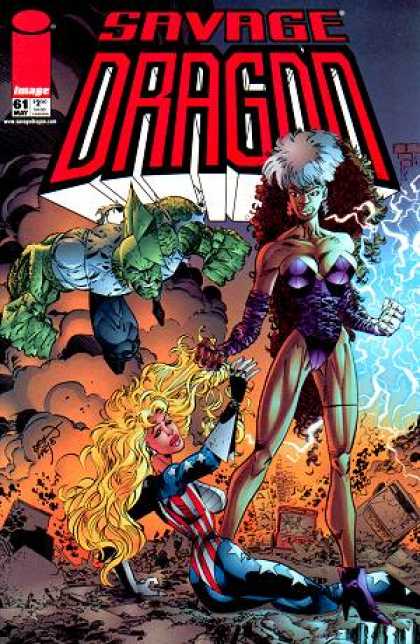
Continuity Notes: Powerhouse is an Erik Larsen creation who first appeared (without a name) in Spider-Man #15. She’s a prototype for the Savage Dragon character Rapture. Larsen also drew an alternate cover for this issue, which was used as the basis for the cover to Savage Dragon #61.

Miscellaneous Note: The final splash page of an evil, possessed Wolverine directly mimics the ending of Savage Dragon #14.

Review: I wasn’t too eager to continue buying Wolverine at this point, but I was a Savage Dragon fan at the time, so I was willing to give Larsen a chance. He lost me before this arc finished. In retrospect, this storyline actually isn’t so bad, but at the time I had a hard time getting past Matsuda’s art, and found a lot of the dialogue irredeemably bad. When online fans made similar complaints, I recall Larsen admitting that Lenil Francis Yu would’ve been a better choice as artist, and he revealed that editorial had rewritten more than a few pages of the story. While Yu does eventually return, the editorial rewrites never stop. Reading Larsen’s issue-by-issue catalog of rewrites online (for Wolverine and Nova) was surreal. I was used to freelancers complaining about rewrites after they left a book, but not during their run.

Larsen did a lot of press before his run began, so even though his stint on the book wasn’t very long, we have a clear idea of how he interpreted the character and what he wanted to do with the title. Larsen’s complaint, even though he admitted he wasn’t a regular reader of the book, was that Wolverine spent too much time fighting ninjas, guys in trenchcoats, and Sabretooth. He wanted to see Wolverine face off against Blastaar or Annihilus. That didn’t seem to represent the sentiment of most fans, who wanted the books to be even more “realistic,” but I think it’s a legitimate way to go. At least it’s not another recycling of the original Claremont/Miller miniseries. Obviously, it’s all in the execution, but I don’t think there’s anything inherently wrong with pitting Wolverine against Avengers and Fantastic Four villains. It probably would’ve been best to mix them in with some of the established villains instead of wildly going off in a new direction, though, given the amount of sheer hate these opening issues generated.

The new art and direction for Wolverine, coupled with the frosty responses to the “Hunt for Xavier” and “Magneto War” crossovers, contributed to a strong backlash against the X-titles in 1998/1999. I don’t know if too many of the vocal haters actually stopped buying the books, but the overall sentiment of fans online was intensely negative. Regardless, this isn’t a bad start for the run. My major complaint at this point is Matsuda’s artwork, which is already looking rushed and inconsistent.

Friday, September 30, 2011

X-MAN #48 & #49, February-March 1999


The Blood of the Righteous

Credits: Mark Bernardo (writer), Luke Ross (penciler), Bud LaRosa (inker), Mike Thomas (colors), Comicraft (letters)

Mark Bernardo returns for another fill-in, and he’s brought along one more obscure villain from the ‘80s. This time it’s the Crusader, a villain who’s only claim to fame is offending Pat Robertson, who happened to come across his debut in Thor. While the art is an improvement over Luke Ross’ ‘90s Spider-Man work, the story is a great disappointment when compared to Bernardo’s previous fill-in. The Crusader wants to kill the famous faith healer X-Man, X-Man meets a suicidal aspiring singer, and of course the two threads meet at the end. After X-Man saves her life during the battle, the singer’s inspired not to kill herself (< cheap shot > reading all of these X-Man comics has the opposite effect on me < /cheap shot >). The Crusader realizes the error of his ways and returns to his monastery after X-Man’s telekinetic hand wave destroys his mystic armor. The end. Twenty-three pages filled.


Skyfall

Credits: Terry Kavanagh (writer), Luke Ross (penciler), Bud LaRosa (inker), Mike Thomas (colors), Comicraft (letters)

It looks like Kavanagh has an issue to waste before next month’s Generation X crossover, so we’re treated to another flagrant time-killing one-off. X-Man discovers an alien craft crashing onto Earth, and wouldn’t you know it, the alien that emerges is a beautiful female he instantly falls in love with. Her name is Sylph, which in a massive coincidence is also an English word that means “slight and graceful female” or “an elemental soulless female being imagined to inhabit the air.” He protects her from her fellow aliens, which don ant-shaped bionic armor while hunting her for some reason.

After a brief fight scene, X-Man discovers that Sylph is a wanted criminal in her world. Specifically, she’s a doctor who killed thousands of her patients while experimenting on them. Her defense is that she was trying to stop a plague and her patients were dying anyway. X-Man claims that he doesn’t care about her rationalizations and won’t stand in the way of justice. Yet, in the very next panel, he declares that he won’t abandon her either. I have no idea what’s supposed to be happening in the next scene, but apparently he’s…going with her to join her punishment in the slave camps? Wha…? Luckily for all of us, his first glimpse of the camps shocks him so much he inadvertently lets go of Sylph’s hand, which causes him to instantly teleport back to Earth. (All of those events occur off-panel, by the way. X-Man has to explain what happened during his one-panel disappearance in a lengthy monologue.)

So, what did we learn today? The only woman X-Man finds more attractive than his mother is a genocidal maniac, and Terry Kavanagh is becoming progressively unglued. Seriously, was anyone at Marvel paying attention to this book by 1999? How on Earth did this thing get published?

Related Posts Plugin for WordPress, Blogger...