Of Mists and Mirrors: Media Blizzard Part One
Credits:
Dan Jurgens (story/pencils), Klaus Janson (inks), Gregory Wright
w/Malibu’s Hues (colors), Richard Starkings & Comicraft (letters)
The Plot:
Dr. Ramirez tells Spider-Man that his D.I.T.-Chip is being used by the
new Mysteryvision TV network to entrance viewers with 3D images taken
directly from their minds. Spider-Man visits the network’s
headquarters, where he meets founder Randolph Hines. Hines tricks
Spider-Man into putting on a pair of 3D goggles, which project his
darkest fears into reality. Hines, who reveals himself as Mysterio,
then sends his Christmas-themed monsters to terrorize the city. When
Spider-Man tries to stop them, he discovers his webshooters have frozen
shut.
The Subplots:
Ben meets photography student Jessica at the Daily Grind. He later
recognizes her as the girl who took photos of him a few nights earlier
when he re-emerged as Spider-Man.
*See __________ For Details: “Media Blizzard” is continued in Amazing Spider-Man #408.
Forever Young:
Ben tells Jessica he was interested in photography back in his high
school and college days…“a looong time ago!” When Jessica later gives
him a tour of Centennial University, he remarks that it’s been years
since he felt like a student.
I Love the ‘90s: Spider-Man wonders if Jonah Jameson will one day target Mother Teresa.
Gimmicks: This issue features a fifth-ink cover, but keeps the standard cover price.
Review:
“Media Blizzard” was intended to be Mysterio’s grand return to the
titles, complete with a revamped costume and new 3D hologram gimmick.
Neither of these stuck, but I honestly like Mysterio’s new look, and
think making his illusions holograms isn’t necessarily a bad idea,
either. (I imagine if Mysterio ever makes into one of the films, that’s
the angle that will be taken.) The main failing of “Media Blizzard” is
that it comes across as a fairly pedestrian Spider-Man story, yet it
was stretched over the entire line for a month, simply because Marvel
wanted to keep the books in a permanent crossover. It’s hard to make
illusions seem like a viable threat in the first place, and using them
as the basis of a mini-event is an even harder sell.
The
personal life subplots aren’t quite so dull, thankfully. I think that
the eventual revelation that Jessica is the daughter of Uncle Ben’s
killer is a stretch even by comic book standards, but Jurgens does an
admirable job of fleshing her out as a supporting cast member this
issue. His Ben Reilly is also a likeable enough protagonist, clearly
inspired by the classic Lee/Romita stories. I can see why people have
labeled Jurgens one of the best Ben writers, even if he apparently
wanted to ditch the character immediately.
Wednesday, January 9, 2013
Monday, January 7, 2013
SENSATIONAL SPIDER-MAN #0 - January 1996
The Ultimate Commitment
Credits: Dan Jurgens (story/pencils), Klaus Janson (inks), Gregory Wright (colors), Richard Starkings and Comicraft (letters)
The Plot: Ben Reilly starts his life over in New York, deciding to reclaim the mantle of Spider-Man. He uses chemicals from the drug store to create a crude web fluid, then takes leftover fragment scraps from Centennial University’s fashion department to sew a new costume. Nearby, Armada steals the Digital Imagery Transmission Chip from its creator, Professor Ramirez. Spider-Man defeats Armada and saves Ramirez’s life, but is unable to stop one of Armada’s orbs from carrying the chip away. The orb takes the chip to Mysterio.
The Subplots: Ben runs into Anna Watson at Aunt May and Uncle Ben’s gravesite. Her reaction to his scruffy appearance inspires him to change his look. Later, inside CU’s fashion department, he cuts his hair and dyes it blond. While readjusting to life in New York, Ben meets The Daily Grind's owner and her son, and fashion student Desiree Winthrop. Ben’s offered a job at The Daily Grind by the owner (whose name we later discover is Shirley Washington). As he webslings in his new costume, mystery characters Wendall and Jessica notice him. Jessica has an unspecified grudge against Spider-Man that will be revealed in future issues.
Web of Continuity: Mysterio’s new, fishbowl-less look debuts this issue. And, clearly, we’re still knee-deep in the Clone Saga.
*See _________ For Details: The story of Peter and MJ’s quiet, “retired” life is explored in the Spider-Man: The Final Adventure miniseries.
Forever Young: Ben reflects on how long it’s been since he designed his original costume in his high school days.
Gimmicks: This issue is double-sized, on glossy paper, with a cardstock cover and a 3D "holocard". The cover price is $4.95. You could also argue that simply being a #0 issue is a gimmick.
Creative Differences: As Glenn Greenberg reveals in the Life of Reilly, Ben’s blond hair was the brainchild of new group editor Bob Budinasky, and wasn’t particularly popular amongst anyone who actually worked on the books. The gimmick cover of this issue was also considered something of a dud amongst the spider-office, I believe.
Review: Sensational Spider-Man was really Web of Spider-Man with a new name and higher production values, so I guess I’ll continue to review it under the same rules I established for Web. The first year of this book is quite a mess, perhaps even messier than Web’s early issues, with Dan Jurgens leaving by issue number six, and the entire clone storyline being retconned a few issues later. The marketing hook for this title, aside from a new number zero and number one (and shiny paper), was Dan Jurgens. Jurgens was considered the main creator on the Superman titles at the time, and his addition to the Spider-Man titles made him one of the few freelancers to have worked on both Superman and Spider-Man, and the only creator to work on both franchises simultaneously.
I’m not saying this to diminish Dan Jurgens’ work at all, but I’ve never quite understood why Marvel felt this was such a powerful marketing hook. The Superman titles were decent sellers at the time, but I’m certain that even the controversial Clone Saga Spider-Man books were outselling them. And if we’re talking Wizard approved hot artists, I’m not sure where Jurgens ranked on that list. He’s one of the better mainstream superhero artists of this era, yes, but he has a very traditional, restrained style. His work is barely flashy by early ‘80s standards; by late 1995 this style was practically quaint. Again, I personally like it, and I’m sure 90% of Marvel’s output at the time would’ve benefited by having Jurgens replace Deodato Studios or Generic Fake Manga Artist, but is he really what Marvel’s target audience wanted? Is Dan Jurgens that much more of a draw than Ron Frenz…or even Alex Saviuk, who was stuck drawing adaptations of the Spider-Man cartoon at the time?
As for Jurgens’ writing -- I suppose his major claim to fame is killing off Superman, right? Not exactly the best resumé item when you’re stepping on to a franchise that’s already steeped in controversy. I remember people speculating that Jurgens was being brought in to place the “hit” on Peter Parker – an inane theory, yes, but the core audience was already infuriated by this storyline. They didn’t want someone to bring more stunts into the comic. Personally, I've never had strong feelings toward Jurgens’ writing work. This issue exhibits his ability to tightly plot a one-issue introductory story, but the dialogue is occasionally corny and I don’t think anyone is going to consider Armada a classic villain. His gimmick, aside from having little gizmos that fly around him, is that he has an emotional attachment to his doodads, and even gives them female names. I can easily see a writer today deceiving himself into thinking he’s edgy by making this a sexual fascination, but it’s played here as just a quirk. And as a defining character trait, that’s barely anything to go on. He has about as much depth as any of the villains that attempted to steal Hostess Fruit Pies back in the ‘70s.
So, the story’s on the level of Tom DeFalco’s work from this era. There are no noticeable holes to pick in the plot, but there's very little to draw the reader in. The art is helped a bit by Janson’s inks, but like I said before, this is competent but not quite extraordinary work. This is a five-dollar comic meant to launch a new era of the franchise (the “Spider-Renaissance” as it’s called in the hype page) …I don’t think it did the job.
Saturday, January 5, 2013
Lost Liefeld?
Thought this might be of interest to everyone. Rob Liefeld is posting pages from a Howard Mackie penned inventory issue that was going to run in either X-Factor or New Mutants in 1989, before his regular run on New Mutants began. He'll post more in the coming days.
http://robliefeldcreations.com/?p=3013
Friday, January 4, 2013
THE BOOK OF FATE #12 - January 1998

One Man’s Fate
Credits: Keith Giffen (plot and pencils), Alan Grant (script), Bill Reinhold (inker), Gaspar (letterer), Mike Danza (colorist)
Summary: While exiled from Earth, Fate and Lobo go barhopping. Meanwhile, Dr. Occult threatens Sentinel not to pursue his lawsuit against Fate, Amethyst cancels her plans for Fate, and Chaos and Order decide Fate has kept the balance between them too well. Lobo takes Fate back to Earth to drink at a bar for forgotten heroes. After Lobo passes out, Fate’s forcibly thrown outside. He wanders the alley, wondering if the universe has turned its back on him.
Irrelevant Continuity: Fate has apparently lost his powers by the end of the story, presumably after Chaos and Order choose to ignore him.
Review: Four issues after the letter column promised that Lobo wouldn’t be appearing in this title, Lobo appears in this title. I don’t think Lobo was considered that much of a sales draw by late 1997, so presumably he’s here because Giffen feels like using him again. This is largely a joke issue, mocking the public’s refusal to accept Fate as a protagonist, so theoretically Lobo wouldn’t be out of place for at least this story. It turns out that neither Giffen nor Grant has too many great jokes in mind for the character, unfortunately, so he spends the issue reciting his old punch lines and making a few references to his powerful farts. Some of the meta-humor does work, though. Amethyst outright declares her plans for Fate “cancelled” due to the universe’s lack of interest in him. Chaos and Order decide that he hasn’t tilted the balance one way or the other, making him such a dull protector of the balance he isn’t worth noticing. And Guy Gardner’s bar for cancelled DC heroes, all of whom can’t stand Fate, is amusing.
So, as it turns out, it’s okay to hate Fate. This version, at least. Good. What a waste of Ron Wagner and Bill Reinhold, though.
Wednesday, January 2, 2013
THE BOOK OF FATE #11 - December 1997

The Perception of Doors
Credits: Keith Giffen (plot), Alan Grant (script), Matt Smith (penciler), Steve Mitchell (inker), Gaspar (letterer), Mike Danza (colorist)
Summary: To escape his prison cell, Fate concentrates on where he’s “supposed to be.” He suddenly appears in a strange room with Amethyst and two of her followers. She tells him that his “time will come” shortly before he materializes in Arnold’s bathroom. Vera reluctantly volunteers to help him go into hiding, but Fate walks off. He’s soon greeted by Sentinel, who offers to send Fate into Exile until the mystic community clears him. In Exile, Fate meets Lobo.
We Get Letters: The editors admit in the letter column that the “Convergence” crossover was confusing and didn’t have a clear reason to exist. They seem especially proud of a crossover they edited called “Final Night,” though.
I Love the ‘90s: Vera says that Jared’s face is “better known that Princess Di’s.”
Miscellaneous Note: The title of the issue is likely a reference to a novel by Aldous Huxley called The Doors of Perception.
Review: With one issue left to go, an entire issue is squandered on merely getting Fate from Point A to Point B, intercut with a few vague, futile conversations. Knowing that the Jared Stevens Fate is one issue away from disappearing into obscurity, it’s hard for me to care about Dr. Occult lecturing Vera on the importance of Jared learning to teleport on his own, a conversation that lasts several pages. (What was the point of bringing Vera into the book in the first place? I was never entirely certain on what her brother’s role was supposed to be, so seeing him replaced towards the end of the book’s run with his nerdy sister is even more vexing.) And there’s Amethyst’s evil plot, which I doubt is going to be thwarted in the next twenty-two pages. (If anyone did bother to bring Amethyst back into the DC continuity of this era, I suspect it was to undo these changes and make her a heroine again anyway.) Finally, Sentinel appears to set up the inevitable Lobo guest shot. This may tie in with the ongoing subplot that has Sentinel suing Jared for his mystic artifacts, but it’s not as if that storyline brought a lot of excitement to the series in the first place.
One more issue…
Monday, December 31, 2012
THE BOOK OF FATE #10 - November 1997

The Final Gathering
Credits: Keith Giffen (plot & pencils), Alan Grant (script), Bill Reinhold (inker), Gaspar (letterer), Mike Danza (colorist)
Summary: War’s human avatar enters the bathroom, shortly after Fate uses his daggers to unlock his chains. War reveals the Four Horsemen’s plan to destroy the world, confident that Fate can’t stop them. When the four “philanthropists” appear onstage, a disguised Fate uses his daggers to kill three of them. War stops time and engages Fate in battle. After Fate kills him, time returns to normal, leaving Fate at the mercy of the security guards.
I Love the ‘90s: The heightened security at the event is compared to the last time “Clinton had a haircut,” which might be a reference to Bill Clinton’s famous haircut on an airport runway. Later, Fate says his disguise makes him feel like “Michael Jackson on a particularly bad day.” I think this is a reference to the heavy makeup he’s wearing to cover his face tattoo.
We Get Letters: The editors continue to defend Fate’s retconned origin with the dubious claim that it’s allowed this series to be friendlier to new readers.
Review: So the Four Horsemen arc has developed for four months now, and it ends with the hero assassinating the villains in their civilian identities while from a safe distance. Yes, that’s an anti-climax, but it’s perfectly in-character for Jared Stevens, and Giffen still gives himself room for a few sick visuals. I’m not a huge fan of Giffen’s art from this era, but he undeniably draws incredible demons, so the Fate vs. War fight is pretty entertaining. (I still would’ve preferred Ron Wagner’s version, though.) Some of the setup for the story, particularly War and Famine’s dinner date preceding the conference, is also executed quite well. If Giffen could’ve kept the Four Horsemen as interesting throughout the entire arc, or perhaps shortened this storyline by an issue, the book could have picked up a decent momentum by this point.
Friday, December 28, 2012
THE BOOK OF FATE #9 - October 1997

Swiss Cheese
Credits: Keith Giffen (plot and pencils), Alan Grant (script), Bill Reinhold (inker), Gaspar (letterer), Mike Danza (colorist)
Summary: The avatars of the Four Horsemen appear at a conference in Switzerland, as Dr. Occult meets with Fate and Vera. Fate dismisses his advice, but later submits to Vera’s request to do more research on the Horsemen. He steps away to go to the bathroom, and discovers that he’s now in the bathroom of a Swiss hotel. He’s soon captured by the authorities and taken to another bathroom. He opens the door and is teleported yet again.
Production Note: Ron Wagner was apparently misidentified as the penciler in the original credits. Alan Grant is also credited as only "Grant," leading me to wonder if the editor forgot that Steven Grant was also doing work for DC at the time.
Review: This issue -- exciting bathroom teleportation! It’s another issue of Fate derisively dismissing any help that’s offered him on supernatural affairs, only to find himself in over his head in a mystical adventure. I’ve noticed that the letters page is running more and more letters from readers annoyed by the lead character, and the editorial response is always along the lines of “Jared never believed in magic before, so it’s going to take some time for him to figure this stuff out!” Nine issues in and this has already gotten extremely old. He doesn’t come across as a rational skeptic, just an obnoxious man-child that rarely has any sarcastic or cynical observations that are actually funny.
Even if the main character is a disappointment, the book could still be saved with some imaginative storylines. Instead, we’ve gotten three issues in a row of the Four Horsemen making vague plans to do…something. To Giffen’s credit, the avatars he’s created for the Horsemen are potentially interesting (a Senator who crusades for peace, a Mother Teresa analogue, a billionaire philanthropist, and a mystery man on a cell phone), but all of their scenes have been fairly redundant so far. The saving grace for this title is usually the art, but Ron Wagner is absent this month. (Looking at comics.org, apparently the previous issue was his last.) The art’s taken an abrupt swerve into ‘90s Giffen territory (almost Trencher-esque, but not as abrasive), and it’s not nearly as attractive as the earlier issues.
Wednesday, December 26, 2012
THE BOOK OF FATE #8 - September 1997

Better Off Dead
Credits: Keith Giffen (writer), Ron Wagner (penciler), Bill Reinhold (inker), Gaspar (letterer), Mike Danza (colorist)
Summary: Vera snaps out of her spell as a process server knocks on the door. He assures Vera that Jared isn’t dead and revives him. He then hands him a summons for Sentinel’s lawsuit and leaves. Later, Dr. Occult greets Jared in an alley, giving him his card and inviting him to talk. Inside the Conclave Monolith, a mystery woman is informed of Dr. Occult’s actions. Meanwhile, personifications of the Apocalypse continue to appear, killing innocent people.
We Get Letters: Every letter printed in the letters page is negative this issue. Most of them are from established readers that are upset that the new Fate’s continuity makes no sense (as opposed to the entire storylines that make no sense). The editors respond that giving Fate a new origin was necessary in order to sell the importance of the “final” Order vs. Chaos war (which honestly makes no sense to me). They also assure the fans that DC would never change Alan Scott’s origin…“He is, after all, the original Green Lantern!”
Review: Giffen advances the main storyline incrementally, as Fate’s death in the previous issue is dismissed quickly so that the focus can return to the Apocalypse characters and Sentinel’s lawsuit. And Dr. Occult appears, which may or not mean something to someone familiar with obscure DC continuity. This is followed by another vague scene, which has an unnamed blonde woman from the Conclave question if Dr. Occult is planning to train Fate in the mystic arts. Maybe this shouldn’t bother me, but it’s annoying to see character after character appear with no explanation. I have no idea if I’m supposed to know who they are, or if they’re intentional mysteries. If Mystery Blonde Lady is an established character, would it kill Giffen to have one of her female servants identify her by name?
I’ll give Giffen the benefit of the doubt and assume that the Apocalypse subplot pages are intentional mysteries, but even these scenes are a drag on the book. Almost a third of the issue is consumed with pages of possessed women turning people into dried out corpses. There’s no discernible advancement of the plot, and the scenes feel needlessly padded. Bring back the rats, please.
Monday, December 24, 2012
THE BOOK OF FATE #7 - August 1997

Signs
Credits: Keith Giffen (writer), Ron Wagner (penciler), Bill Reinhold (inker), Gaspar (letterer), Mike Danza (colorist)
Summary: Jared finds himself pursued by rats. He escapes by tricking them into falling several stories off a building. With Arnold away, Jared turns to his sister Vera for help explaining the phenomenon. She appears to be Jared’s ally, until she receives a mysterious phone call. Vera then pulls out a gun and shoots Jared in the back. Meanwhile, the other personifications of the Apocalypse discuss Pestilence’s actions, and Sentinel testifies to the Conclave that Jared has mystical possessions that are rightfully his.
I Love the ‘90s: Jared is uncomfortable using the internet. Vera tells him to just “point and click.”

Review: This is absurd and entertaining, as opposed to most of this series’ run, which has been absurd and irritatingly confusing. Using an army of literal rats as the manifestation of Pestilence is probably the cleverest use of the concept I’ve seen in comics, and of course Ron Wagner easily does the concept justice. That cover alone is enough reason to love Ron Wagner. How many books on the stands in August 1997 could grab your attention like this? Regarding the story, Giffen is setting up a handful of new storylines, and bringing back the Senator character from the previous arc. Now we know he’s some personification of the Apocalypse, information that for some reason couldn’t be conveyed during the previous month’s utterly pointless crossover. Oh, and Sentinel has turned against Fate, which according to the letters page, is apparently a tie-in with whatever books Alan Scott was appearing in at the time. I don’t have a lot of faith that any of this will have a coherent conclusion, but hopefully I can get something out of the story while enjoying the pretty pictures.
Friday, December 21, 2012
X-MEN: CHILDREN OF THE ATOM #3 - June 2000

Children of a Lesser God
Credits: Joe Casey (writer), Steve Rude (penciler), Andrew Pepoy (inker), Paul Mounts (colors), Jim Novak (letters)
Summary: William Metzger appears on television, waving a copy of a celebrity magazine, asking which stars could be mutants. Warren Worthington, who’s still acting as a vigilante, is shocked to see his face on the cover. Later, Magneto attempts to recruit him, but Warren refuses. Meanwhile, Fred Duncan informs Professor Xavier that Jack Winters is a known felon. Xavier follows Winters and Scott Summers to the nuclear plant Winters is robbing. When Scott refuses to use his powers on a guard, Winters violently beats him. Scott finally strikes back, but spares Winters’ life. Xavier offers Scott a new home.
I Love the '90s: A news report details a charge by the White House that a certain intern had “alluring” mutant powers. A silhouette of Monica Lewinksy is superimposed over the White House.
Review: Yes, this looks pretty. And as a modern reimagining of some old back-up stories, it’s decent enough, but the series still feels largely pointless, and it’s reached the halfway point by now. The issue opens with even more scenes of young Iceman being really cold, the generically evil William Metzger is still recruiting teenagers, a scene reminds us that Fred Duncan is talking to an invisible “Bill,” Angel is still a local vigilante, and numerous TV news montages remind us yet again that people are really afraid of mutants. If Casey were desperate to fill pages, you’d think he would at least find a way to check in on Hank and Jean. I do honestly like the idea of young Bobby Drake practically freezing to death, and Angel’s vigilante scene in this issue is great, but I feel as if we’re covering the same ground repeatedly, all for a story with a predestined ending. The numerous shipping delays during the book’s original run surely didn’t help the series’ pacing, either.
Wednesday, December 19, 2012
CABLE #74 - December 1999

Mind Games
Credits: Joe Pruett (writer), Bernard Chang (penciler), Jon Holdredge (inker), Gloria Vasquez (colors), Comicraft’s Saida Temofonte (letters)
Summary: Caliban attacks the team, injuring Proudstar. He abruptly leaves, following the call of Apocalypse’s new Horseman of War, Deathbird. X-Force follows, only to be ambushed by Caliban’s new psionic pestilence powers. Cable enters the Astral Plane to rescue the team, not realizing that this was a trap designed to steal Cable’s physical body while his consciousness was distracted. Cable later awakens in Apocalypse’s custody. Meanwhile, Stacey and Irene reflect on Cable’s impact on their lives.
Continuity Notes: Apocalypse has given Caliban pestilence powers that somehow don’t work physically, but instead attack the mind. For unexplained reasons, Moonstar, Domino, Meltdown, and Jesse Bedlam aren’t affected by his powers.
Review: This is Joe Pruett’s strongest issue so far, and perhaps not coincidentally, it’s also another non-Liefeld issue (the second in four issues). Pruett’s awkward prose is paired back dramatically this time, and he actually manages to write adequate exchanges between the cast. It’s not perfect, of course, as he clumsily hammers home the idea that this is a “new” compassionate Cable, but this is much easier to read than his previous issues. Pruett, or perhaps someone in editorial, has seen fit to outright state that this warmer, fuzzier Cable will be rejoining X-Force in order to look after his former charges, which is likely a hint that no one working on the books had any idea what “Counter-X” was going to be at this point.
And while it’s easy to mock Liefeld for missing half of the issues of his run so far, at least we got Bernard Chang as a fill-in. Some of his facial expressions are still bizarre, but for the most part, he’s able to do a great action issue in that “chunky” post-manga style that was emerging during this time. His scenes in the Astral Plane, which cast the action as a montage within a film strip, are particularly nice.
Monday, December 17, 2012
GENERATION X #59 - January 2000

Artie and Leech’s Day Off!
Credits: Jay Faerber (writer), Terry Dodson (penciler), Rachel Dodson (inker), Kevin Tinsley (colors), Comicraft (letters)
Summary: Artie and Leech sneak out while Gen X visits a museum in New York. The team searches for the duo, as Artie and Leech aid Spider-Man against Sandman. Emma pairs with Tom Corsi, who explains his reluctance to join the school considering his past with Emma. Chamber futilely tries to talk to Husk about her new attitude, while Skin and Synch run into She-Hulk and ask for an autograph. Finally, Artie and Leech are caught by the Avengers after impersonating Thor and Captain America. When the team arrives to pick them up, Emma makes peace with Firestar.
Continuity Notes:
· Banshee and Jubilee aren’t with the team, because they’ve traveled to the X-mansion following the “death” of Wolverine. The footnote points to Uncanny X-Men #375.
· Tom Corsi reminds Emma of the time she had Empath force him and Sharon Friedlander to, well, mate like animals in New Mutants #39. Later, Emma has to apologize again for manipulating Firestar in the past, and sending the Hellions to retrieve her in an early New Warriors story.
I Love the '90s: Artie and Leech impersonate two of the Backstreet Boys (the blonde one and the “bad boy”…I’m not going to look up their names), and cause a riot.
Approved By The Comics Code Authority: Chamber uses “wanker” again, this time to describe Artie and Leech.
Review: I think the only two X-titles not directly involved with some aspect of the big Apocalypse crossover are Generation X and X-Force. And while X-Force is embroiled in John Francis Moore’s extensive Deviants storyline, Generation X isn’t caught up in anything so dramatic. Even the major storylines at the time, Emma’s sister becoming the new White Queen and the acceptance of humans into the school, aren’t so important that they must be addressed in every issue. So, they kill an issue in New York, and it makes for a decent story, although it clearly looks diminutive when compared to the rest of the line.
Mixed in with the comedic scenes and character moments, Faerber’s used the opportunity to address some continuity issues surrounding Emma’s role as a hero. It’s clear the character was not created with the goal of one day being reformed, so her blatantly evil actions from the past must be addressed. And Faerber handles the past continuity well, allowing Emma to say the only thing she can say -- “sorry.” This could come across as lazy or insincere, but the scenes do feel genuine and Faerber is able to make Emma as sympathetic as she’s been since this book was launched.
While it’s easy to dismiss this issue as filler, maybe there is a lasting significance to the story. Is this the first time Terry Dodson was asked to draw Marvel heroes outside of the X-universe? Faerber’s given him quite a list of heroes to handle throughout the story, and to be honest, the results are mixed. The cover is a good example…some of these characters look amazing, others just look wrong. In fairness to Dodson, he was still new to any of the “mainstream” Marvel figures, and it’s obvious he got a lot better as the years went on.
Friday, December 14, 2012
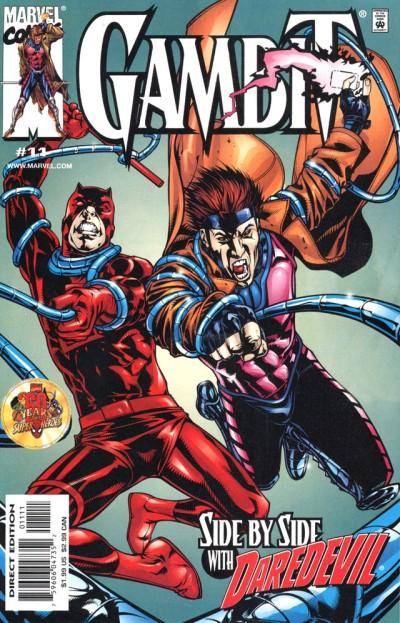
GAMBIT #11 - December 1999

The Hamster Run
Credits: Fabian Nicieza & Steve Skroce (story & art), Andy Owens (inker), Shannon Blanchard (colors), Comicraft’s Troy Peteri (letters)
Summary: Gambit and Daredevil pursue Constrictor, who’s stolen a synthetic organ from a hospital. Gambit needs Constrictor’s adamantium so that New Son can save Sabretooth, while Constrictor and Daredevil are fighting over the organ. Constrictor stole the organ for mob boss Salvatore Donato, who’s holding Constrictor’s childhood girlfriend, and Donato’s daughter, hostage. Daredevil wants the organ for Judge Harris Beuchler, who was next on the transfer list. After Constrictor is chased to the mobster’s home, Daredevil learns that Beuchler bought his way up the list ahead of Donato. Gambit devises a mutual solution: Constrictor gives Gambit his adamantium coils, the judge gets the organ, and Gambit uses his powers to dissolve the shards of glass that damaged Donato’s stomach when he was poisoned in prison.
Continuity Note:
· Fontanelle scrapes the memories of Mr. Sinister, witnessing him reading a story about the “Black Womb Killer” in 1891.
· Sabretooth is near-death following the removal of his adamantium. New Son claims he can save Sabretooth if he has more. I don’t know if we were ever told where exactly this adamantium was implanted in his body, but the idea of him having an adamantium skeleton was dropped after this story.
Miscellaneous Note: The Statement of Ownership has average sales for the year at 96,359 with the most recent issue selling 64,240 copies.
Review: This issue barely ties into the ongoing New Son plot, and obviously isn’t very Gambit-centric, but it’s still strong. Daredevil the true star of the story, as he risks his life to retrieve an organ one of his mentors needs to survive, only to discover that the judge subverted the law to extend his life. In order for this to work, though, you have to assume that a convicted mobster would receive higher priority than a respected judge in the first place, which might be a stretch. (I don’t know if past criminal convictions are considered in any way when making the organ transplant list, but I wonder if a judge would have to resort to outright bribery in order to rank higher than a mobster). Regardless, the premise isn’t so implausible that it ruins the story.
Nicieza’s done a great job creating a series of conflicting motivations and unexpected twists. As the story points out on the final page, Constrictor is actually the character with the noblest actions, since he fought to save the only true innocent in the conflict. Gambit doesn’t even want to save Sabretooth, and Daredevil’s hero turns out not to be so righteous (although, I can’t really blame him for wanting to outlive a convicted drug dealer and racketeer). The sarcastic third-person narrative captions also add a lot of life to the story, particularly the running series of jokes about Constrictor’s face and all of the horrible things that are happening to it. This easily could’ve been time-killer, but instead it’s one of the better standalone stories from the era.
Wednesday, December 12, 2012
CABLE #73 - November 1999

Pestilence!
Credits: Joe Pruett & Rob Liefeld (story & art), Lary Stucker w/Dan Fraga (inks), Optic Studio (colors), Comicraft (letters)
Summary: Caliban emerges from a cocoon in San Francisco and immediately follows Cable’s trail. While hunting Cable, Caliban befriends a young boy who isn’t afraid of mutants. Unfortunately, Caliban is chased off by his father and the boy is hit by a truck when he follows Caliban. A crowd forms and threatens Caliban, reviving his bloodlust. Meanwhile, Cable meets with X-Force, giving them information on all of his safehouses in case he doesn’t survive his fight with Apocalypse. Suddenly, Caliban, now calling himself Pestilence, crashes into X-Force’s headquarters.
Continuity Notes:
• Siryn’s appearance on the cover is a mistake, as she isn’t a member of the team at this point. She isn’t in the story, but the presence of Domino and Sunspot together makes it hard to pinpoint where this issue could fit in X-Force continuity.
• Blaquesmith and Ozymandias have formed an alliance against Apocalypse. Ozymandias asks Blaquesmith if his pupil, presumably Cable, is “ready.” Ozymandias’ connection to Caliban’s disappearance in X-Force #70 isn’t mentioned.
Review: So, now that Joe Pruett and Rob Liefeld are being credited as “storytellers,” does that mean Liefeld actually did co-plot these stories? I was always under the impression that Liefeld took this simply as an art assignment because he missed drawing the character (and his publishing company had folded.) I do distinctly remember Joe Pruett denying that he was involved with plotting issue #75 at all, and Liefeld claiming the plot didn’t come from him, leading to the theory that one of Marvel’s editors mapped out the story uncredited. Was that the only issue plotted by editors? Regardless, we’re getting deep into crossover territory, which means if Joe Pruett ever did have a clear vision for this book, it’s going to be buried anyway.
I don’t want to keep harping on Pruett, but his work on the X-books so far has placed him in sub-Kavanagh territory. There is a bright spot this issue, as Cable learns of Siryn’s injury in X-Force #90 and laments ever recruiting Feral into the team, but that’s essentially it. The rest of the issue is just cardboard. Almost every page is overloaded with supposedly deep text that’s so clumsily written you almost feel sorry for the poor letterer who has to type it out. “A famous writer once asserted that ‘you can never go home.’ As Cable sits among his former students…enjoying the closeness and warmth that only comes from the cohesive bond that is a family…he thinks of this literary line and is glad it is the exception and not the rule.” And that’s just one of the clunkers. Pruett’s prose is just a chore to read, and it chokes almost every page of the book. (This is assuming that Pruett and not an editor wrote these lines, of course.)
But, hey, Rob Liefeld’s back after that exhaustive stint of one issue, so that counts for something, right? Most of the issue is a conversation scene, which displays Liefeld’s talent for never drawing backgrounds, or believable facial expressions. Sometimes X-Force has a floor, but usually their couch just manages to float four feet off the ground. Liefeld’s been in the industry for over ten years at this point, and he still can’t draw a credible conversation scene to save his life, or figure out little things like “How does furniture touch the floor?” or “How do normal human beings bend their knees and sit down?” He’s also forgotten, again, which of Cable’s eyes is the mechanical one. I bet the creator of Cable was just furious to see someone get a basic detail like that wrong…
Monday, December 10, 2012
MUTANT X #15 - December 1999

The Ripple Effect
Credits: Howard Mackie (writer), Cary Nord (penciler), Andrew Pepoy (inker), Gina Going (colors), Chris Eliopoulos (letters)
Summary: After the Friends of Humanity nuke the X-Men’s mansion, President pro tem Graydon Creed declares amnesty for Nick Fury and SHIELD. Now promoted to General, Fury invades the Six’s home, allegedly to “protect” them from terrorists. The Six, joined by Cerebro, escape to Forge’s mountain headquarters where they meet the pro-mutant resistance: Captain America, Sebastian Shaw, Katherine Pryde, and Sunfire. Abruptly, Sunfire turns on his teammates and destroys the mountain complex. The team escapes with Captain America, while Forge’s new Cerebro design emerges as a monster from the wreckage.
“That’s Crazy Because They’re Different”: Kitty, now Katherine, Pryde has become the Hellfire Club’s Black Queen since her last appearance. Sebastian Shaw, for some reason, has yellow word balloons and is apparently wearing armor based on Ronan the Accuser’s. Nick Fury is still a remorseless anti-mutant bigot on this world.
Continuity Notes: There are a lot of vague deaths in the issue. The X-Men were killed in the nuclear attack, according to Cerebro. Sebastian Shaw, Katherine Pryde, and Forge are apparently killed when the mountain complex is destroyed, at least according to Bloodstorm. Sunfire is presumably dead, too.
“Huh?” Moments: Where to start? For some reason, two Nightcrawlers are members of the X-Men during their group shot. Graydon Creed has somehow become President in-between issues (What happened to President Starr and Vice President Kelly? Or Reed Richards becoming President in the ’99 annual?). And, most egregiously, Havok warns Brute to keep his voice down while traveling underwater in the team’s jet, because Nick Fury, who’s several yards away in another ship, might hear him. That one has got to go down in the Howard Mackie Hall of Fame.
Better Than X-Factor? : Oh, this is somehow even worse than X-Factor. What could you even say about something this bad? I guess I’m obligated to mention that Cary Nord’s art is stylish and attractive, but for some reason he draws one horrific Captain America. It’s unbelievable that an artist who’s clearly extremely talented could dog one of Marvel’s most important characters so badly. If only that were the issue’s only flaw…
This is essentially unreadable. Apparently, Mackie’s decided that the Mutant X universe needs a massive humans vs. mutants conflict, because that’s never been done, but he doesn’t know how to undo the peaceful relations he’s already established for the book. Now, he could develop this in a credible way, as he creates a series of events that begin to unravel the passive co-existence between the two races. Maybe use the series to write a thoughtful examination of just how fragile peace could be. Make the readers care as they watch old hates resurface and mutants go back into hiding. But, no, this is Mutant X. In a move that would make even a fanfic writer blush, Mackie’s decided that the entire mutant/human dynamic of this universe will be undone in just four pages.
Now, Havok and his teammates are a persecuted minority, because of course they are, and they’re on the run from the comically bigoted Nick Fury. (And don’t call him “Colonel” any more, unless you want him to literally kill you.) They run into more arbitrary recastings of established characters, which are promptly killed off by Sunfire, who’s suddenly taking orders from a mysterious “they” who want everyone dead. Things blow up, people die off-panel, and somehow Captain America becomes a team member. So, that’s the new direction, I guess. Captain America joins a persecuted group of mutants, and who cares how many continuity and logic errors had to be endured in order to get here. How did any of this get past an editor?
Friday, December 7, 2012
NEW MUTANTS #90 - June 1990

To Hunt the Hunter
Credits: Louise Simonson (writer), Rob Liefeld (penciler), Hilary Barta (inker), Glynis Oliver (colors), Joe Rosen (letters)
Summary: Sabretooth murders one of the remaining Morlocks, Samson, as Caliban returns to the sewers for vengeance. Meanwhile, Cable and the New Mutants move into the underground complex beneath the ruins of the X-Men’s mansion. After Rictor freezes during a Danger Room session, he decides to prove himself by defeating Masque and the rogue Morlocks in the nearby tunnels. He heads into the tunnels alone, and is soon assaulted by Sabretooth. His life is saved when Caliban attacks Sabretooth. At home, Cable and the New Mutants prepare to rescue Rictor.
Continuity Notes:
· The X-Men’s mansion was destroyed during the “Inferno” crossover. Sabretooth is killing any surviving Morlocks after the “Mutant Massacre” because he hates to leave a job unfinished.
· Following Cyclops’ suggestion, the team has moved into the X-Men’s old underground bunker in order to hide from Freedom Force. Cable has also ordered the team to design new costumes, which will allegedly confuse Freedom Force “at least momentarily.” The behind-the-scenes reason is simply that Rob Liefeld wants to design new costumes for the New Mutants. Cable’s metallic battle suit also debuts this issue, even though he only wears it to tour the new facilities.
· Rictor begins dropping hints about his father’s past with Cable. He denies Boom Boom’s sarcastic implication that Cable’s a “mass murderer,” but accuses him of stealing his father from him during an inner monologue on the next page. Later, when Rictor’s overwhelmed by opponents in the Danger Room, he claims that the same thing happened to his father. And, finally, Rictor mentally accuses Cable of setting him up, “just like you did my father” after he fails in the training sequence.
· Cable comments that he can’t push Rictor too hard, or else he’ll lose him, like he lost his son. We’ll learn years later that Cable “lost” his son when Stryfe brainwashed him, which doesn’t seem like something that can be averted with a positive father/son relationship.
Review: The bold new direction for New Mutants truly begins this issue, as Cable officially becomes the team’s new mentor, new costumes debut, and the cast moves to a (somewhat) new location. Already, this feels abrupt. If Cyclops were truly concerned about the government locating Cable, I would tend to think that he could hide quite comfortably inside the giant sentient alien that X-Factor uses as a skyscraper. And why is Cyclops so eager to help this stranger out anyway? If he really thinks Cable is innocent of whatever it is the government is accusing him of, shouldn’t X-Factor make an effort to clear his name? And if Cyclops doesn’t think Cable is innocent, why is he leaving him in charge of a group of teenagers? Unless there’s an issue of X-Factor that addressed these questions, it’s hard to buy the hasty shift in status quo.
Ignoring how the creators have gotten to this point, this does work fairly well as a set-up issue for the new direction. Yes, Rictor’s motivation is childish and dim-witted, but that’s pretty consistent with his characterization at this point. The team is given enough room to interact with one another, a few vague clues are dropped about their mysterious new teacher, and Cable is actually portrayed as a sympathetic mentor for the team. He’s concerned about pushing them too hard in the Danger Room, he wants to make sure they continue their studies, and even though he’s more willing than his predecessors to send the team into battle, he at least does it reluctantly. Does this sound anything like the man from the early issues of X-Force? Cable hasn’t even shot anyone in the back yet!

Unfortunately, Rob Liefeld’s art continues to deteriorate. This is an early example of Liefeld drawing squinty expressions instead of actual eyes, and he pulls the trick so often you barely see any pupils this issue. Other shortcuts include repeating the same drawing of Rictor twice during a conversation scene, and simply inserting the Official Marvel Handbook’s diagram of the mansion’s interiors during a scene that calls for the cast to describe all of the wonderful features of the complex. And the closing image of the issue is a gratuitous splash page of a tiny-headed Cable hugging, yes hugging, a giant, unrealistic gun that’s at least six feet tall. Don’t worry, X-Force, we’ll get there soon…
Wednesday, December 5, 2012
WOLVERINE AND THE PUNISHER #3 - December 1993

Damaging Evidence - Part Three
Credits: Carl Potts (writer), Gary Erskine (artist), Garrahy/Javins/Matthys (colors), Richard Starkings w/John Gaushell (letters)
Summary: After their fight, the Sniper assumes Damage and Wolverine have killed each other. Soon, Sniper stakes out the funeral of one of the people allegedly murdered by the Punisher, correctly assuming the Punisher will also be there. Sniper picks off several of the mourners before he’s stopped by the Punisher. Following Sniper’s final words, Punisher travels to the chemical plant where Damage fought Wolverine. He helps Wolverine recover and they both promise to help the other if one goes over the edge. Later, Kingpin hires Donald Pierce to rebuild Damage.
Approved By The Comics Code Authority: Wolverine refers to Damage as a “bastard.” And this is before Damage drives a giant blade through his chest. Later, several heads explode during Sniper’s killing spree at the funeral.
Monday, December 3, 2012
NEW MUTANTS #89 - May 1990

The Gift
Credits: Louise Simonson (writer), Rob Liefeld (penciler), Hilary Barta (inker), Brad Vancata (colors), Joe Rosen (letters)
Summary: Cable’s helicopter is shot down over Manhattan’s East River. Freedom Force pursues him into the city, ambushing him after he buys a trenchcoat to cover his metal arm. Nearby, Cannonball, Boom Boom, and Sunspot are buying Wolfsbane a going away present. They stumble upon Cable’s fight and aid him against Freedom Force. Cable returns home with the mutants and encounters his old friend Moira MacTaggert. Cable convinces Moira to let Wolfsbane stay and join his mission. The team unites around Cable, with the exception of Rictor, who apparently knows him.
Continuity Notes:
· What are Cable’s first thoughts when encountering the New Mutants? “I’ve seen them -- on television! X-Factor’s young mutant charges.” He doesn’t recognize Cannonball as the mutant savior he’s come from the future to train and protect, oddly enough.
· Cable’s able to use his bionic eye to sense the rapid approach of Super Sabre.
· Moira comments that Cable’s become “even more the metal man” when she sees him this issue. When the story of their first meeting is finally told in Cable #-1, Cable’s already half-metal (or half-techno-organic, however you wish to phrase it.)
· Cable tells Moira that he has to stop terrorists, presumably the MLF, from constructing a powerful bomb. I don’t believe this motivation is mentioned ever again. It could've been a metaphor, but that's not the way the scene reads.
· Rictor tells Warlock that Cable doesn’t recognize him, but “I know him all too well!” Years later, this mystery is resolved when a flashback reveals Cable’s clone, Stryfe, killed Rictor’s father before his eyes. Rictor’s reaction to Cable in these issues is rather subdued in light of this revelation.
Review: When I discovered that Moira MacTaggert was the first existing character to have a shared retconned past with Cable, I thought it was an odd choice. Well, now I get it. It was just a cheap justification to place Cable in charge of the New Mutants! And it does make a certain amount of sense; the associated authority figures that allegedly take care of the New Mutants aren’t going to let just anyone assume responsibility for the team. This (almost) works as a quickie rationale for why the kids are willing to trust him and the adults are okay with Cable looking after the team.
What isn’t explained is why a Shadow King-possessed Moira MacTaggert so easily gives up on her mission to bring Wolfsbane back to Muir Island. I can guess the sloppy retcon explanation, Cable used his immense telepathic powers to minimize the Shadow King’s influence and sway Moira over to his side (even though Cable shouldn’t be aware of his telepathy at this point), but this makes no sense within the context of the story. I’m also unclear on why exactly Cable is trying to reach X-Factor’s ship at the beginning of the story. Cable hasn’t mentioned X-Factor in his previous two appearances, but now he’s apparently relying on them to help him stop the MLF and rescue Rusty and Skids. I believe X-Factor were supposed to be Rusty and Skids’ guardians during this time, so that does make sense, but the idea isn’t clearly explained in the story. (Another Sloppy Retcon Explanation: He knows that X-Factor’s ship will one day become his computer aide and confidant, the Professor, and he’s looking for his help. Alternate Sloppy Retcon Explanation: He subconsciously knows that his biological parents live there.)
For the sake of plot convenience, Cable luckily runs into the young charges living in X-Factor’s ship while he’s fighting Freedom Force in an alley. Oddly enough, we’ll later learn that Cable came to this specific era to recruit Cannonball to his cause anyway, so it’s also mighty convenient that he happened to run into him while on a totally unrelated mission. Oh! Maybe Cable’s powerful, yet nonexistent, telepathic abilities drew Cannonball and the others to the alley!
So, yes, it’s hard to read this story without thinking of all of the insane retcons that have been shoehorned into Cable’s past. Judging the issue in its proper context, however, doesn’t help it out much. There are still dubious coincidences, vague motivations, and a shockingly abrupt shift of power to this new guy named Cable. It's true Moira vouches for him, but everyone knows she’s been acting strangely lately. And, this new guy is outright telling the New Mutants they could be killed on this mission he has for them. Yet, everyone’s eager to sign up. And while I’m willing to cut Liefeld some slack on his earlier issues, his work is getting egregiously bad at this point. The staging of the fight scenes is inconsistent from panel to panel, characters appear to spontaneously float on air, and everyone seems to strike ridiculous poses even during mundane conversation scenes. In terms of continuity, this is a monumentally important issue, but it’s easy to understand why no one ever wants to dwell on its details.
Subscribe to:
Posts (Atom)