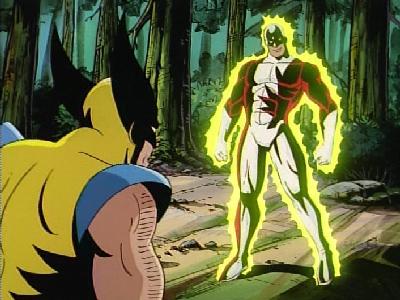
Madripoor
Credits: Louise Simonson (writer), Rob Liefeld (penciler), Hilary Barta (inker), Joe Rosen (letters), Brad Vancata (colors)
Summary:
Sunfire meets Cable and the New Mutants in Madripoor, where the
Japanese government has traced the manufacture of Sleet, a new drug that
was used to poison the water supply of a Japanese town. Cable’s
convinced that the Mutant Liberation Front is behind Sleet. With the
aid of portable Cerebro units, the mutants split up and search
Madripoor. Cannonball, Boom-Boom, Warlock, and Sunfire are soon
captured by MLF operatives. Meanwhile, Cable tracks a mutant signature
that turns out to be Wolverine. They immediately fight, much to
Sunspot’s horror.
Continuity Notes:
-
Rob Liefeld is still drawing Cable with that giant knife on covers and pin-ups, but I don’t think it’s ever used in any story.
- Cable
knew Sunfire’s father, Suburo Yashida, and apparently has a deep
respect for him. Whether or not he’s already met Sunfire is ambiguous,
but Sunfire does tell Cable it’s a shame his son met such an “untimely
fate.” This is another early reference to Cable’s son, a mystery that
flounders around for years before it’s finally decided that Tyler,
a.k.a. Mr. Tolliver, a.k.a. Genesis, is Cable’s son. (More accurately,
his adopted son from his wife’s previous relationship.) Since Tyler
exists in the future, it’s unclear how Sunfire knows about him.
-
More
of Cable’s advanced technology appears, as he rides through the sky
with Sunspot and Boom-Boom on a flying motorcycle. He still hasn’t been
identified as a time traveler at this point, however.
-
This
issue marks the first appearances of three MLF members: Dragoness,
Kamikaze, and Sumo. As you might’ve discerned, they’re all from Japan
(Dragoness even links her mutantcy to the “twisted genetics” created by
Hiroshima’s bombing). This is the first indication that the MLF is a
global organization, an idea that’s quietly ignored over the years.
-
Stryfe
meets the New Mutants for the first time, teleporting into the battle
with Zero after Cannonball’s team defeats Dragoness, Kamikaze, and Sumo.
He uses a “paralysis ray” (rather than his massive telekinetic powers,
oddly enough) to incapacitate the team.
Creative Differences:
Numerous lettering corrections this issue. One is during Stryfe’s
introduction of the Japanese MLF members to General Coy (who’s aiding
the team in Madripoor). Another correction has Sunfire lecturing Cable
on the futility of revenge when Cable talks about killing the man who
killed his son. Later, Stryfe’s dialogue has been altered as he
congratulates Zero for teleporting them into the battle just in time.
An entire page of Cable and Wolverine’s fight scene has also been
re-lettered, and judging by the shift in coloring techniques, I’m
assuming the original page from New Mutants #93 has been altered somehow in the initial Cable and the New Mutants trade paperback (page 146 in case you’re curious).
“Huh?” Moment:
Boom-Boom is able to identify Kamikaze’s power as the ability to
“explode on impact” even though this is the first time they’ve met and
he hasn’t used his powers yet.
Review:
As the cover says, we just knew a Wolverine/Cable fight “had to
happen,” so here we are.  Before the story reaches that point, there’s a
totally unrelated plot involving the MLF that must be addressed. I
actually like this incarnation of the MLF, a global group of terrorists
with a masked leader and a different set of mutants operating all across
the globe. They’re a lot like Cobra, but since Cable is essentially a G. I. Joe character
thrust onto a mutant team at this point, it works. If the MLF were
ever allowed to develop as a concept, there’s a lot of potential here.
Unfortunately, the team’s destined to become background players in
Cable’s war against Stryfe, and once Stryfe is revealed as an insincere
believer in his own cause, the rest of the MLF are just cast off as
forgotten cannon fodder. I don’t think anyone’s ever cared enough about
them to even use them as cheap shock value deaths.
At
the time this was published, of course, no one knew any of this was
coming. I’m sure the target audience was thrilled to see Stryfe finally
confront the team face-to-face, and to receive even more vague clues
about Cable’s past. And throwing in Sunfire is a nice nod to longtime
readers, as well. (I guess it could be argued that linking Japan and
Madripoor creates the impression that Asia is much smaller than it truly
is, but I think it helps to establish just how extensively the MLF has
infiltrated the continent.) And because this book hasn’t totally left the Bronze
Age yet, many of the ongoing character subplots are still advanced,
even in the midst of an all-action issue. Cable has an internal
monologue revealing how much he does care about his students,
Wolfsbane’s relationship with Rictor continues, against the team’s
objections, Cannonball is annoyed by Sunfire’s attitude and the
revelation that Cable has a son, and Sunspot reflects on how much more
respect he has for Cable than Professor Xavier. This leads into the
final scene, as Sunspot witnesses Cable fighting another one of his
idols, Wolverine, and is heartbroken. It’s melodramatic, yes (and I’m
not sure if it’s ever been established that Sunspot has strong feelings
either way about Wolverine), but you need these character moments,
especially in a teenage superhero title.
And, yes, I’ve skipped New Mutants #92. It was apparently an inventory issue involving the Skrulls, one that Marvel didn’t bother reprinting in the original Cable and the New Mutants
trade, or in the newer editions. There might’ve been a one-page scene
establishing why the characters are flying to Madripoor at the end of
the issue, but I don’t feel like I’m really missing anything to be
honest.
Before the story reaches that point, there’s a
totally unrelated plot involving the MLF that must be addressed. I
actually like this incarnation of the MLF, a global group of terrorists
with a masked leader and a different set of mutants operating all across
the globe. They’re a lot like Cobra, but since Cable is essentially a G. I. Joe character
thrust onto a mutant team at this point, it works. If the MLF were
ever allowed to develop as a concept, there’s a lot of potential here.
Unfortunately, the team’s destined to become background players in
Cable’s war against Stryfe, and once Stryfe is revealed as an insincere
believer in his own cause, the rest of the MLF are just cast off as
forgotten cannon fodder. I don’t think anyone’s ever cared enough about
them to even use them as cheap shock value deaths.
At
the time this was published, of course, no one knew any of this was
coming. I’m sure the target audience was thrilled to see Stryfe finally
confront the team face-to-face, and to receive even more vague clues
about Cable’s past. And throwing in Sunfire is a nice nod to longtime
readers, as well. (I guess it could be argued that linking Japan and
Madripoor creates the impression that Asia is much smaller than it truly
is, but I think it helps to establish just how extensively the MLF has
infiltrated the continent.) And because this book hasn’t totally left the Bronze
Age yet, many of the ongoing character subplots are still advanced,
even in the midst of an all-action issue. Cable has an internal
monologue revealing how much he does care about his students,
Wolfsbane’s relationship with Rictor continues, against the team’s
objections, Cannonball is annoyed by Sunfire’s attitude and the
revelation that Cable has a son, and Sunspot reflects on how much more
respect he has for Cable than Professor Xavier. This leads into the
final scene, as Sunspot witnesses Cable fighting another one of his
idols, Wolverine, and is heartbroken. It’s melodramatic, yes (and I’m
not sure if it’s ever been established that Sunspot has strong feelings
either way about Wolverine), but you need these character moments,
especially in a teenage superhero title.
And, yes, I’ve skipped New Mutants #92. It was apparently an inventory issue involving the Skrulls, one that Marvel didn’t bother reprinting in the original Cable and the New Mutants
trade, or in the newer editions. There might’ve been a one-page scene
establishing why the characters are flying to Madripoor at the end of
the issue, but I don’t feel like I’m really missing anything to be
honest.
Prey for the Living
Credits:
Louise Simonson (plot), Fabian Nicieza (script), Rob Liefeld
(penciler), Hilary Barta (inker), Rick Parker (letters), Mike Rockwitz
(colors)
Summary:
The team follows Rictor into the Morlock Tunnels, as Caliban and
Sabretooth continue their fight. When the team interferes, Sabretooth
runs off with Rictor as a captive. Rictor discovers a new manifestation
of his powers and frees himself from Sabretooth. Suddenly, Masque and
the remaining Morlocks enter, demanding Sabretooth be left to their
justice. Caliban returns, breaks Sabretooth’s back, and apparently
kills him. The team returns home, although Caliban is determined that
one day they must be tested. Later, Rictor secretly spies on Cable
training in the Danger Room and develops a new respect for him.
Continuity Notes:
-
This issue marks Cable’s first meeting with Masque, although the rivalry between them doesn’t develop until the end of New Mutants’ run, after Cable takes Feral in.
- All
of Calban’s talk of mutants being tested and prepared for the future
comes from his association with Apocalypse, which defined the character
during this era.
-
Liefeld once again draws Caliban without a mouth, or even a lower jaw, for reasons I can’t begin to understand.
Creative Differences:
When Rictor is recuperating at home, all of the dialogue between him
and the team has been re-lettered. Their conversation simply reiterates
Rictor’s insecurities in the Danger Room from the previous issue.
I Love the '90s:
Boom-Boom refers to Cable as a “bohunk,” although I think that’s more
specifically Nicieza slang than ‘90s slang. She later references her
crush on Johnny Depp, a line that’s aged surprisingly well.
Review:
Is this the first Liefeld/Nicieza in-your-face jam? I believe so.
Louise Simonson has stated in interviews that Liefeld preferred Nicieza
to her as writer on New Mutants,
which eventually led to her departure, although I don’t know if Liefeld
was openly campaigning for Nicieza at this point. If Nicieza wasn’t
hired as the guest scripter this issue at Liefeld’s request, I’d be
curious to know why Bob Harras selected him. Was it a case of hiring
someone within the office who could get the job done on time, or did
Harras always consider Nicieza a potential regular for the mutant
titles? I have to admit that Nicieza’s script suits Liefeld’s
sensibilities more than Simonson’s, although he is prone to some
laughably melodramatic lines. (Caliban: “You can rake at me all you want with your claws and your barbaric fervor, Sabretooth -- but for one such as Caliban, who has weathered the agonies of physical reformation and the ravages of self-distress to find a purpose in life -- your mania is as unto a gentle breeze against a granite cliff!” All of this is said while Caliban lands one punch on Sabretooth, by the way.)
In
terms of story, this doesn’t advance the ongoing MLF or Freedom Force
plotlines one inch, nor is Cable given any shocking revelations this
issue. The only lasting significance of the story would be Cable
emotionlessly allowing the Morlocks to kill Sabretooth, which is a
precursor to the cold-hearted, virtually amoral Cable that Liefeld and
Nicieza’s X-Force
will bring us. Of course, even at this stage, no one thought that
Sabretooth was truly dead, so the mercilessness of Cable’s decision was
already muted.
As
for the art, this has to be Liefeld’s weakest issue yet. Hilary Barta
doesn’t seem to know what to do with Liefeld’s pencils, as many pages
are inconsistently inked with bold and thin lines, other pages have a
manga influence, and some pages just look blurry. It’s hard to fault
Barta’s work, though, considering that Liefeld’s influences are all over
the place and it’s not as if anyone’s developed a standard method for
inking his pencils. It’s possible that the inconsistent look of the
title helped convince Bob Harras to allow Liefeld to ink his own
pencils, which will create its own set of issues later on.
X-Ternally Yours
Written by Julianne Klemm
Summary:
Gambit returns home to Louisiana after his brother Bobby is kidnapped
by the Assassins Guild. He agrees to marry the leader of the Assassins,
Bella Donna, in exchange for Bobby’s freedom. However, Bella Donna has
given Bobby a fake tithe to give the External during her ceremonial
tithe gathering, hoping that the External will destroy the entire
Thieves Guild as punishment. The X-Men follow Gambit to Louisiana and
reveal Bella Donna’s plot to the External. She spares Bella Donna’s
life, but strips her of her powers. Freed from his oath, Gambit returns
home with the X-Men. Meanwhile in the Savage Land, Barbarus attacks
Xavier and Magneto.
Continuity Notes:
-
Gambit is referred to as “Remy” for the first time, a step the show is taking towards using real names for the characters.
-
This
marks the debut of the Assassins Guild and Thieves Guild in the
animated series. We also see the first of the Externals. The External
(or “X-Ternal”) is supposed to be Candra, although she isn’t called by
name in the episode. She’s also been given a darker skin tone and
different hair style from her comics counterpart, so I guess there’s
some leeway there if someone wants to label this a wholly different
character -- but really, it’s Candra.
-
The plot of this episode seems to be inspired by the first Gambit miniseries,
even though that miniseries was still being released when this episode
aired. I’m assuming that Bob Harras had much of the story worked out in
advance while meeting with the show’s producers, and that he had
some amount of influence on Howard Mackie’s plot for the comic.
-
Gambit
has a brother in trouble in the miniseries as well, although this one
was named Henri and didn’t resemble Bobby in any way.
“Um, Actually…”:
Gambit and Bella Donna wed as teenagers in the comic, in an arranged
marriage designed to bring the Guilds together. The truce was broken
when Gambit inadvertently killed Bella Donna’s brother during a duel,
which lead to him abandoning home and eventually joining the X-Men.
Approved By Broadcast Standards:
Gambit remarks that “They’re going to waste my brother.” “Waste” was a
popular replacement word for “kill” during this era of action cartoons,
although Gambit does go on to say “kill” twice during a tirade on the
futility of the Guilds’ rivalry.
 Review: I’ve
enumerated my disdain for the Thieves Guild and Assassins Guild before.
The Externals aren’t that great a concept, either, but at least
there’s some potential there. But the Guilds are just a horrid idea
that's lingered for twenty years now in the face of overwhelming apathy. They live in the
swamp, dress like Dokken roadies, and play the role of pawns for an
immortal mutant in order to obtain powers…powers they apparently never
use to do anything. And there’s some Montague/Capulet (or perhaps
Hatfields and McCoys) feud that’s also supposed to drive this nonsense,
but I’ve never encountered anyone who’s cared.
As far as Guild
stories go, I guess this isn’t any dumber than any of the comic stories,
but the producers have somehow made Bella Donna even more unlikable
than the comics ever did. She’s a jilted lover in the source material
as well, but here there’s no reason whatsoever for Gambit to have ever
cared about her. Bella Donna can almost work as a character when she
has a legitimate reason for hating Gambit, but if she’s just shrill and
possessive all the time
and an eager participant in the Guild wars, then she’s the worst kind
of cartoon supervillain. And for a story that’s just begging to be
about Gambit and Rogue’s relationship, there’s surprisingly little focus
given to Rogue throughout the episode. And, yes, I realize I just
suggested making a story better by focusing on Gambit and Rogue’s
relationship…that’s how dreary this one is.
Credit to http://marvel.toonzone.net/xmen/ for the screencaps.
Review: I’ve
enumerated my disdain for the Thieves Guild and Assassins Guild before.
The Externals aren’t that great a concept, either, but at least
there’s some potential there. But the Guilds are just a horrid idea
that's lingered for twenty years now in the face of overwhelming apathy. They live in the
swamp, dress like Dokken roadies, and play the role of pawns for an
immortal mutant in order to obtain powers…powers they apparently never
use to do anything. And there’s some Montague/Capulet (or perhaps
Hatfields and McCoys) feud that’s also supposed to drive this nonsense,
but I’ve never encountered anyone who’s cared.
As far as Guild
stories go, I guess this isn’t any dumber than any of the comic stories,
but the producers have somehow made Bella Donna even more unlikable
than the comics ever did. She’s a jilted lover in the source material
as well, but here there’s no reason whatsoever for Gambit to have ever
cared about her. Bella Donna can almost work as a character when she
has a legitimate reason for hating Gambit, but if she’s just shrill and
possessive all the time
and an eager participant in the Guild wars, then she’s the worst kind
of cartoon supervillain. And for a story that’s just begging to be
about Gambit and Rogue’s relationship, there’s surprisingly little focus
given to Rogue throughout the episode. And, yes, I realize I just
suggested making a story better by focusing on Gambit and Rogue’s
relationship…that’s how dreary this one is.
Credit to http://marvel.toonzone.net/xmen/ for the screencaps.
Repo Man
Written by Len Wein
Summary:
Wolverine is kidnapped by Alpha Flight at the bequest of General
Chasen, who wants to study Wolverine’s adamantium skeleton. Wolverine
appeals to his former friend Vindicator, and his wife Heather Hudson,
for freedom. Heather refuses to continue the invasive tests, but Chasen
ignores her objections. Alpha Flight reacts to Wolverine’s cries of pain
and disobeys Chasen’s orders. They fight Chasen’s android guards as
Wolverine defeats Vindicator and escapes. Meanwhile, Magneto and Xavier
are ambushed by Vertigo of the Savage Land Mutates.
Continuity Notes:
-
This is the “classic” interpretation of Alpha Flight: Vindicator, Shaman, Sasquatch, Snowbird, Northstar, Aurora, and Puck.
-
Wolverine flashes back to the Weapon X project. The Professor from Barry Windsor-Smith’s Weapon X
serial appears, taunting Wolverine as adamantium is bonded to his
skeleton. Wolverine escapes, and is later rescued in the wilderness by the
Hudsons, in a scene virtually identical to his origin story in the
comics.
-
Domino,
Nightcrawler, Archangel, Cannonball, Psylocke, Quicksilver, and Scarlet
Witch (the last two together) all make brief cameos as Jean uses Cerebro to search for
Professor X. Domino is wearing the outfit Greg Capullo designed for
her, circa X-Force #23, which is surprising when you consider the issue was only a few
months old when this episode aired. Cannonball is also seen in his
current X-Force costume, and with blond hair. When he appears years
later in one of the final episodes, he has brown hair and is a neophyte
mutant with no connections to any X-team.
“Um, Actually…”: Wolverine implies that Alpha Flight is a mutant team, when only two of these members (Northstar and Aurora) are mutants.
Saban Quality: The animators seem simply unable to draw the maple leaf on Vindicator’s costume correctly.
Approved By Broadcast Standards: Wolverine’s adamantium bonding process is completely bloodless, as opposed to the Weapon X serial. No bears are killed, either.
Review:
Isn’t it cool that Wolverine’s creator got to write his origin story
in the cartoon? Of course, the origin we’re actually seeing is a
combination of stories by Chris Claremont and Barry Windsor-Smith, but
it’s nice to know that Hollywood offered Len Wein some recognition for
creating/co-creating Wolverine and the New X-Men. (Perhaps a better plot would’ve
been a flashback story retelling the events of Giant-Sized X-Men
#1, since Wein did write that one, and this is an era of the X-Men’s
past the cartoon usually ignored.) Even if Wein isn’t writing “his”
Wolverine, the punk teenager with claw-gloves, he still has a grasp on
the character Wolverine evolved into. This is easily one of the better
Wolverine episodes, if not the best.
And
for fans of the comics, it’s a huge thrill to see Alpha Flight make an
appearance. Readers were still getting over the excitement of seeing a
faithful X-Men adaptation on television; seeing obscure characters like
Alpha Flight reenacting a story from the Claremont/Byrne days was more
than many of us would’ve ever expected. Looking back, there isn’t a lot
of time spent exploring Wolverine’s relationship with the team, and
Vindicator comes across as a bigger jerk than he ever did in his initial
appearances, but Wolverine’s connection with Heather remains unchanged.
The conflict of a scientist who’s loyal to her country but also to her
friend is another example of the show going where kids’ TV normally
wouldn’t, and the voice acting benefits the material by remaining fairly
restrained and natural. Unfortunately, I don’t think the show utilizes
Alpha Flight again, although I think this episode created enough of an
impression to help convince Toy Biz that a market existed for Alpha
Flight toys. Again, something that just seemed unthinkable at the time.
Having
Len Wein as a writer on the series introduces the possibility of other
comics writers contributing to the show. Both Roy Thomas and Gerry
Conway have written for television. So has Marv Wolfman. (Conway and
Wolfman both wrote early episodes of the FOX Spider-Man series, and a few Batman episodes.) And I recently discovered that Larry Hama was writing for the revamped Jonny Quest
during this era. Surely he would’ve been an easy fit for any
Wolverine-centric episode of the show. I wonder…what if one of the
producers contacted Chris Claremont about writing for the series? He
was on the outs with Marvel at the time, and numerous fans were still
anxious for him to one day return to the X-Men. What if he made his
grand return to the X-Men via the cartoon show? Did Marvel have veto
power over the writers? Would Bob Harras have objected? What if
Claremont orchestrated a season-long arc similar to the “Shattered Star”
era of Uncanny X-Men
#249-269? What if he used the cartoon as his chance to finish the 1991
Shadow King storyline with his original ending that left Xavier and
Wolverine dead? Just imagine if he used the cartoon to introduce the Neo? Could you imagine that as a third season premiere, right after Eek the Cat?
Red Dawn
Written by Francis Moss & Ted Pedersen
Summary:
Omega Red is resuscitated by a group of Communist generals determined
to rebuild the USSR. Colossus seeks the X-Men’s help, but finds only
Jubilee is home. She travels with him to Russia, leaving a note behind
for the others. Wolverine soon arrives to aid Colossus, revealing that
he faced Omega Red during the Cold War. When Storm and Rogue finally
arrive, Omega Red is defeated when Storm uses her powers to force him
into another cryogenic sleep. The Russian mutant Darkstar places the
generals in custody, and Colossus returns home with his sister.
Meanwhile, Xavier and Magneto evade dinosaurs in the Savage Land.
Continuity Notes:
-
Presumably, Rogue and Storm are returning from Africa, following the previous episode.
-
An
image of Captain America appears on a video monitor during the
flashback to Omega Red’s creation, hinting at Omega Red’s comic book
origin (he was Russia’s response to America’s super-soldier program).
Later, Maverick is shown fighting alongside Wolverine during his first
encounter with Omega Red.
-
The producers clearly used Fabian Nicieza and Andy Kubert’s storyline from X-Men
#17-19 for inspiration. Not only do the armored soldiers (the ones
that killed Colossus’ parents) appear, but Jubilee is wearing the same
jacket and snowsuit in the episode that she wore in the comics. Plus,
Darkstar appears in both stories, as she’s obligated to do any time
mutant heroes visit Russia.
Saban Quality:
Wolverine is wearing his current costume during his flashback to his
days as a Cold War secret agent. He’s even wearing his “X” belt buckle,
decades before the X-Men are actually formed.
"Actiiing!":
Storm, as she attacks Omega Red: “Forces of nature’s cold –
FREEZE!!!” The way Colossus continues to pronounce “my family” and
“Illyana” has always cracked me up, as well.
Approved By Broadcast Standards: The tanks the generals send to conquer Colossus’ town shoot laser blasts instead of mortar shells.
“Huh?” Moment: Jubilee’s firecracker powers somehow manage to effortlessly remove anti-mutant graffiti from the walls of a convenience store.
I Love the '90s: Colossus refers to Russia as his “newly-freed homeland.”
Review:
After hinting at Omega Red’s existence twice, viewers finally discover
who the pale steroid-freak with unbelievable hair is supposed to be.
(They’ll have to wait a few years for Maverick to make a real
appearance, while Deadpool remains a vague mystery figure.) Colossus
also returns, teasing fans of the comic yet again that he might join the
X-Men, even though the producers apparently had no interest in ever
altering the cast of the show. I’ve stated before that Colossus’ voice
acting is a major drag on his appearances, but there are a few
entertaining moments between him and Jubilee this episode. I assume the
story is structured so that Colossus only meets Jubilee in the
beginning simply to force her to fly a jet to Russia by herself. It’s a
silly gag, but I liked it.
 Omega
Red’s first appearance in the comics was notable because it also
introduced one of the very first flashbacks to Wolverine’s past, an
angle this episode curiously chooses to gloss over. Without the Team X
material, the basic story of Omega Red is pretty tame. He has no
personality traits outside of “evil” and doesn’t create much of a
conflict for the team. At the time, however, simply seeing Omega Red on
television felt exciting. This was a character, less than two years
old, that would never be on an obvious list of villains to appear on an X-Men
animated series. If the producers were willing to use Omega Red, then
surely any character from the canon could appear. Not necessarily in good stories, mind you, but the unpredictability was a lot of fun.
Credit to http://marvel.toonzone.net/xmen/ for the screencap.
Omega
Red’s first appearance in the comics was notable because it also
introduced one of the very first flashbacks to Wolverine’s past, an
angle this episode curiously chooses to gloss over. Without the Team X
material, the basic story of Omega Red is pretty tame. He has no
personality traits outside of “evil” and doesn’t create much of a
conflict for the team. At the time, however, simply seeing Omega Red on
television felt exciting. This was a character, less than two years
old, that would never be on an obvious list of villains to appear on an X-Men
animated series. If the producers were willing to use Omega Red, then
surely any character from the canon could appear. Not necessarily in good stories, mind you, but the unpredictability was a lot of fun.
Credit to http://marvel.toonzone.net/xmen/ for the screencap.
Whatever It Takes
Written by Julia Jane Lewald
Summary:
Storm and Rogue travel to Tanzania to investigate a tear in the Astral
Plane. There, Storm encounters Mjnari, a boy she helped deliver during
her youth. Mjnari is now a mutant with speed powers, and an ability to
see the Astral Plane entrance that resides in Mt. Kilimanjaro. The
Shadow King emerges, possessing Mjnari and demanding Storm volunteer to
take his place. Mjnari rebels against Shadow King by tricking him into
the Astral Plane shortly before its tear heals, sealing him within.
Meanwhile, Wolverine tracks Morph to Brazil, and after a violent
encounter, decides he isn’t ready to return to the team. In Antarctica,
Magneto and Xavier escape an avalanche and emerge in the Savage Land.
Continuity Notes:
-
Storm’s
released from the hospital at the start of the episode, after missing
all of the action in “Till Death Do Us Part (Part 2).”
-
The Shadow King makes his animated debut. His past with Storm is taken directly from the flashbacks in Uncanny X-Men #117. Storm also helped a woman give birth to a boy named Mjnari in Uncanny X-Men #198, although that story was set in the present and was not a flashback.
-
Beast
theorizes that Bishop’s time traveling has created this tear in the
Astral Plane. I think the producers have only a vague idea of what the
Astral Plan is supposed to be.
-
Bloodscream
and Roughhouse make a brief cameo, exiting the bar in Brazil as
Wolverine enters. Later, Morph shapeshifts into Deadpool, Omega Red,
and Maverick while taunting Wolverine.
-
The
Savage Land makes its first appearance on the series. Sinister has
somehow blocked Xavier and Magneto (who was also tricked by Morph into traveling to Antarctica) from using their powers after they
enter, and an unintended side effect is Xavier’s ability to walk. This
never receives a satisfactory explanation; I assume he’s able to walk
simply to make his adventure with Magneto easier on the writers.
Saban Quality:
Storm checks the pulse of infant Mjnari by slamming her head on his
chest twice. The model for teenage Storm during this scene is also the
same one used for adult Storm during the rest of the series.
Review:
I used to view “Whatever It Takes” as one of the weaker episodes of
the second season, but it actually holds up better than I remembered.
My major issue with the story was the bizarre treatment of the Astral
Plane, which is just as bad as I remembered, but the rest of the episode
is fairly enjoyable. It’s nice to see an episode dedicated to Storm’s
past so faithfully adapted from the comics, right down to her childhood
encounter with the Shadow King. Before Shadow King became something of a
joke in the comics, I remember being genuinely disturbed when I read
his appearances as a kid (this was before every
villain had become a murderous sadist), and it’s fun to see him on the
show simply because he’s such an obscure character you would never
expect to see him in a television adaptation. The Astral Plane plot is
just ridiculous, though, right down to Mjnori somehow developing the
simultaneous mutant powers of super-speed and psychic vision. And why
exactly do the producers think the Astral Plane is a place you can
physically travel to…and get trapped inside? Introducing Shadow King
and ignoring his link to Xavier is also a mistake, although this is
rectified in a later episode.
Speaking
of Xavier, hey, he can walk again! This is obviously nonsense, but
I’ve always enjoyed his ongoing subplot with Magneto this season. The
show captures what’s inherently cool about the Savage Land, and pairing
Xavier with Magneto for a multi-episode arc was a smart move on the
producers’ part. The other subplot addressed this episode is
Wolverine’s pursuit of Morph, which seems to be over almost as soon as
it’s begun. All it takes is one fight with Morph to convince Wolverine
that he isn’t ready to rejoin the team, a lesson you’d think he would’ve
learned last episode. Still, Cal Dodd is able to play Wolverine’s
disappointment and frustration very well, and it’s always encouraging to
see one episode impact the next. Like I’ve said before, this is a
major reason why this show really felt like an X-Men cartoon in the early years.
Till Death Do Us Part (Part 2)
Written by Michael Edens
Summary:
The X-Men escape their traps and regroup at the mansion. Wolverine
exposes Morph in his disguise as Professor X, forcing him to run away.
The team follows Morph to Sinister’s island, where he’s holding Cyclops
and Jean captive. The team fights Sinister’s enforcers, the Nasty
Boys, and frees Cyclops and Jean. A confused Morph escapes, but
Wolverine vows to find him. Meanwhile, Professor Xavier and Magneto
meet in Antarctica, and are soon ambushed.
Continuity Notes:
-
The Nasty Boys make their animated debut. The Marauders will later return as
the accepted goons for Mr. Sinister in the comics, but the Nasty Boys were newer
characters at the time, and perhaps perceived as more appropriate for a
younger audience.
-
Morph assumes his identity as the priest from the previous
episode, helpfully informing Cyclops and Jean that their marriage is
invalid.
-
According
to Mr. Sinister, Cyclops and Jean’s offspring will grant him access to
great power. This was the only thing approaching a motivation for
Sinister at the time in the comics; later, we’ll learn that he wants
Cyclops and Jean’s child as the ultimate weapon against Apocalypse.
-
Sinister
claims he’s followed Cyclops and Jean their entire lives, leading to a
series of flashbacks to their childhoods. The first image of the X-Men
in their original uniforms appears when Cyclops fights the
Super-Adaptoid in his flashback.
"Actiiing!": Cyclops’ emotional speech to Sinister ends with this clunker: “Just…stay away from my friends!!!”
“Huh?” Moment: The Friends of Humanity are able to neutralize Jubilee’s powers by simply tying her hands behind her back.
Review:
I just realized that the Cyclops/Jean wedding from these episodes
likely inspired their wedding in the comic. After all, Bob Harras was
still involved as a consultant at this time, and we know for a fact that
the initial idea behind “Age of Apocalypse” came from a story
conference between Harras and the show’s producers. This could also
explain why many felt the marriage came out of nowhere at the end of
1993; it’s not as if the fans were privy to these story conferences,
after all. Wouldn’t it be interesting if it took the FOX cartoon to
finally marry the couple? (Oddly enough, several seasons pass on this
show before they officially marry, missing any tie-in with the wedding
in X-Men #30 by a few years.)
Anyway,
the second season debut is resolved with the heroes predictably
escaping danger and rescuing their friends, although Professor X remains
in jeopardy and Wolverine leaves for a “Hunt for Morph” subplot. The
portrayal of Morph, or “Dark Morph” as I believe he’s officially known
when under Sinister’s thrall, was pretty rare in the days of cartoon
characters always on the side of pure right or pure wrong. Morph’s
inner battle could come across as pure cheese, but the performances
actually sell the concept. The confrontation between Morph and Cyclops,
the person forced to leave him for dead in the series’ opening
storyline, is easily a highlight of the episode. I often poke fun of
Cyclops’ voice acting in this series, but Norm Spencer does a credible
job in this episode, bringing a humanity to the character that was often
missing.
The
animation is also noticeably improved this episode. The background
designs on Sinister’s lab are truly impressive, evoking the eerie feel
from the character’s earliest appearances. I love the freakish, weird
plant/animal hybrids that Sinister uses as his lab equipment in the
episode, along with the bug that climbs into Morph’s ear and somehow releases
his dark side. The comics abandoned this element of the character once
his Victorian origin was established, but I miss seeing Sinister as
this total mystery figure with alien paraphernalia. We should also be
thankful that whomever did the Dick Dastardly voice at the end of
episode thirteen is gone, replaced with an appropriate baritone and an
accompanying electronic enhancement that reminds me of the Batman: The Animated Series’
Mr. Freeze. This is a fine debut for Sinister, although in retrospect,
I don’t think he ever lives up to these two episodes as the show
progresses.