Wednesday, August 4, 2010

WEB OF SPIDER-MAN #37 - April 1988

When Strikes the Slasher!

Credits: James Owsley (writer), Steve Geiger (penciler), Keith Williams (inker), Rick Parker (letterer), Gregory Wright (colorist)

The Plot: Numerous fashion models have become victims of the mysterious Slasher. Dakota North takes the case, as Peter worries for MJ’s safety. Backstage at a show, MJ’s friend Elyse receives flowers from her obsessed fan, Harvey. Desperate for Elyse’s attention, Harvey hires an actor to pose as the Slasher, so that Harvey can “save” Elyse. When the imposter targets MJ and Elyse, they run for safety. Dakota North and Spider-Man apprehend the imposter, but MJ is soon the target of the real Slasher, the deranged and envious Elyse. Spider-Man stops Elyse in time, as Harvey realizes he has a lot to learn about love.

The Subplots: None.

Forever Young: Peter chides himself for having an “adolescent inferiority complex” after he learns that MJ has paid his quarterly tax bill.

Review: Gerry Conway is now handling Spectacular Spider-Man, so we’re back to fill-in mode. Owsley and Geiger did two earlier issues, and were apparently supposed to be the regular creative team for a brief period. I wonder if this issue was originally supposed to run with their other issues, and later went through some rewrites to make it fit in with the post-wedding status quo. That would fit with Owsley/Priest’s claims that his scripts were being rewritten, although the marriage plays such a major role in this story it’s hard to imagine it being written before the wedding.

Because this is a 1980s Jim Owsley comic, the superhero action is limited, the tone is often dark, and the villain is a deranged serial killer. There is some humor, and a happy ending, so it’s not as bleak as some of the Spidey material from his stint as editor. There isn’t a lot of room to sell the mystery, but I like the way Owsley hints that the random stranger Howard hired to impersonate the Slasher might actually be the killer. That’s the twist ending you normally get in comics, so the revelation that he’s innocent is a good reversal. Peter is also handled well, as he continues to deal with his insecurities over MJ’s success. Why exactly Dakota North is in this issue is beyond me, but Owsley seems to enjoy writing her and her hapless brother/assistant, also.

Tuesday, August 3, 2010

WEB OF SPIDER-MAN #36 - March 1988

Phreak-Out!

Credits: Gerry Conway (writer), Alex Saviuk (penciler), Keith Williams (inker), Rick Parker (letterer), Janet Jackson (colorist)

The Plot: After Peter returns home, Steve sneaks into the science lab and dons his electric exo-skeleton. Jake and his girlfriend Ronda spot Steve and follow him inside. When Jake flips the light switch, the circuits connected to Steve’s suit overload. Electric power consumes Steve, who soon names himself “Phreak-Out.” Still angry with Peter, he breaks into the Parkers’ apartment and kidnaps Mary Jane. Spider-Man follows him to Times Square, where Jake and Ronda also arrive. When Steve absorbs too much energy, his suit shorts out and he is arrested.

The Subplots: Mob hitman Tombstone is following Roland Rayburn. When Robbie Robertson spots Tombstone riding by, he’s distressed. Meanwhile, in South America, Tarantula is ordered to kill Spider-Man.

Web of Continuity: This brief cameo is actually the first appearance of Tombstone. Like the Roland Rayburn and Tarantula subplots, Tombstone’s story is continued in Spectacular Spider-Man.

Production Note: The flexographic printing in this issue is atrocious. Some of the word balloons are simply illegible.

Review: Okay, two issues in a row with silly villains is a little much. Not content with just remote-controlling outdated robots, Steve now has to wear a ridiculous power-suit (reminiscent of the one worn by Transformers villain Circuit-Breaker, only more revealing) and cause havoc in Times Square. If this poor kid’s fashion sense is okay with partial sleeves, a bare midriff, and exposed thighs, maybe he deserved to be picked on. The story ends with Jake comforting Steve as he’s placed in custody, as he swears that they’ll work out their problems…together. Any story that ends with the actual line “that’s a promise…friend” as the high school jock gives the misunderstood nerd a thumbs-up has obviously crossed the line into camp. The comic was published when the majority of the audience didn’t consist of jaded middle-aged men, so I’ll cut it a little slack, I guess.

Conway does try to use the story to make a statement about Peter Parker, as Peter and MJ disagree over whether or not he was ever like Steve. It’s interesting that MJ is adamant that Peter was never a “loser” in high school, since that’s one of the terms I hear people use to describe him when discussing a return to the “classic” status quo. Their discussion about Peter’s personality, and his response to his teenage alienation, is my favorite part of the issue, and an early indication that Conway can handle their relationship well.


Monday, August 2, 2010

WEB OF SPIDER-MAN #35 - February 1988

You Can Go Home Again!

Credits: Gerry Conway (writer), Alex Saviuk (penciler), Keith Williams (inker), Rick Parker (letterer), Bob Sharen (colorist)

The Plot: Peter Parker arrives at his alma mater, Midtown High, to begin his stint as a substitute teacher. He encounters Steve Petty, an introverted scientific genius. Football star Jake Dorman is angry with Steve for refusing to tutor him. Peter breaks up a confrontation between them, then follows Steve to the science lab. He learns that Steve’s father has arranged for ICM technology to be donated to the school. One of ICM’s donations is the Living Brain, which Steve reactivates after another run-in with Jake. As Spider-Man, Peter is eventually able to stop the robot. After the melee, Steve disappears.

The Subplots: A mystery man, Roland Rayburn, is mentally manipulating a taxi driver. Meanwhile, in a South American republic, Capitan “El Arana” Alvarez kills a dissident student. He’s soon selected by the government to become the new Tarantula.

Web of Continuity: The Roland Rayburn and Tarantula storylines are carried over to Spectacular Spider-Man, which Gerry Conway will begin writing in a few months. Peter says he’s been “gone six years” from high school, placing his age here at 23 or 24. He’s substituting for a week (with a “temporary teaching certificate”) as a favor for his old principal, Principal Scott. The Midtown principal in Untold Tales of Spider-Man was named Davis, but that’s an easy enough continuity problem to fix (modern Marvel couldn’t even keep Peter’s school consistent with the original issues). Midtown High is now a graffiti-covered dump, compared to a “scene out of Full Metal Jacket” by Peter.

Forever Young: Well, c’mon, it’s a story about Peter Parker teaching at his old high school. There’s no way Marvel of this era was under the impression that Spider-Man was supposed to represent “youth” (the Marvel of the ‘70s that had him graduating college probably didn’t feel that way, either). One of the students sarcastically asks if Peter went to Midtown High during the Ice Age.

I Love the ‘80s: Many of the students at Midtown are ‘80s punk rockers, and even the less extreme students (like Jake on the cover) have rather embarrassing haircuts. Jake also complains about Steve ruining a “forty dollar pair of jeans” after Steve accidentally spills his lunch on him.

Review: Now we’re getting somewhere. Almost. This is the first issue of the Gerry Conway/Alex Saviuk run, although a few more fill-ins are still on the horizon (Conway isn't officially announced as the regular writer until several issues later, so maybe these two issues were also considered fill-ins). The Conway/Saviuk material is why I have fond memories of this title, and I believe Conway goes on to have the longest stint as writer, and I know Saviuk certainly draws more Web issues than anyone else, so some much-needed consistency is on its way. I believe the idea of Peter becoming a teacher has shown up three times over the years. In the ‘70s, it’s my understanding that he briefly taught undergraduates as a graduate student. In the ‘00s, he was a full-fledged teacher at an incorrectly named, and located, Midtown High during JMS’ run. And here, in a long-forgotten two-parter from the ‘80s, he’s back at Midtown High as a sub. This had potential as a new status quo, but the idea is quickly dropped after this arc is over (Peter does re-enroll at ESU as a graduate student later this year, which I assume was the creators’ way of reviving the school element of the franchise).

It’s obvious from the cover and choice of villain (both taken from ASM # 8) that this story isn’t taking itself too seriously. However, it’s not really played as comedy, either. During his stint, Conway will occasionally use outright goofy villains, but still treat them as real threats. Spider-Man’s honestly afraid that the Living Brain is going to kill him throughout their fight, which is actually more dramatic than it has any right to be. I think this was probably the tail-end of an era where a writer could present a silly villain, acknowledge their ridiculousness, and then sell it as a lethal menace. Living Brain probably had no business appearing after 1964 (think about how crazy Marvel’s timeline is if a robot like this was built while Peter Parker was in high school), but this issue kind of pulls it off.

Conway also continues serious character arcs in those issues with the goofy villains, and there’s a glimpse of that here. The connection between Peter and Flash and Steve and Jake isn’t just implied; Peter outright acknowledges it as soon as he sees them (for some reason, that makes using such an obvious idea a little more palatable). Peter reflects on his own high school misery, and wonders if he can reach Steve. The misanthropic Steve actually takes a liking to Peter, because he assumes the great Peter Parker from the school’s science awards must be a great scientist today. Peter doesn’t know how to tell him that his scientific career hasn’t gone anywhere (which could’ve been an invitation to have Peter beat himself up, but Conway doesn’t really go there). Conway avoids an obvious cliché and actually inverts the bully/victim relationship a bit. Jake actually isn’t that bad of a guy, while Steve is perpetually angry and clearly a brat who doesn’t deserve a lot of sympathy. Peter wonders if Jake is someone he just can’t help, as the story continues to the next issue. This isn’t the greatest start for the new creative team, but it has more depth than you would expect out of a “teenager resurrects the Living Brain” story. Conway’s Spider-Man always feels “right” to me, and Saviuk’s Romita-style work is a good fit for the title.

Friday, July 30, 2010

SPAWN #32 - June 1995

Appearances

Credits: Todd McFarlane (story), Greg Capullo & Todd McFarlane (art), Tom Orzechowski (copy editor & letters), Steve Oliff & Olyoptics (colors)

Summary: Following Cagliostro’s guidance, Spawn invades Heaven’s skyscraper in New York. When Spawn grabs what appears to be a defenseless elderly lady for cover, Rafael orders the angels to stand down and agrees to return Bobby, who is being studied in Heaven’s space station, to Earth. He arrives with the Redeemer, who promptly attacks Spawn. Spawn tries to protect Bobby and the elderly woman during the fight, and eventually teleports away. As Spawn recovers, Cagliostro reveals to Bobby that they survived an encounter with God. Meanwhile, Terry reveals his plan to Wanda, as Jason Wynn assures Chief Banks he’ll discover how their connection to Billy Kincaid was uncovered.

Spawntinuity: The opening narration claims that Spawns only appear every four hundred years. It also describes Spawn’s body as “necro-plasm” which is the first time the term has been used (Grant Morrison called it “psychoplasm”). Cagliostro still isn’t “Cogliostro” yet, but this is the first time he’s called “Cog” by another character. Cog gives Spawn a blank card which soon reveals the address of Heaven’s skyscraper, which is reminiscent of the scene between Spawn and a mystery man from Grant Morrison’s run (issue #18). Cog also says that God is “a chameleon of sorts…the Lord can appear in many forms.” The elderly lady that’s obviously supposed to be God declares that she allowed these events to happen, and that because Spawn’s willing to fight for other people, he’s destined to be “the one.”

Spawn Stuff/The Big Names/I Love the‘90s: On the Image Info page, Terry Fitzgerald talks about attending the 1995 E3 event, which unveiled the Sony Playstation and Sega Saturn systems. Michael Jackson showed up at a party to try out the games. Fitzgerald says that a Spawn Super Nintendo game is coming soon, and that a Playstation game is in the works, but it won’t be out until 1996 because they’re putting so much work into it. The game doesn’t come out until late 1997, and it’s horrendously bad by any standard.

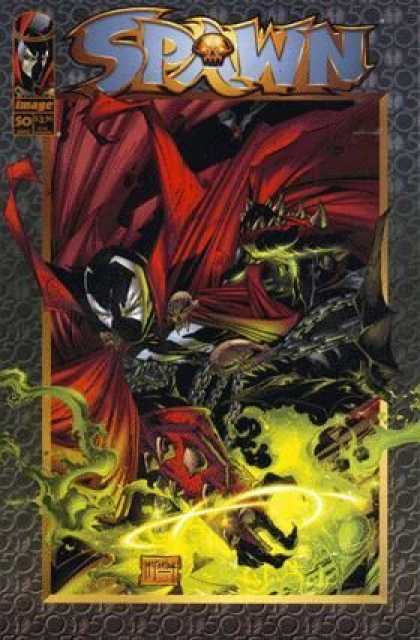
Review: After six months of hype, Spawn’s new costume debuts. And he meets God. This sounds like the events of a big anniversary issue, but for some reason McFarlane decided to work them into #32 (I wondered if this was the third anniversary of Spawn, but #1 was cover-dated May 1992). As McFarlane later admits, Spawn’s new costume isn’t very different from his original, and all of the pre-release hype was a little much. Even by ‘90s standards, the costume’s a bit over the top, although I do like the new skull designs and the tattered cape. Oddly enough, even though they’re years away, both the cartoon and movie use the original design.

While Spawn often feels needlessly decompressed, this issue actually gives you the impression that things are happening. He rescues his friend, the angels in New York make a move, God shows up, some hints about the future are given…it’s like a “season finale” issue. It’s also obvious that McFarlane’s now trying to make Spawn more sympathetic, as he spends the entire issue apologizing for using “old lady-God” as a hostage, and several narrative captions assure us that he’s bluffing, and that his costume won’t harm her anyway. Because Spawn’s not truly evil, we even learn that he’s “the one,” whatever that means. Why exactly McFarlane veered so far in the other direction over the years, and made the character even more unlikable, is beyond me.

While the main story feels meaningful, those two subplots are still dragging. After months of exciting scenes of Terry studying files, we now have a page dedicated to him telling Wanda his plan to spy on Jason Wynn. He already decided to do that last issue; now a month has passed and his subplot page this issue is just dedicated to him telling his wife about his plan. Just as boring is the Chief Banks scene, which has him repeating what happened last month to Jason Wynn. I know that McFarlane wants to assure the reader that he hasn’t forgotten these storylines, but why does he bring them back up every month and do nothing with them? The “reminder” scenes just become reminders of how slow this book usually is.

Blood Feud - Preludes & Nocturnes

Credits: Alan Moore (story), Tony Daniel (pencils), Kevin Conrad (inks), Tom Orzechowski (letters), Steve Oliff & Olyoptics (colors)

Summary: John, a self-professed “monster hunter,” finds the crucified Curse in Spawn’s alleys. He tortures Curse and forces him to claim that he saw Spawn feeding on small children.

Review: This is a six-page teaser for the Spawn - Blood Feud miniseries. Since it only runs six pages, and one of them is a “Spawn poses like Batman” splash, there’s not a lot to say. Moore gives John the “sadist with a sarcastic sense of humor” characterization that’s a hallmark amongst British writers, and gets a few decent jokes out of it. I will say that these extra six pages of content are free, which reminds me of one reason why I liked McFarlane’s output in the ‘90s. With the higher production values of his comics (and refusal to do high-priced gimmick covers), and insanely detailed action figures, I always felt as if he was trying to give the audience its money’s worth. (I guess I didn’t personally blame him for that Spawn Playstation game…)

Thursday, July 29, 2010

SPAWN #31 - May 1995

The Homecoming

Credits: Todd McFarlane (story), Greg Capullo & Todd McFarlane (art), Tom Orzechowski (copy editor & letters), Steve Oliff & Olyoptics (colors)

Summary: Spawn rides a boxcar into New York and is reunited with Boots and Bobby. Elsewhere, Gabriele’s replacement Rafael orders a new attack on Spawn. Aspiring minister Phil Timper is chosen to become the new Anti-Spawn. Dubbing himself “The Redeemer,” he tracks down Bobby, who still has traces of Spawn’s energy after his resurrection. Spawn tries to stop Bobby’s abduction, but Redeemer blasts him away. Spawn’s costume begins to behave erratically. After recuperating for hours, Spawn awakens with a new costume. Meanwhile, Terry decides to work directly under Jason Wynn in order to learn his secrets, and Sam sends a threatening message to Chief Banks.

Spawntinuity: Bobbie is spelled “Bobby” again this issue. Spawn still has the hole in his chest given to him by the Curse. He claims that he didn’t want to expend the energy required to fix it, so he had his costume cover the hole. Jason Wynn is no longer Anti-Spawn because the angels feel a true believer would be a better candidate.

I Love the ‘90s: The real-life Terry Fitzgerald (a friend of McFarlane’s who works on the book) mentions a petition by fans for a Spawn website. He reprints all of the screen names that signed the petition, including DRKSPAWN, ShpAWN, and DEAMONHACK.

Review: So, Spawn’s back in New York, just in time for another attack by the Anti-Spawn (renamed “The Redeemer” for no apparent reason). Anti-Spawn debuted in Greg Capullo’s first fill-in issue, so I guess it’s fitting that he returns in the first issue that gives Capullo official credit as the main artist. The art doesn’t look radically different from the previous five issues, although the style is slightly cartoonier. That’s a bit surprising, since Capullo had a deeper grounding in credible anatomy than McFarlane ever did, but I guess Capullo has fully adapted to the Image style now. I still enjoy his art, even though the figures are now contorting in odd ways and the number of jagged detail lines is off the chart.

The story’s mainly an excuse to have Spawn fight Anti-Spawn/Redeemer again, even though they barely have a confrontation. Numerous pages are devoted to Spawn brooding as he slowly returns to the alleys, followed later by more pages of brooding as he watches over his homeless “children.” Plus, his costume spontaneously freaks out, so that eats up a few pages. Spawn’s new costume, which was hyped for months, is only in the shadows this issue, as #32 was deemed the important revelation issue. The subplots are also moving at a snail’s pace, although the separate Terry Fitzgerald and Sam &Twitch stories have small advancements this month. Plus, Bobby/Bobbie’s resurrection actually ties into the main story, which is the only mileage I remember McFarlane getting out of the idea.

Wednesday, July 28, 2010

SPAWN #30 - April 1995

The Clan

Credits: Todd McFarlane (story), Tom Orzechowski (story assist, copy editor, & letters), Todd McFarlane & Greg Capullo (art), Steve Oliff & Olyoptics (colors)

Summary: Spawn continues to wander the South. He encounters Brad Armstrong, whose family is being terrorized by the Ku Klux Klan. When Spawn tries to stop them, he’s shot in the head and lynched. After recovering, Spawn discovers that the local judge is also a KKK member. Spawn secretly punishes the various Klansmen, then arranges to meet the judge alone. Spawn transforms Judge Missen into a black man, which soon leads to his own lynching by the Klan. Spawn hands Brad Judge Missen’s files, which implicate the local government’s attempts to steal Brad’s property, and leaves town.

Spawntinuity: Sam and Twitch have a brief scene, reminding us once again that they have dirt on Chief Banks. Spawn’s thoughts confirm he had a tryst with Angela. When speaking to Brad, Spawn calls Terry Fitzgerald a “token black” for the government, and says that “the white man” is responsible for torching him and replacing him with “the next one who was let into line.”

Spawn vs. Lawyers: Two of the Klansmen are named “Johnny” and “Peter.” Peter David has said that John Byrne contacted him, asking David to join him in a lawsuit. David assumed the names were a swipe at them, but didn’t want to pursue a lawsuit.

Spawn Stuff: The first hints of a Spawn movie have begun. The movie is released relatively soon by New Line, the studio mentioned in this issue.

Review: I’ve always liked the fact that McFarlane made Spawn a black hero without really drawing attention to his race. Rather than creating one character who’s supposed to represent an entire race, Spawn exists as a character who happens to be black, which is significant in its own way. Now, because the character is in the South, he just has to run into the Klan, and give a speech about how terrible the white man is. After witnessing the Klan’s harassment of Brad, Spawn reveals to him that there was a racial motive behind his own murder. That’s a potential avenue to explore, but why is this only coming up now? And why wasn’t it ever brought up again? If Spawn really believed this, why wouldn’t he use “racist” as an adjective when listing all of Jason Wynn’s other horrible attributes? I have to assume Tom Orzechowski scripted this sequence, if only because it just doesn’t fit with the previous stories McFarlane wrote (Spawn also uses thought balloons in the start of the issue, which only happened in the issues Orzechowski scripted).

If the last issue didn’t fulfill McFarlane’s cliché quota, he’s working overtime here. Apparently, doing research on the KKK just meant watching movies set during the 1930s, which is the decade this town apparently lives in. Everyone lives in shacks in the middle of barren fields, and I’ll just bet none of these hicks has ever experienced the joys of indoor plumbing or electricity. If Spawn actually did travel through time after exiting Hell, that’s a potentially good idea. It would keep him out of the alleys for a while, give him a wider variety of people to meet, and pose the dilemma of how he could get back to modern times. Instead, he just happened to land back in America, just not in the specific state he wanted, and his main obstacle to getting home is how long it takes him to walk to a train station. (He couldn’t even land in Kosovo, or Darfur, or someplace engaged in conflicts we don’t normally see in comics?)

For some reason, he stays in this town for what seems to be a decent amount of time, since some of the Klansmen from the issue’s opening are sued by Brad and found not liable (Spawn couldn’t have taken care of the Klan during all of those weeks?). After giving the lead Klansman his appropriately ironic punishment, Spawn hands Brad a file that details everything the local government’s done against him (another story resolved with a manila file folder!) and wanders off, “The Lonely Man” playing in the background, I’m sure. The judge’s ironic fate actually works fairly well, as it’s reminiscent of something that might’ve happened in an old EC comic (“Racist Swaps Race” might’ve been an actual EC story for all I know). Since that type of story has mostly died out by the ‘90s, Spawn’s a good enough title to resurrect it, and I believe that is the direction McFarlane eventually goes in. Everything else in this issue, however, is hackneyed beyond belief.

Tuesday, July 27, 2010

SPAWN #29 - March 1995

Father

Credits: Todd McFarlane (story), Todd McFarlane & Greg Capullo (art), Tom Orzechowski (copy editor & letters), Steve Oliff & Olyoptics (colors)

Summary: Spawn finds himself in Florence, Alabama where he’s taken in by young Andy Frank. Hiding in the Franks’ shed, Spawn learns that Andy and his older brother Eddie are being abused by their alcoholic father, Joe. After Joe pulls a gun on Andy, Spawn decides to take action. He magically tattoos “I Beat My Kids” all over Joe’s body, hoping to teach him a lesson. After Spawn leaves town, an even angrier Joe lashes out at his kids. Eddie shoots Joe to save Andy’s life. Meanwhile, Sam discovers that Chief Banks hired Billy Kincaid to murder Senator Jennings’ child.

Spawntinuity: In a quick flashback, we learn that Al Simmons hit Wanda once. Spawn’s cloak, which was left behind in Elysium during the Angela miniseries, is shown in tatters here. I’m not sure if McFarlane didn’t know all of Angela’s plot details when writing this issue, or if this is an intentional point to show Spawn’s costume can regenerate.

Spawn Stuff: McFarlane has begun shooting commercials for Todd Toys (I can't find them on Youtube, though).

Review: I remember a TV Guide review of the HBO Spawn series remarking that when Spawn didn’t spew blood, it spewed clichés. That’s certainly true of this issue, as Spawn finds himself in the middle of a Lifetime original movie, complete with the sleepy small town setting, neighbors who don’t ask questions, cherubic blonde child abuse victims, and the horrifically evil father who’s actually a pillar of the community. (He’s a respected police officer and church leader! Get it?! He’s, like, a total hypocrite!) The dad’s not even a mean drunk; he’s just unrepentantly evil, and even has an exaggerated “Ha-ha-ha-ha!” lettering font worthy of the Red Skull he lets out after beating his kids. I guess McFarlane gets some credit for the small twist at the end, as Spawn’s punishment does nothing to deter the abuser and only makes things worse. The ending, however, won’t be hard for anyone even remotely familiar with “abuse” stories to figure out.

The worst aspect of the issue, though, is the one-panel revelation that Spawn used to beat his wife. It’s portrayed as a one-time incident he always regretted, but it’s a hideous revelation to make about your title character. Downplaying it as a one-panel flashback is another boneheaded idea, because this is something that surely needs to be fleshed out. Spawn’s entire motivation as a character is supposed to be his love for his wife, but now we’re told in a quickie flashback that he smacked her around once? Aside from the fact that it undermines the entire premise of the series, it’s just tasteless. If McFarlane had to reveal this (the brief justification is that Al Simmons’ life of violence eventually bled into his home life), he should’ve established the circumstances around the incident and given Spawn more room to be repentant of his actions. Spawn could’ve seen himself in the boys’ father and wonder if that was the direction he was headed, or begin to question if Terry really is a better husband for Wanda. Actually, this revelation, as dumb as it is, could’ve been the impetus for Spawn to stop obsessing over Wanda and to go in a new direction. Instead, it stands out as a one-panel “whaaaat?” moment that was quickly forgotten.

Monday, July 26, 2010

ANGELA #3 - February 1995

Angela Part Three

Credits: Neil Gaiman (story), Greg Capullo (pencils), Mark Pennington (inks), Tom Orzechowski (letters), Todd Broeker & Fierce Colorgraphics (colors)

Summary: The demon Smut discovers Spawn and Angela in the darkness, which is revealed to be a section of Hell. Spawn and Angela fight their way through a demon war to reach a dimensional gate. Spawn visualizes Earth after reaching the gate, and is transported to the American suburbs. Angela rematerializes in Elysium, where she’s reunited with her friends. She visits Gabrielle, who confesses to framing Angela, unaware she’s being taped. Later, an older angel arrives to replace Gabrielle, as Angela decides to live as a freelance ex-angel.

Spawntinuity: Gabrielle reveals that Angela’s lance disappeared after Spawn touched it, along with any record of her mission on Earth (which gave Gabrielle the opportunity to frame her). Gabrielle speculates that Spawn somehow reshaped reality to escape the other plane the lance sent him to. I’m assuming this ties in to the hints McFarlane used to drop that Spawn was “special’ in some way.

Review: After an indeterminate amount of time alone in the dark together, Spawn and Angela are now bickering like an old married couple. In-between their fight with a horde of demons, they do the classic sitcom shtick of refusing to speak directly to one another, so another character has to be their emissary. In this case, it’s Smut, the cutesy demon who looks like a housecat (and later the star of a Gaiman/Capullo story for a CBLDF benefit comic). This is pretty funny, and Capullo, whose art has been stellar throughout the miniseries, is given a lot of ogres and monsters to draw. Gaiman isn’t treating the Spawn universe as fancifully as Alan Moore did, but he does realize that this material can’t be taken too seriously and he knows when to introduce humor into the story.

At the conclusion, Angela abandons her career as an angel and, with the subtlety of a punch to the throat, declares that “you don’t have to work for the big two…there are alternatives.” I can’t imagine to what she’s referring. I hope this was just a cute in-joke, because if we’re supposed to retroactively view the entire story as a statement on the comic book industry, that means we have dangerous spitfire Todd McFarlane escaping from the treacherous ranks of Marvel-Heaven. Surely, Angel Todd wouldn’t engage in any of the business practices used by mean ol’ Marvel-Heaven.

Friday, July 23, 2010

ANGELA #2 - January 1995

Angela Part Two

Credits: Neil Gaiman (story), Greg Capullo (pencils), Mark Pennington (inks), Tom Orzechowski (letters), Steve Oliff & Olyoptics (colors)

Summary: Kuan Yin and Anahita take Spawn to Elysium to testify on Angela’s behalf. After Spawn drops his disguise and is revealed in court, he’s immediately attacked by the angels. Feeling that she has nothing to lose, Angela joins Spawn in the fight. After crashing out of a window, Angela orders Spawn to use his cloak to teleport them away. As the cloak envelopes them, Surielle blasts it. Spawn and Angela emerge in darkness. They have a conversation, as Angela moves closer to Spawn for warmth.

Spawntinuity: Spawn’s costume has a violent reaction to being in Elysium. However, when he was previously summoned to Heaven, his costume didn’t react. Elysium is described as “heaven-ish,” so perhaps that’s enough for an Image No-Prize. After getting blasted by Surielle, Spawn’s cape, now near-death, is left in Elysium. Angela tells Spawn that she knows why Malebolgia selected him, but doesn’t give any details. During the trial, Spawn changes into the only human form he can take, the blonde white guy he transformed into in the early issues of his series. It’s my understanding that after many, many years, McFarlane has finally begun to address who the blonde guy is in the current issues of Spawn.

Review: I think Gaiman once said that there was a lot of “running around” in the early Image comics he saw, so I’m not shocked he’s worked in a chase/escape sequence. Teaming Angela with Spawn works out well, as the characters do share some chemistry together. Spawn’s utterly clueless about any of the supernatural elements of his new life, which sets him up for numerous arrogant, dismissive putdowns from Angela. The ending is a little vague about what exactly Spawn and Angela are doing in the dark, but later stories clarify that the two really did do what every teenage boy assumed they did (plus, they’re surrounded by a heart on the cover, which is a pretty big clue). Angela’s really the aggressor in this, and I guess it fits the character Gaiman’s created to give her a stereotypically male libido. However, if we’re supposed to believe Spawn’s so deeply in love with his wife, having him hook up with another female doesn’t cast him in the best light. Maybe McFarlane realized this, because even though future stories could’ve played off the demon/angel romance angle, the idea’s dropped very quickly. Gaiman’s also introduced the idea that Spawn can channel previous Hellspawns in his dreams, which is another vehicle for new stories I don’t think McFarlane ever explored.

ANGELA #1 - December 1994

Angela Part One

Credits: Neil Gaiman (story), Greg Capullo (art), Tom Orzechowski (letters), Todd Broeker & Fierce Colorgraphics (colors)

Summary: While hunting a dragon, Angela is arrested by a host of angels. The angel Surielle removes Angela’s trophy earrings as she places her in prison. Angela’s friends, Kuan Yin and Anahita, refuse to believe the charges against her. They discover Gabrielle’s testimony, which falsely claims Angela hunted Spawn on Earth without a permit. Kuan Yin and Anahita travel to Earth and confront Spawn.

Spawntinuity: Angela claims that this is her hundred thousandth birthday, and that she’s killed over thirty Hellspawn. The angels are currently searching for her missing lance, which was left on Earth after her encounter with Spawn in issue #9.

Spawn vs. Lawyers: I know there was a trade reprint of this miniseries, but I imagine the Gaiman lawsuit has kept it out of print.

Review: Look at that cover. It certainly fits the criteria for a Boob War comic, doesn’t it? This, of course, isn’t mindless T&A and violence, although Gaiman isn’t shying away from those elements. Gaiman always said he did this work to impress his teenage son, but the story doesn’t read as if he’s only pandering to a juvenile audience. There’s a lot of action and scantily clad angels, but Angela is given a distinct personality (she’s arrogant, reckless, and quick to make enemies), a few literary references are thrown in, and most of the dialogue is pretty clever. Spawn’s introduced with a two-page sequence that has him reviewing how pathetic his life is and declaring that he has to stop obsessing over his wife. Yeah, like that’ll happen any decade soon.

Thursday, July 22, 2010

SPAWN #28 - February 1995

Protector

Credits: Todd McFarlane (story), Todd McFarlane & Greg Capullo (art), Tom Orzechowski (copy editor & letters), Steve Oliff & Olyoptics (colors)

Summary: Wanda searches the alleys, hoping to find Spawn. She’s horrified to discover the Curse, who Spawn crucified against a wall hours earlier. While running away, she’s accosted by a gang. Spawn rescues Wanda, and inadvertently shouts out her name when he recognizes her. He only explains that he’s someone who cares, as he realizes that Wanda is terrified of him. She hands him a photo of her family and leaves, promising never to return. Meanwhile, Sam discovers info on Chief Banks he can’t believe.

Todd Talk: Todd admits he’s been forgetting to hide Felix the Cat in the backgrounds.

Review: Wanda finally meets Spawn, although she of course doesn’t learn his true identity. McFarlane treats much of this issue as a character piece for Wanda, dedicating caption after caption to explanations of how cautious and clear-headed she normally is. She never goes into the city, so interacting with street people and searching the back alleys is supposed to be a horrifying ordeal for her. Spawn’s now more brutal than ever, as he crucifies the Curse and keeps him chained up for later punishment. I imagine McFarlane did this deliberately to contrast with the image Wanda has of his previous self, and the scene that has Wanda discovering the Curse is an effective way of crashing Spawn’s two lives together. Artistically, this is one of the best McFarlane/Capullo collaborations. The book still isn’t specifying who’s doing what, but it looks as if McFarlane’s mostly inking, as the figures have a stature and consistency that I associate with Capullo. McFarlane’s real strength as an artist is his inking, and the back alley setting gives him a lot to work with.

Wednesday, July 21, 2010

SPAWN #27 - January 1995

Cursed

Credits: Todd McFarlane (story), Todd McFarlane & Greg Capullo (art), Tom Orzechowski (copy editor & letters), Steve Oliff & Olyoptics (colors)

Summary: A deranged businessman christens himself “The Curse” and targets Spawn, envious that God has blessed him with powers. He moves into Spawn’s area of the alleys and builds his own following of the homeless. Meanwhile, Spawn uses his powers to raise the dead for the first time. Exhausted after resurrecting Bobbie, he’s unprepared for the Curse’s attack. After blasting a hole in Spawn, and deciding that he must’ve gained his powers from Satan, Curse abandons the fight. Spawn soon recovers and fights through the Curse’s followers to reach him. Meanwhile, Wanda decides to investigate how Spawn knows Terry.

Spawntinuity: The Curse, who later becomes something of a recurring villain, debuts. He explains that he’s poked out his left eye, scarred his face, and chopped off his right arm, all as sacrifices to God (cybernetics replace the missing arm, so he's kind of a cheat). How exactly he’s amassed a homeless following over the course of a few pages isn’t clear, unless he’s just giving them money to stand around and call him “master.” Bobbie’s resurrection obviously follows Spawn’s appearances in Youngblood, but the story ignores the other homeless victims of Chapel’s massacre (most likely, McFarlane didn’t know the full details of those two issues while writing this story).

I Love the ‘90s: There’s a “Howard Stern for Governor” sign snuck into one of the backgrounds.

Spawn Stuff: The second line of Spawn action figures has launched, with characters like Angela and Malebolgia, and Chapel and Badrock courtesy of Rob Liefeld. There’s also an oversized Spawn trading card set from Jim Lee’s Wildstorm Productions, featuring art by Michael Golden, Bill Sienkiewicz, Walter Simonson, Tim Sale, and more.

Review: Let’s see, Spawn’s on issue #27 and so far his rogues gallery consists of a demon, an angel, a cyborg, a mobster, and a shadowy government bureaucrat. Yeah, it’s time to introduce a new villain (and potential action figure), so now we have the Curse. Curse is another McFarlane villain motivated by insanity, and like the Hobgoblin, he has a religious bent. You could view him as a parody of religious extremists, but he’s so over-the-top I don’t think McFarlane even seriously considered going in that direction. Really, he’s just crazy and he’s declared Spawn as his enemy. Curse isn’t much of a villain, but his story at least follows up the events of the previous arc, which had Spawn’s location revealed to the world. Of course a mysterious being with supernatural powers is going to attract some lunatics, so I don’t really mind Curse as the antagonist for an issue or two. I always thought the image of Spawn with a giant hole in his chest was cool, and used to wonder if McFarlane would ever produce a Spawn figure based on this issue.

Rereading this, I now wonder why McFarlane didn’t connect Curse to Bobbie’s resurrection scene, since this would help to reinforce the villain’s delusion that God’s chosen Spawn but forsaken him. You would also think that McFarlane had a direction in mind after giving Spawn the ability to resurrect the dead, but it seems like he abandoned this idea pretty quickly. The resurrection wasn’t followed by a “Zombie Bobbie” or “Indestructible Bobbie” storyline; after he was briefly studied by Heaven's agents, Bobbie just went back to being an average bum.

Tuesday, July 20, 2010

YOUNGBLOOD #10 - December 1994


Credits: Rob Liefeld (story & art), Eric Stephenson (script & edits), Danny Miki & Jonathan Sibal (inks), Christian Lichtner, Kiko Taganashi, & Extreme Color (colors), Kurt Hathaway (letters)

Summary: Chapel demands that Spawn reveal how he cheated death, or more of his friends will die. Spawn explains his deal with a devil, which emboldens Chapel. Confident that death won’t stop him either, he puts a gun to his head and commits suicide. Meanwhile, Youngblood finishes its battle with Maddock. Their telepath, Psilence, senses the coming of a great darkness, as Chapel arrives in Hell.

Todd Rob Talk: Rob Liefeld has a column called “Robservations.” Why didn’t I know about this sooner? He speaks about the holiday season in the past tense, even though this issue is cover-dated for December, and promises announcements about new television and movie projects soon. He also announces this is the last issue of Youngblood for a while, as he’s begun work on a Badrock solo series.

Not Approved By The Comics Code Authority: The word “ass” is censored, even though it was used in the first chapter of this storyline. Aside from the excessive amount of decapitations during Youngblood’s fight, there’s also a gruesome two-page spread dedicated to Chapel’s face getting blown off. Liefeld thanks Stephen Platt for the “layout assistance and inspiration” for the spread.

Review: In case you’re wondering, issue #9 was the Image-X issue (a Badrock solo story by Jim Valentino, which ignored the cliffhanger Badrock was involved with in the previous issue). After what was likely a wait of several months, the Chapel/Spawn is finally finished. “Fight” probably isn’t the most accurate word, since they have no physical contact with one another during either issue. Oh, well. A lot of homeless people died, so at least the kids got some violence. Chapel’s death scene is utterly ridiculous, but there’s something I like about it. If any of Al Simmons’ friends knew he was alive, of course they would want to know how he cheated death. Chapel, apparently, has always been a psychopath, so having him commit suicide in the delusion he can get the same deal Spawn got makes a perverse amount of sense. He doesn’t even want to wait for death…he’s going to make that deal now! It’s so flagrantly dumb, I can’t help but to admire it.

Monday, July 19, 2010

YOUNGBLOOD #8 - September 1994


Credits: Rob Liefeld (story & art), Eric Stephenson (script & edits), Danny Miki & Jonathan Sibal (inks), Kiko Taganashi, Donald Skinner, & Andre Khromov (colors), Kurt Hathaway (letters)

Summary: As Youngblood faces the evil Maddock, former member Chapel stalks the alleys of New York. He shoots Spawn’s friend Bobby in the head during his killing spree of the homeless. Chapel confronts Spawn, taunting him to use his powers in a fight, or to heal his friends.

Spawntinuity: Bobby is usually spelled "Bobbie" in Spawn. Chapel claims he’s killed several of Spawn’s friends, although Bobby and new (unseen) character “Chas” are the only ones listed by name.

Review: So it’s come to this…Youngblood. I have no intention of reviewing all of Spawn’s guest appearances from Image’s early days (this site has a comprehensive list if you’re interested), but this storyline directly crosses over into the Spawn series, so I thought I’d give it a look for completism’s sake. What else would you expect to find in Youngblood? It’s insanely violent, various cast members are blatant clones of Marvel characters (did you know there’s an Image knockoff of Sabretooth called “Warwolf”?), everyone has too many teeth and veins around their necks, and all of the heroes and villains are oozing either blood or saliva during the fight scenes. As unappealing as all of this is, I could see how an adolescent might be interested in it. The issue opens with Youngblood avenging the deaths of three members, which isn’t something Avengers would probably give you (and it’s one way to take advantage of Liefeld’s propensity to create a dozen characters at a time, although I doubt all of the characters were allowed to die). And as tough and nasty as Wolverine might be, he isn’t going to go on a killing spree of the homeless just to get the attention of an old rival he hasn’t seen in a while.

I’m amazed that this is Youngblood volume one, and it’s only on issue number eight. Spawn started a few months after Youngblood and was in its mid-twenties by this point. I realize Liefeld diverted his focus to numerous other titles (the Extreme Checklist in this issue has seven additional series being released this month), but I didn’t know Youngblood shipped so rarely in the early days. A spinoff, Team Youngblood, is already on issue eleven! How did a spinoff reach a higher issue count than the original series?

Friday, July 16, 2010

DAYDREAMERS #1-#3, August-October 1997

Once Upon A Time…

Credits: J. M. DeMatteis (plot), Todd Dezago (script), Martin Egeland (penciler), Howard M. Shum (inker), Richard Starkings & Comicraft (letters), Kevin Somers (colors)

Daydreamers, a.k.a. Another Thing That Pissed Steve Gerber Off, is a spinoff miniseries from the post-Onslaught era of Generation X. Shortly after Franklin Richards was added to the cast of the book, the series did a “split up the cast” storyline, followed by a crossover arc. Consequently, Franklin barely made his presence felt in the series, which is a shame since very few people have ever explored the connection between the mutant child of Marvel’s First Family and the assorted X-teams. The other ignored Gen X cast members included Artie and Leech (the two younger kids at Xavier’s school who seemed to just live in a treehouse), and Howard the Duck, who gave Skin and Chamber a ride during their road trip. For no discernable reason, Man-Thing and the ultra-obscure Tana Nile also popped up in the series shortly before the cast was divided.

The six characters were exiled together after Black Tom’s attack in Generation X #25, which is where this mini picks up. Man-Thing has the team floating inside the Nexus of All Realities, and it isn’t long before Howard the Duck falls into a wacky alternate universe. This reality recasts the Marvel Universe as fairy tale and fantasy characters, so we have two of the Incredible Hulk’s multiple personalities represented as Twiddle-Dee and Twiddle-Dum, the Scarlet Witch as the Wicked Red Witch of the Southeast, and Dr. Strange as a transvestite Good Witch of the North. Meanwhile, the mysterious Dark Hunter stalks the team as they track down Howard. The debut issue is enjoyable, although the script only has a few slight laughs, and the art leans too much towards standard superhero work and not enough towards an appropriate cartoony tone. I’ve never seen such a lifeless Howard the Duck.

Across the Universe

Credits: J. M. DeMatteis (plot), George Broderick, Jr. (script), Martin Egeland (penciler), Howard M. Shum (inker), Richard Starkings & Comicraft (letters), Kevin Somers & Digital Chameleon (colors)

Things get crazier, as Man-Thing suddenly develops the ability to speak. No explanation is offered this issue, although we do learn why Tana Nile ended up in Gen X’s backyard in the first place. (She came to Earth to escape her imperialistic alien race; she wanted the Avengers’ help and ended up with Artie and Leech.) The RuPaul version of Dr. Strange transports the team away from the Dark Hunter, where they land in a legally protected parody of a Dr. Seuss book. Everything must be spoken in rhyme in this reality, which the script gets some mileage out of. Because Howard refuses to go along, the crew gets thrown in jail. Meanwhile, Artie is upset with Franklin, and seems to be hinting that he’s directly responsible for the Dark Hunter. In the end, Dark Hunter invades the prison and kidnaps Artie while the team tries to escape. Howard demands Man-Thing teleport them out of this existence, as he did earlier during Black Tom’s attack (Man-Thing acknowledges that this isn’t one of his powers and he doesn’t know how he did it in the first place). While trying to follow Dark Hunter’s path, Man-Thing somehow transports them to Duckworld, the home planet Howard’s been trying to reach for years. They’re shocked to discover Howard is an icon in this world, complete with his own golden statue. If the next issue somehow ties this into the 1986 Howard the Duck movie, I’ll be thrilled.

Dark Eyes

Credits: J. M. DeMatteis (plot), Todd Dezago with Andy Jozefowiez (script), Martin Egeland (penciler), Howard M. Shum (inker), Richard Starkings & Comicraft (letters), Kevin Somers & Digital Chameleon (colors)

There is a joke about the movie, but it’s not the explanation for Howard’s celebrity status. Howard meets his parents, who reveal that his adventures on Earth have been televised for years on Duckworld. However, Howard realizes that these aren’t his parents, as Franklin begins to behave strangely in the living room. When Leech and Man-Thing start asking him too many questions, Franklin throws a tantrum that apparently kills them. Howard and Tana Nile begin to piece things together and realize that they were never traveling through alternate realities (Franklin’s powers, combined with Man-Thing’s connection to the Nexus, created the worlds), Man-Thing never spoke (it was only Franklin’s voice talking through him), and the Dark Hunter isn’t a villain after all (he’s Franklin’s subconscious).

Franklin’s dealing with the loss of his parents, and with the help of Dark Hunter, he finally makes his peace with their deaths. Not that Marvel ever expected us to believe they were dead, but it’s a little odd that this mini was published just as the Heroes Reborn stunt ended and the heroes were making their way back to the Marvel Universe. It seems like this would’ve had more impact if it were published right after the Onslaught event. Still, the emotions are portrayed rather persuasively, and the twist ending works as a legitimate surprise. I’m not sure why exactly this merited its own miniseries, unless Marvel really wanted to test the waters for a book with a kid-friendly cast. I would’ve preferred this as an ongoing subplot in Generation X, penciled by Chris Bachalo. It could’ve livened up a few issues, but I guess that space was needed for more Zero Tolerance material (in fairness, those issues weren’t that bad either). Now, does anyone know why this mini had so many guest scripters…and why two of them had no connection to the X-office?

Wednesday, July 14, 2010

X-FORCE #73-#74, January-February 1998

Stop Motion

Credits: John Francis Moore (writer), Andy Smith (penciler), Mark Morales w/Scott Hanna & Sean Parsons (inks), Comicraft’s Kolja Fuchs (letters), John Kalisz (colors)

Summary: Warpath and Siryn arrive in Kansas, where they retrieve the envelope containing information on Project: Stepladder. They’re confronted by Edwin Martynec, who transforms into his feral form and takes them captive. To their surprise, Martynec has a Zero robot as an assistant. He reveals to Warpath that Stryfe was Stepladder’s secret leader, and the person behind the destruction of Camp Verde. Siryn and Warpath break free of their restraints, but Martynec injects Warpath with an amphetamine. Siryn knocks Martynec out, but is unable to revive Warpath. Meanwhile, Domino’s interference in a bank robbery attracts the police’s attention, X-Force travels with Richie Algeria to New Orleans, and Domino contacts the Hellhouse to find mercenary work.

Continuity Notes: Edwin Martynec first appeared in the X-Force Flashback issue. Officially dead since the Arroyo Labs fire, he now goes by “Martin Edwards.” He explains that Stryfe recruited him for Project: Stepladder to “genetically engineer his next generation of mutant disciples.” Some of the previous issues weren’t clear, but John Francis Moore is obviously going with the idea that Zero wasn’t a unique robot and is part of a series.

Review: Stryfe? Zero? X-Force had long abandoned this era of its history (and didn’t even feature Cable by this point), so it’s surprising to see Moore revive these characters. Revealing that Stryfe was behind the Camp Verde massacre clearly isn’t what the original creators had in mind, but I like the idea. Moore’s two obvious solutions for resolving the murders are to create a new villain as the culprit, or to tie it to an existing one. He combines the two ideas, revealing that Stryfe was involved in genetic engineering we never knew about and Camp Verde had to die to keep it quiet. Considering that Stryfe created the Legacy Virus, this actually isn’t a big stretch. The fact that the Liefeld characters were already considered kind of embarrassing by this point works to the story’s advantage. The revelation comes out of nowhere, but it works as a legitimate surprise and not cheap shock value. Moore also keeps up with the subplots, touching base with the rest of the cast and setting up a potential romance between Sunspot and Meltdown (Sunspot tells her that Cannonball’s lucky to have her while she’s writing him a letter). I’m disappointed Adam Pollina didn’t draw this issue, but Andy Smith’s art works fairly well. He’s thankfully improved since that Strong Guy Reborn one-shot.


Afterlife

Credits: John Francis Moore (writer), Adam Pollina (penciler), Mark Morales (inks), Comicraft (letters), Marie Javins (colors)

Summary: In Hell, Warpath is attacked by Stryfe. Stryfe claims that he’ll be released from Hell if he delivers Warpath to Blackheart. As Siryn tries to revive Warpath, a valkyrie visits Moonstar and the rest of X-Force. She informs them that Warpath is wrongly being kept in Hell, and opens a portal for X-Force to enter the afterlife. Stryfe defeats the team, forcing Warpath to fight back and protect his soul from Stryfe. Blackheart lets the team go, revealing to Stryfe that this was all a plan to give him false hope of escaping Hell. Warpath’s soul returns to his body, as the rest of X-Force emerges with him in Martynec’s destroyed lab. Meanwhile, the mystery man tailing X-Force kills the mobsters harassing Richie Algeria.

Continuity Notes: Sunspot is using Spanish exclamations, which isn’t accurate since he’s from Brazil (a future letter writer points this out and the editors apologize). Blackheart taunts Meltdown, telling her that even her closest friends are unaware of the things she did while living on the street. These hints have shown up a few times before, usually with the veiled suggestion she might’ve been a prostitute.

I Love the ‘90s: Have I mentioned the Concert Connection ads before? This is a phone service that offers news on celebrities and musical acts such as Alicia Silverstone, Alanis Morissette, Fiona Apple, Dru Hill, Leonardo DiCaprio, and the Backstreet Boys. The ad lists three different numbers to call, with prices ranging from seventy-one cents a minute to $2.99.

Review: Even when Moore lays off on the subplots, he still crams a lot into one issue. This issue probably should’ve been a two-part story, but I guess he wanted to have the cast reunited in time for a new story in the seventy-fifth issue. Consequently, there are some good ideas here, but the hyper pace doesn’t give them much room to breathe. Blackheart tormenting Sunspot and Meltdown, forcing them to face the worst pieces of their souls, is exactly what you want to see when your heroes go to Hell. However, doing the scene in exactly three panels robs it of a lot of impact. And while I’m sure many fans were thrilled to see a nod towards Moonstar’s past as a valkyrie, if you’re not familiar with that continuity, the scene probably reads as “Who’s that woman on the winged horse? Moonstar was a what? They’re in Hell now?”

Even if some of the scenes go by too fast, Moore still uses the main story to advance a few of the ongoing storylines. After their confrontation with Blackheart, Sunspot comforts Meltdown and tells her that her past doesn’t matter. The superhero fight and romantic subplots also merge as Siryn reflects on her relationship with Warpath while she tries to resuscitate him. The two characters have had “the potential romance” storyline building since the start of the series, and while Moore isn’t rushing to have Siryn finally embrace Warpath, he is manipulating events so that Siryn might see Warpath as more than a friend. Warpath, who seems to be Moore’s favorite cast member, also fights some metaphorical demons in Hell and begins the “let go of the past and embrace life” part of his revenge journey. All of these ideas are incorporated into the main action story, which says a lot about Moore’s skills as a writer. I just feel that this probably should’ve been the double-sized anniversary issue, because the story needs more room.

Monday, July 12, 2010

GENERATION X #32 - November 1997

A Day at the Circus!

Credits: Tom DeFalco (writer), Mark Buckingham (penciler), Al Vey, Jon Holdredge, & Scott Hanna (inks), Comicraft (letters), Chris Sotomayor (colors)

Summary: Husk convinces Gen X to visit the local fair, unaware that the Circus of Crime is the headliner. Chamber is immune to the Ringmaster’s hypnotism, which leads to a fight between Gen X and the Circus. After defeating the thieves, Jubilee takes pity on them. She agrees to let them go if they agree to donate their profits from the performance to charity. Meanwhile, Banshee travels to Muir Island to give Moira MacTaggert genetic info on the twins that comprise M. He convinces her to take a break for a picnic, where they share a kiss.

I Love the ‘90s: Jubilee would rather play the videogame Quake than see the circus. She also lets out a “NOT!” during the fight scene.

Review: This is a fill-in issue, although it’s obviously not something that was pulled from inventory. Tom DeFalco acknowledges the ongoing subplots surrounding M’s true identity and the team’s distrust of Emma, so this is actually a smooth transition from the previous issue. Mark Buckingham inked most of Chris Bachalo’s run, so he’s a logical choice to do a guest issue, and probably should’ve been selected to become the regular artist. The tone of the story is pretty close to the lackadaisical mood of the Lobdell run, as the team is given a rather goofy group of villains to face; villains that are hesitant to actually go back to crime and don’t even come across as particularly mean. I’m not sure if the Circus of Crime was always portrayed that way, but DeFalco manages to make them likable enough. Reuniting Banshee with Moira adds some significance to the story, since the characters rarely interacted during the Generation X days. DeFalco also remembers that Moira’s suffering from the Legacy Virus, which Banshee has barely reacted to by this point. Banshee doesn’t bring the M twins with him for fear of infection, which is a rather frank handling of the disease, one that the other writers seemed to ignore. So, yes, it’s filler, but it’s pretty good.

EXCALIBUR #113 - October 1997

Faith

Credits: Ben Raab (writer), Pete Woods (penciler), Scott Koblish (inker), Comicraft (letters), Kevin Tinsley (colors)

Summary: On Wundagore Mountain, Colossus and Meggan are taken in by Bova. Sir Ram challenges Colossus due to his connection to Exodus, but Colossus convinces him that he’s changed. After meeting the High Evolutionary, Colossus and Meggan learn that Exodus is preparing to strike Wundagore and kidnap Magneto’s granddaughter, Luna. He claims that he must face Exodus alone and, despite their protests, teleports them to their original destination. Meanwhile, Wolfsbane and Douglock share an unexpected kiss before she departs for a New Mutants reunion, Peter Wisdom is tortured by a Black Air agent, and Lockheed is confronted by mysterious beings.

Continuity Notes: Luna is living with High Evolutionary because Quicksilver left her in his care while he mourned Crystal (who was believed dead after the Onslaught battle). A footnote says the story of Exodus and High Evolutionary’s battle will be told in the Quicksilver series. Lockheed is shown speaking English again (Warren Ellis had him doing it once) during his confrontation with whoever these mystery characters are supposed to be.

Review: I’ll give Raab credit, he’s picked up the pace this issue. Unfortunately, it looks the Colossus/Meggan storyline has just been an extended promo for the Quicksilver book (and ends with High Evolutionary stupidly rejecting help from two of the most powerful mutants in existence), but the rest of the subplots show promise. Doing a romantic subplot with Douglock is kind of ridiculous, but Raab seems to be aware of that and is actually using it as a plot point. The Peter Wisdom subplot seems like it’s there just to assure readers it hasn’t been forgotten, while Lockheed unexpectedly gets his own arc. Ellis never explained Lockheed’s sudden use of English, and while you could just dismiss the scene as a one-time joke, I think it’s a good starting place for a new story. I’ve had some issues with Raab’s run so far, particularly the previous two issues, but I still haven’t encountered anything that matches the book’s extremely low reputation online. Raab does do a terrible job with Peter Wisdom’s accent, though. Is that why people hated his run so much?

Related Posts Plugin for WordPress, Blogger...